The Infrastructure Sovereignty Problem
Why Your AI Stack Is Ungovernable by Design
By the Lead Intelligence Architect | Touch Stone Publishers
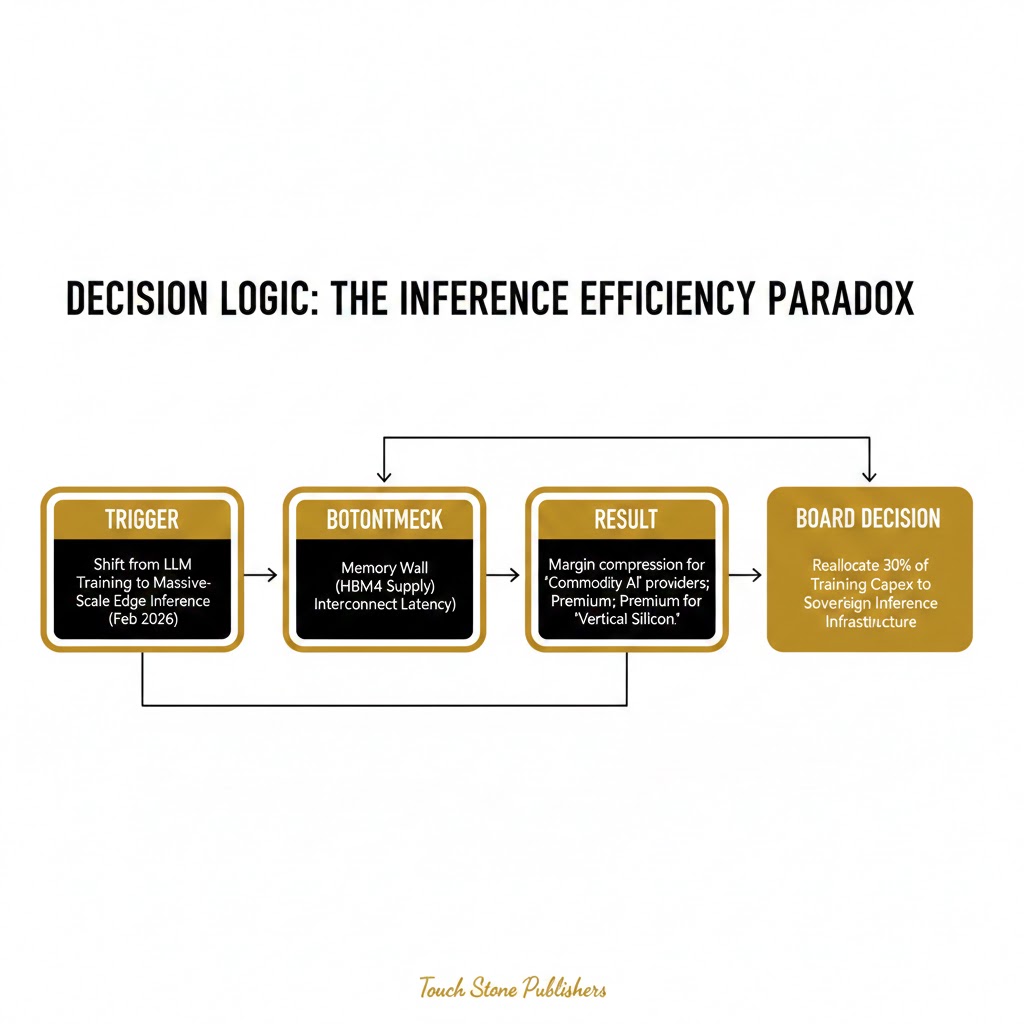
I. The Strategic Assertion (The Thesis)
The era of "Brute Force" AI is over. As of February 2026, the semiconductor industry has hit the Thermal & Memory Wall. The primary bottleneck is no longer raw compute, but the Energy-to-Token Ratio.
Recent data confirms that while training demand remains high, the Velocity of Deployment has slowed because the power grid cannot scale at the rate of silicon iteration. We predict a 12-month pivot toward Application-Specific Inference Integrated Circuits (ASIICs) that prioritize local memory bandwidth.

Visual Intelligence 2: "The Latency Core"
II. The Antithesis (The Contrarian View)
Leading analysts argue that a "Silicon Glut" is imminent. Their thesis suggests that as hyperscalers finalize internal chip designs, NVIDIA’s "Moat of Scarcity" will vanish, leading to a 40% drop in ASPs. They warn of a "Black Swan" event: a sudden cooling in Enterprise AI spend as ROI fails to materialize beyond basic retrieval use cases.
III. The Synthesis (Touch Stone Prediction)
We reconcile these views by identifying the Orchestration Layer as the new value capture point. The next 6 months will see a Bifurcation of the Market: Sustained margins for HBM4-enabled chips (The High End) and a surge in Small Language Model (SLM) hardware (The Edge).
IV. Sensitivity Matrix
| Variable | Bear (20%) | Base (60%) | Bull (20%) |
|---|---|---|---|
| HBM4 Yields | Below 30% | 50-60% | Above 80% |
| Enterprise Adoption | "AI Winter" | Selective Vertical Use | Autonomous Agents Standard |
| Geopolitical Risk | Export Bans Expand | Status Quo Friction | Localized Fab Onshoring |