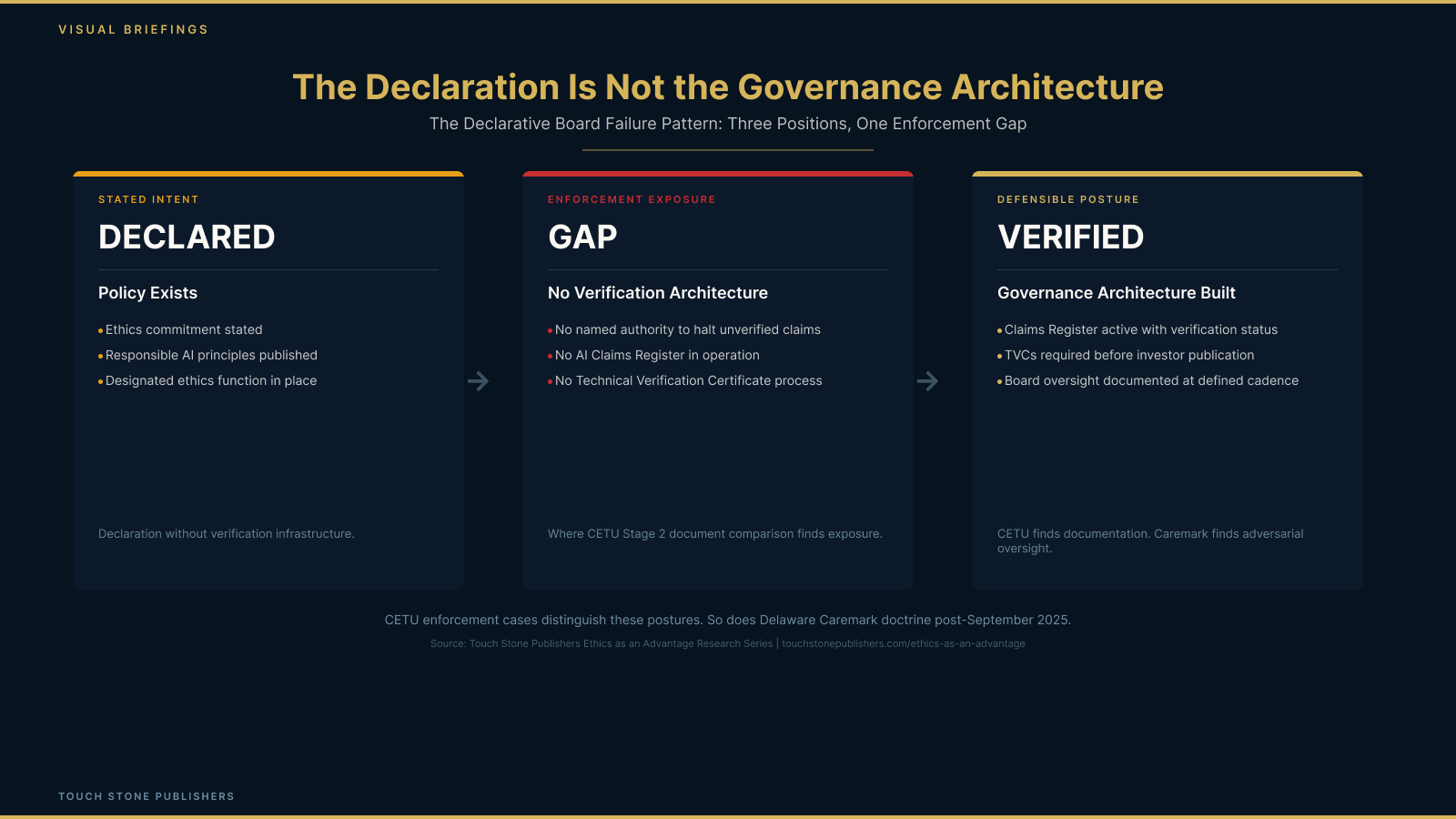
The Declarative Board Failure Pattern (DBFP) is the governance failure at the root of every AI washing enforcement action the SEC’s CETU has pursued to date. The pattern operates in three phases, shown in the framework above.
In the first phase, an organization declares its AI ethics commitment: a responsible AI policy, a set of AI principles, a designated ethics function. The declaration is real. The infrastructure to verify that the declaration is being executed is not yet built.
In the second phase, the gap between the declaration and the verification architecture is where enforcement exposure lives. The organization has published investor-facing AI capability claims. It does not have a current inventory of those claims, a process for verifying them against technical evidence before publication, a named individual with documented authority to halt a claim that is not verified, or a board oversight record that documents adversarial questioning at a defined cadence.
In the third phase, the organization that builds the verification architecture — before enforcement arrives — closes the gap. The claims register, the Technical Verification Certificate process, the board oversight documentation are not compliance exercises. They are the evidence that the declaration was true.
The organizations that Presto Automation and Nate Inc. are now being compared against are the organizations in the third phase. The regulatory and M&A markets are pricing the difference.
The full governance framework for each C-suite role is developed in the Ethics as an Advantage: Why Trust Will Be the Most Valuable Currency in the 2026 Economy Executive Leadership Playbook.
Caption: The Declarative Board Failure Pattern moves from declaration (policy stated) through the governance gap (no verification infrastructure) to defensible posture (claims register, TVC process, board oversight documented). CETU enforcement and Delaware Caremark doctrine distinguish these three positions. The organization in the third phase faces neither enforcement exposure nor derivative liability from the governance gap.
Touch Stone Publishers Limited | 2026 | touchstonepublishers.com