The AI Workforce File Is Coming Before Most Boards Have a Reporting Ritual
Treat AI governance as a reporting system, not a talking point: build a workforce-impact file, a board-oversight file, and a human-contribution file before disclosures, layoffs, or IP disputes force them into existence.
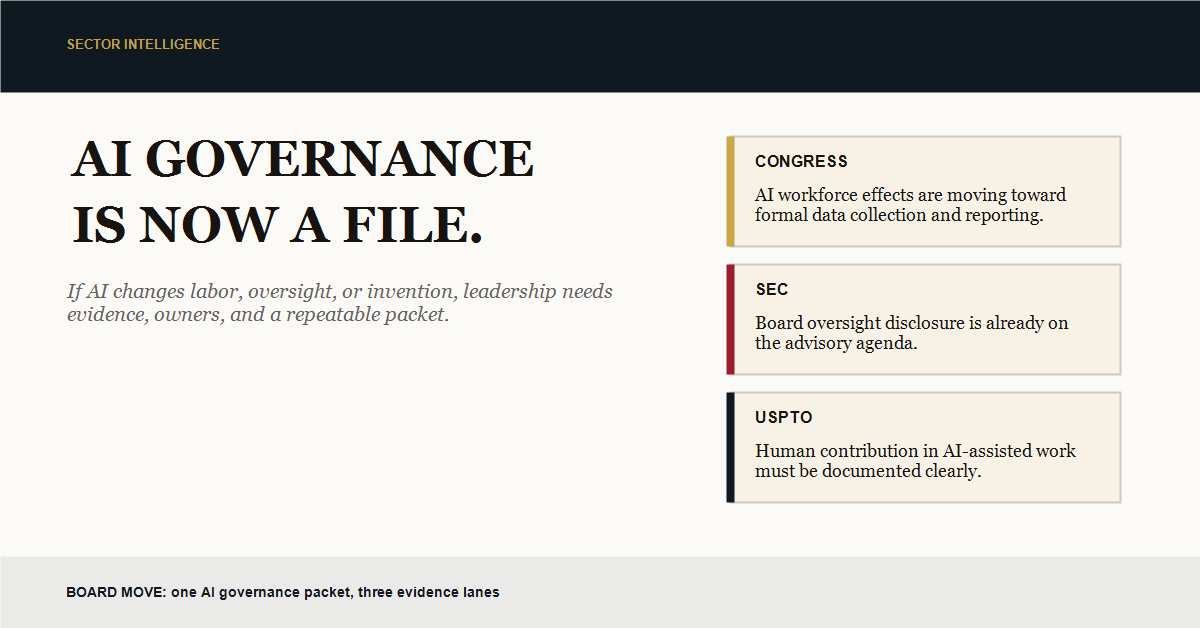
Sector Intelligence for Monday, June 8, 2026. The AI workforce conversation has moved out of keynote language and into document design. Congress now has an active bill built to capture AI-related layoffs and workforce impact. The SEC Investor Advisory Committee has already recommended that issuers disclose board oversight mechanisms and, when material, separate the internal operational effects of AI from consumer-facing effects. The USPTO has now re-stated the human inventorship rule for AI-assisted work. These are not disconnected developments. They describe the same expectation from three angles: if AI changes labor, operations, or invention, leadership needs a file.
The signal is not more AI regulation. The signal is evidence design
The common executive mistake is to read each development in isolation. The workforce bill is treated as employment policy. The SEC recommendation is treated as disclosure politics. The USPTO guidance is treated as patent counsel territory. That framing misses the operating move. Each one is turning AI from a general strategic issue into a documentary one: what was used, where it changed work, who reviewed it, and what evidence proves that leadership was not guessing.
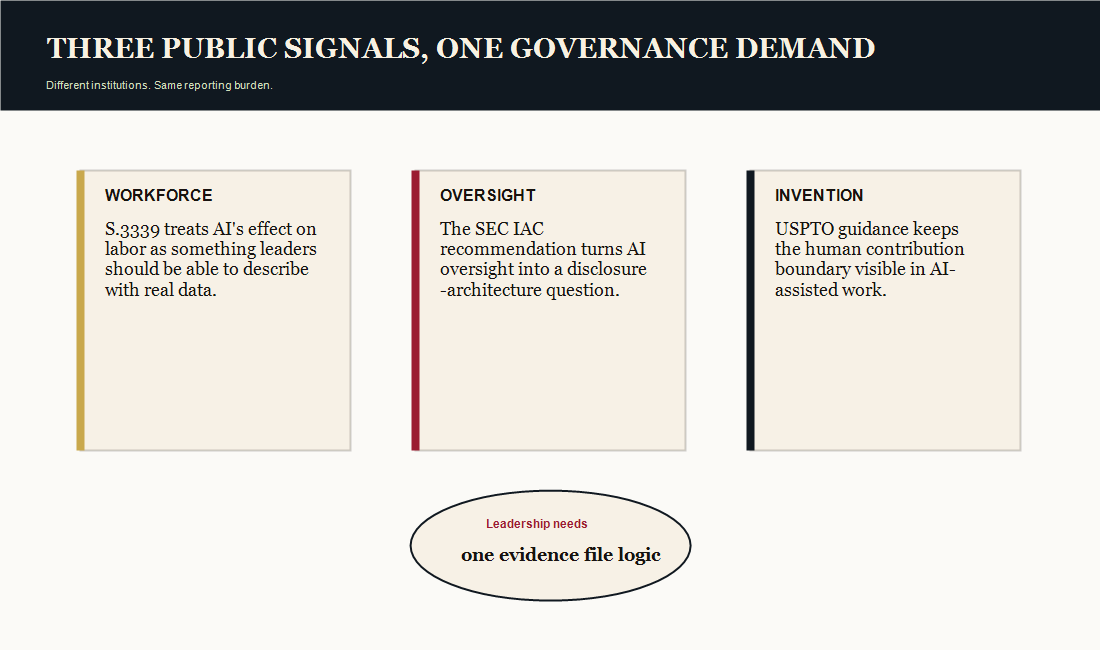
Touch Stone’s AI-First Culture source base argued that AI transformation succeeds only when ritual redesign comes before deployment. This is what that argument looks like when it reaches the public record. The question is no longer whether a company has an AI strategy. The question is whether the company has a repeatable reporting ritual for AI’s operational consequences.
The board packet is becoming three files: workforce, oversight, and human contribution
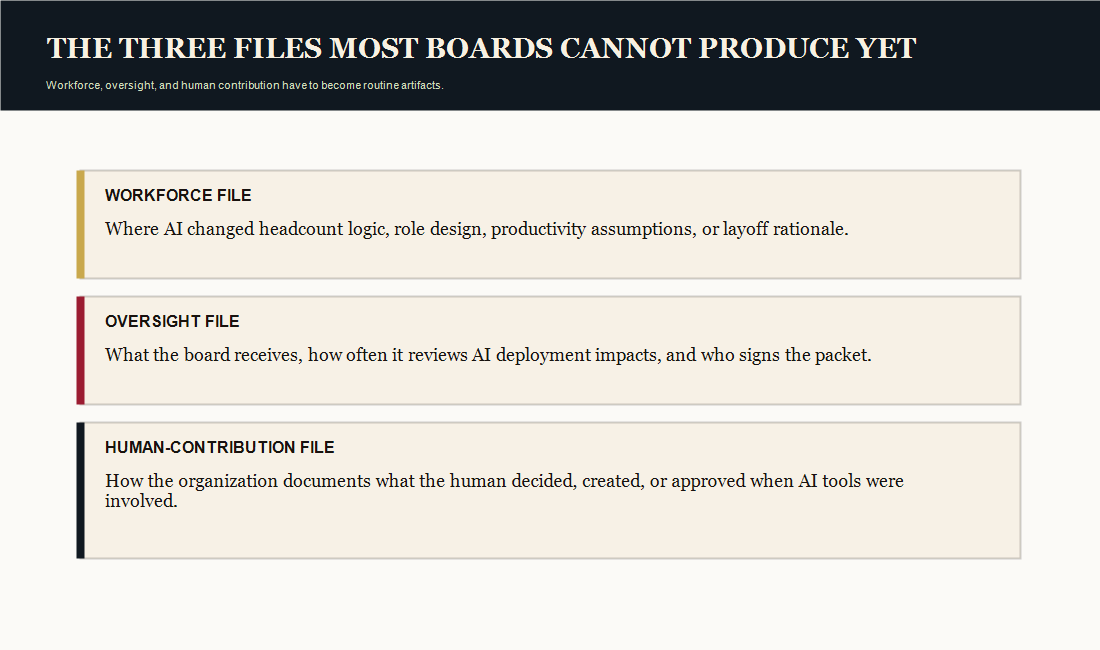
The workforce file answers where AI is changing headcount, role design, or productivity assumptions. The oversight file answers how the board receives AI deployment intelligence and what cadence governs that review. The human-contribution file answers how the organization documents inventive or creative work when AI tools are involved. These are different domains, but they punish the same weakness: organizations that deploy AI faster than they define owners, escalation paths, and proof.
That is why the governance problem is broader than compliance. A company that cannot assemble these files on demand does not merely face legal exposure. It also lacks the management instrumentation required to tell whether AI is producing structural gains or just new language around old work.
The exposed pattern is disclosure without ritual
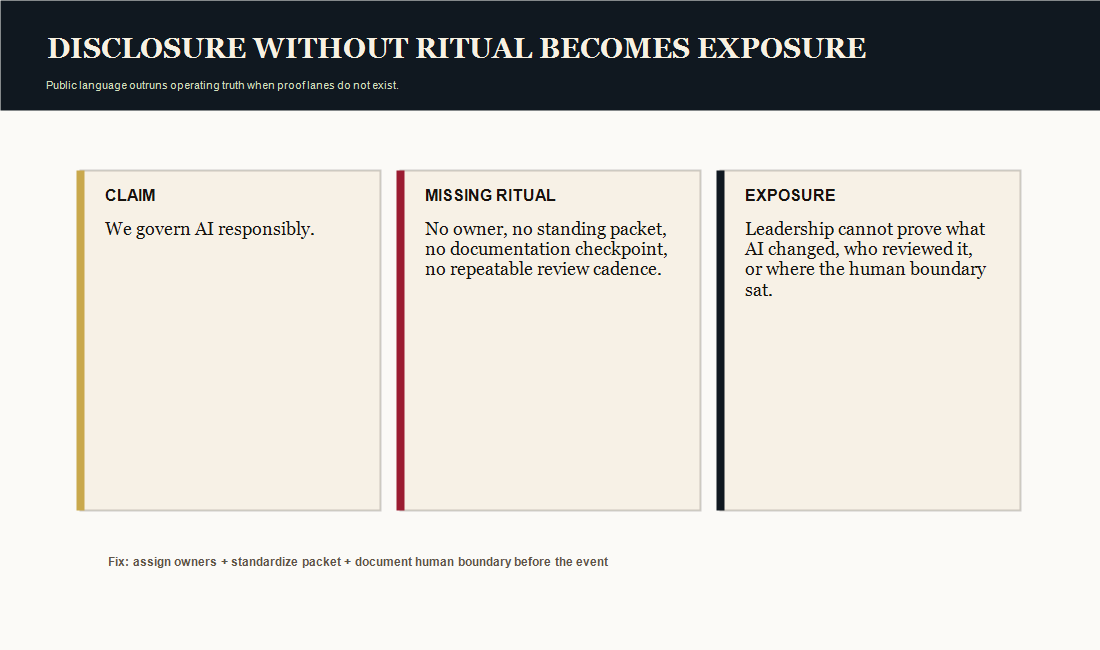
The dangerous posture is not silence. It is partial sophistication. Companies now know enough to talk about AI oversight, AI productivity, and AI-assisted innovation. Many still do not have the ritual infrastructure beneath those claims: no standing board packet, no workforce-impact reporting lane, no documentation checkpoint for AI-assisted invention. That is how public language outruns operating truth.
A board-grade response is practical.
- Name the reporting owners: workforce impact, board oversight, and inventorship documentation each need an accountable executive and review cadence.
- Standardize the packet: one recurring AI governance pack should route signal from management to the board in a format that can survive scrutiny.
- Document the human boundary: if AI contributed to a materially important output, the human contribution and decision authority should be explicit.
- Run the ritual before the event: the file must exist before a layoff announcement, filing cycle, or patent dispute forces it into existence.
If you need the governance architecture behind those files, the AI-First Culture white papers and executive playbook developed the operating model in detail. The board that builds those files before the first serious challenge arrives has built something its successors will benefit from. That is what governance architecture looks like when it is not built in response to a crisis.
Sources
# Sources (primary first)

- U.S. Congress, [S.3339 - AI Workforce PREPARE Act](https://www.congress.gov/bill/119th-congress/senate-bill/3339/titles), 119th Congress. Introduced December 3, 2025; latest action: referred to Senate HELP Committee.
- U.S. Securities and Exchange Commission, Investor Advisory Committee, [Disclosure of Artificial Intelligence's Impact on Operations](https://www.sec.gov/files/approved-artificial-intelligence-disclosure-recommendation-120425.pdf), approved December 4, 2025.
- U.S. Patent and Trademark Office, [Revised inventorship guidance for AI-assisted inventions](https://www.uspto.gov/subscription-center/2025/revised-inventorship-guidance-ai-assisted-inventions), published November 26, 2025.

## Touch Stone source base

- AI-First Culture research brief.
- AI-First Culture board, CRO, and CTO white papers.
- AI-First Culture Executive Leadership Playbook.
If your board needs the reporting architecture behind AI oversight, workforce exposure, and human-accountability boundaries, start with the AI-First Culture white papers and executive playbook.