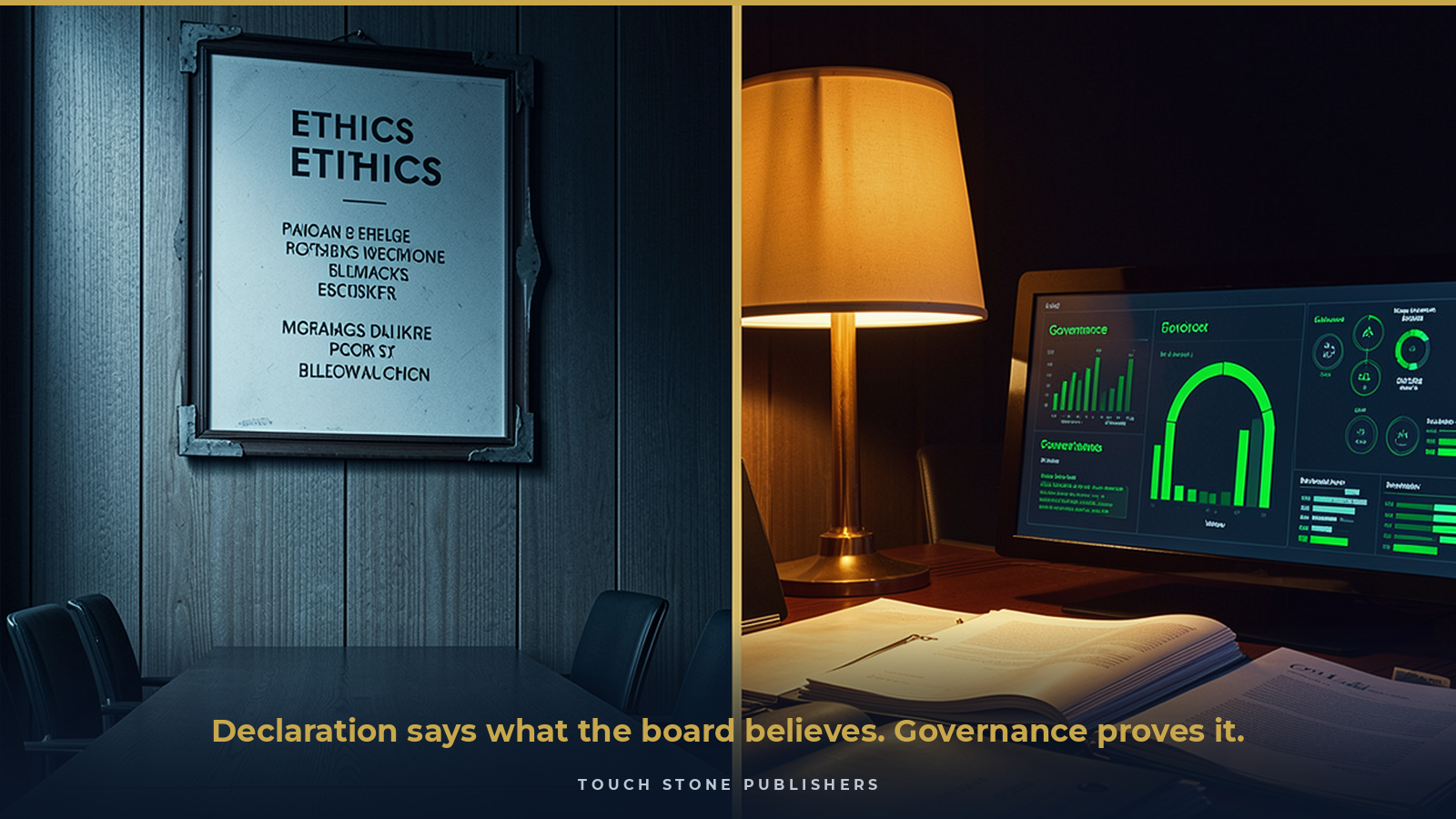
I have been in enough boardrooms to know the difference between the board that talks about trust and the board that builds it.
The ones that talk about it usually have a policy. Maybe a code of ethics framed near the front door. A sustainability report with careful language about accountability and community investment. An AI capability statement in the last investor presentation, approved by the full board in a fifteen-minute agenda item. The words are right. The intent, in the moment the policy gets approved, may even be genuine.
Then the regulator arrives. Or the litigation does. Or the due diligence team asks to see the underlying architecture. Not the policy document. The architecture.
And what was declared turns out not to exist.
I watched this happen recently with a board that had spent three years saying the right things. In a single acquisition conversation, it discovered that none of those things had been built. The AI oversight framework existed as a document. The ethics governance program existed as a stated value. What the acquirer wanted was proof: evidence that the claims had been monitored, verified, tested, and documented as a running system, not assembled for the pitch.
The board had declared. It had not built.
There is a name for what I have seen in rooms like that. I call it the Declarative Board Failure Pattern. A board declares a standard, points to the declaration as evidence of the standard, and builds nothing underneath it to make the declaration true. It is not necessarily fraud. It is something more ordinary than fraud: a board that confused the announcement with the architecture.
Declaration says what the board believes. Governance proves it.
The consequence now is personal in a way that earlier governance cycles were not. The SEC’s Cyber and Emerging Technologies Unit, formed February 2025, is filing parallel civil and criminal AI washing actions against companies whose marketing claims outran what their systems could verify. In April 2025, the Nate Inc. action charged a company that raised $42 million on AI capabilities it never actually deployed. That prosecution is no longer the cautionary extreme. It is the prosecution template. Delaware’s Chancery Court ruled in 2025 that algorithmic and cybersecurity oversight are board-level fiduciary obligations under Caremark, and that the absence of board minutes documenting substantive AI oversight discussions is evidentiary in a derivative claim. The absence of a record is the record.
I am not writing this to frighten anyone. I am writing it because I have also been in the other kind of boardroom.
The other kind builds trust governance not because the regulator demanded it, but because the people in the room understood something essential: what they build will protect or expose the organization long after they are gone. The question was never “will we be caught?” The question was “what are we handing to the people who come after us?”
I watched a board chair run a session once where two full hours turned on a single question. Not a regulatory question. Not a legal question. A governance question: if our AI-assisted claims about product performance turned out to be wrong, who in this room can prove we asked about it? Not “can we prove we had a policy.” Can we prove we asked, received a specific answer, tested that answer, and created documentation that makes good-faith ignorance impossible to claim?
That is the accountability conversation most boards have never had. Who owns the monitoring function? Who receives the quarterly verification report? Who holds responsibility for closing the gap between what we say publicly and what our systems can actually prove?
They spent two hours building the architecture of that answer. Not because enforcement was imminent. Because the chair understood something the first board in this story did not: governance is not what you announce in a crisis. It is what you build before a crisis is conceivable.
That board now has quarterly documentation that any acquirer, any proxy advisor, any shareholder derivative plaintiff would find exactly what the board intended them to find. Not a declaration. A verified system that runs regardless of whether the people who built it are still in the room.
That is the legacy test for any governance model. Not whether it held while the architect was present. Whether it holds when the architect is gone. Whether the verification system runs without being asked. Whether the people who come after understand not just what they inherited, but why it was built the way it was.
The board that builds verified ethics architecture before enforcement arrives builds something its successors will carry forward as institutional strength, not institutional liability. Not a paper trail assembled in the months before a filing. Evidence of a standard the organization held because the people in the room believed it was right.
The full framework for building this architecture is developed in the Ethics as an Advantage Executive Leadership Playbook.
Not survival. Something that outlasts them.