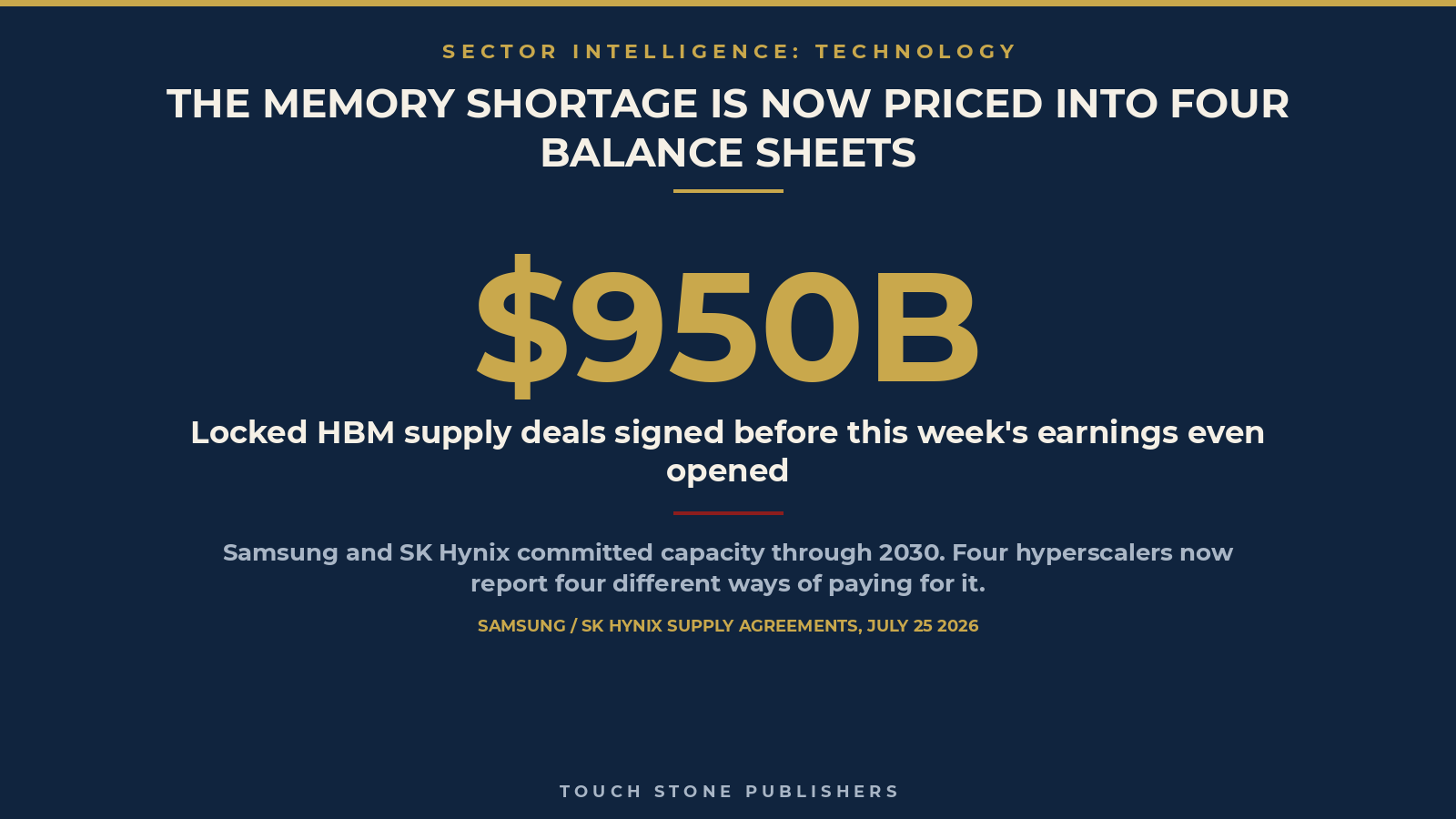
Every major HBM supplier on earth is sold out through 2026, and this week four hyperscalers report earnings that will show how differently each one is paying for that fact.
The Supply Commitment Landed Before The Earnings Calendar Did
Samsung and SK Hynix signed roughly $950 billion in memory supply agreements with Nvidia and Broadcom on July 25, locking AI chip memory capacity through 2030. Samsung and SK Hynix together committed up to 900,000 DRAM wafer starts per month to support Microsoft and OpenAI’s Stargate buildout alone, close to 35 to 40 percent of global DRAM wafer capacity. Micron, the third major producer, is fighting for the remaining Nvidia HBM4 allocation with a market share in the single digits.
The mechanism is capacity, not price. Every high bandwidth memory stack requires through silicon via interconnects and stacked DRAM dies, a packaging process that earns memory manufacturers far more margin than commodity DRAM. That economics pulls wafer capacity structurally away from consumer chips and toward AI accelerators, and it does so regardless of what any single buyer wants to pay. Conventional DRAM contract prices are up 90 to 95 percent in a single quarter. Gartner projects a 130 percent year over year DRAM price rise for 2026. Goldman Sachs calls it the tightest memory market in 15 years, with HBM shortfall reaching 5.1 percent even after every long term agreement signed this quarter.
Alphabet Already Showed The Board What This Costs. Three More Show It This Week.
Alphabet reported first, on July 22, and raised its 2026 capex guidance to $195 to $205 billion from $180 to $190 billion, a $15 billion increase driven directly by AI infrastructure demand. The company posted negative free cash flow for the first time in its history, burning $5.9 billion in the quarter. CFO Anat Ashkenazi’s justification was blunt: demand still outpaces the investment.
Microsoft and Meta report Wednesday. Apple and Amazon report Thursday. Every one of them is now negotiating the same locked, premium priced memory supply Alphabet already paid for, and every board overseeing them will see the capital consequence land in a single reporting week rather than spread across a quarter.
Defensive Risk: a board that treats this quarter’s capex guidance as one company’s spending choice is misreading the signal. The memory supply constraint is structural and multi year. A capex number that looks aggressive against this quarter’s revenue can still be the disciplined choice if the alternative is guaranteed supply at a worse price twelve months from now.
Offensive Advantage: the hyperscaler that owns its silicon roadmap owns its cost structure. Amazon’s Trainium program is the clearest evidence, custom AI accelerators built specifically to run transformer workloads at a lower cost per token than GPU clusters that carry embedded HBM pricing set by someone else’s supply contract.
Four Balance Sheets, Four Answers To The Same Shortage
Microsoft and Meta are paying the premium directly. High bandwidth memory is embedded in the cost of every GPU cluster they build, a line item neither company can negotiate down because the pricing power sits with the memory manufacturer, not the buyer.
Amazon is the one hyperscaler explicitly routing around the shortage rather than absorbing it, using Trainium to shift workloads away from GPU dependent memory pricing entirely.
Apple absorbs the squeeze from the other side. Wafers that would have produced LPDDR5X memory for the iPhone are now producing high bandwidth memory for AI data centers, and Apple carries that opportunity cost into a hardware margin line the market watches closely.
A capital allocator reading all four earnings calls this week is not reading four separate stories. They are reading one shortage, priced four different ways, by four managements making four different bets about how long it lasts.
Board chairs and audit chairs: Take the Board Fiduciary AI Stress Test at touchstonepublishers.com/board-fiduciary-assessment