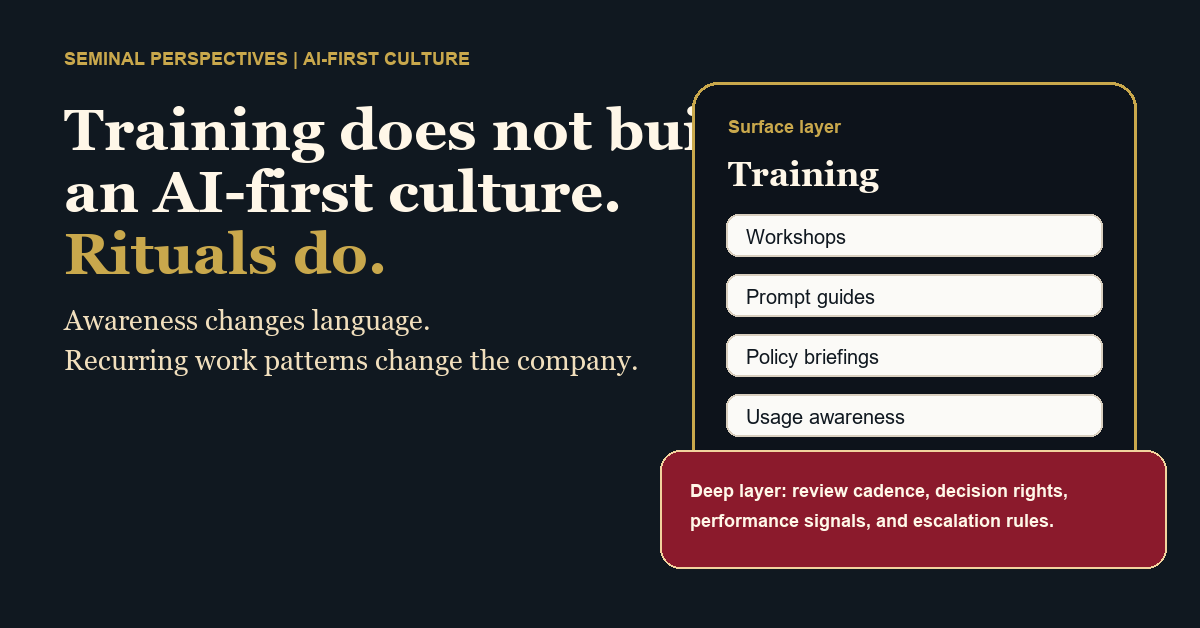
Training Does Not Build an AI-First Culture. Rituals Do.
Organizations that treat AI culture as a training problem will generate usage, not transformation, because culture changes where work is reviewed, rewarded, and governed.
Culture Lives Where Work Repeats
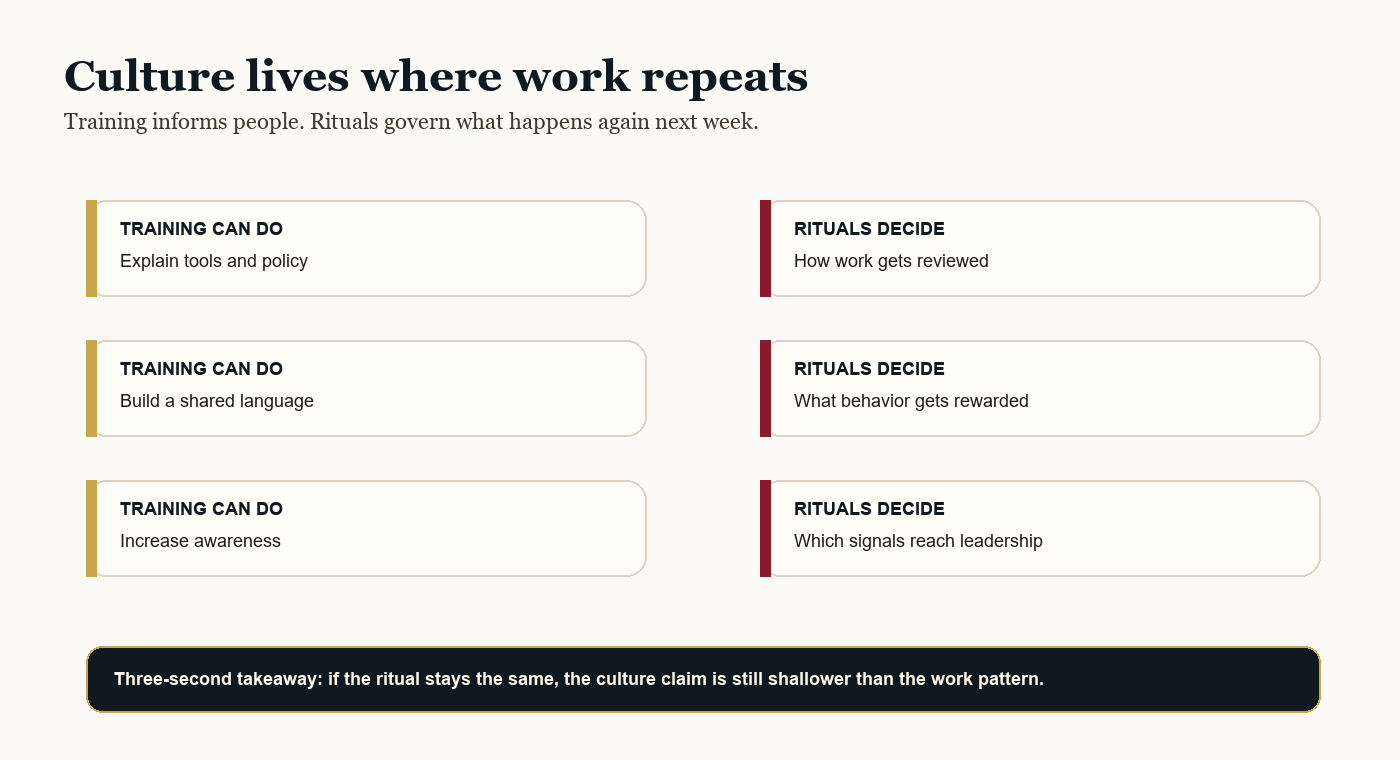
Many executive teams still talk about AI culture as if the problem were awareness.
The assumption sounds reasonable. Run the workshops. Teach prompt use. Publish the policy. Ask managers to encourage experimentation. Then wait for culture to catch up.
That sequence produces familiarity. It does not reliably produce transformation.
The AI-First Culture source base starts from a stricter premise. Culture is not a message layer. It is the recurring pattern inside the rituals that govern real work: planning, review, escalation, performance evaluation, board oversight, and disclosure. If those rituals do not change, the organization may talk differently about AI while continuing to work in the same old pattern.
That is why training alone fails as a culture strategy. Training can explain the new world. It cannot, by itself, redesign the weekly operating review, the performance conversation, the workflow approval path, or the board packet. The organization will keep obeying the ritual structure it already has.
This is also why Touch Stone’s CAIRO framework begins with culture audit and anchor ritual redesign before broad claims about AI maturity. The question is not whether employees heard the message. The question is which recurring work patterns changed because AI entered the system.
Training Cannot Carry an Accountability Load
The deeper problem is not only behavioral. It is structural.
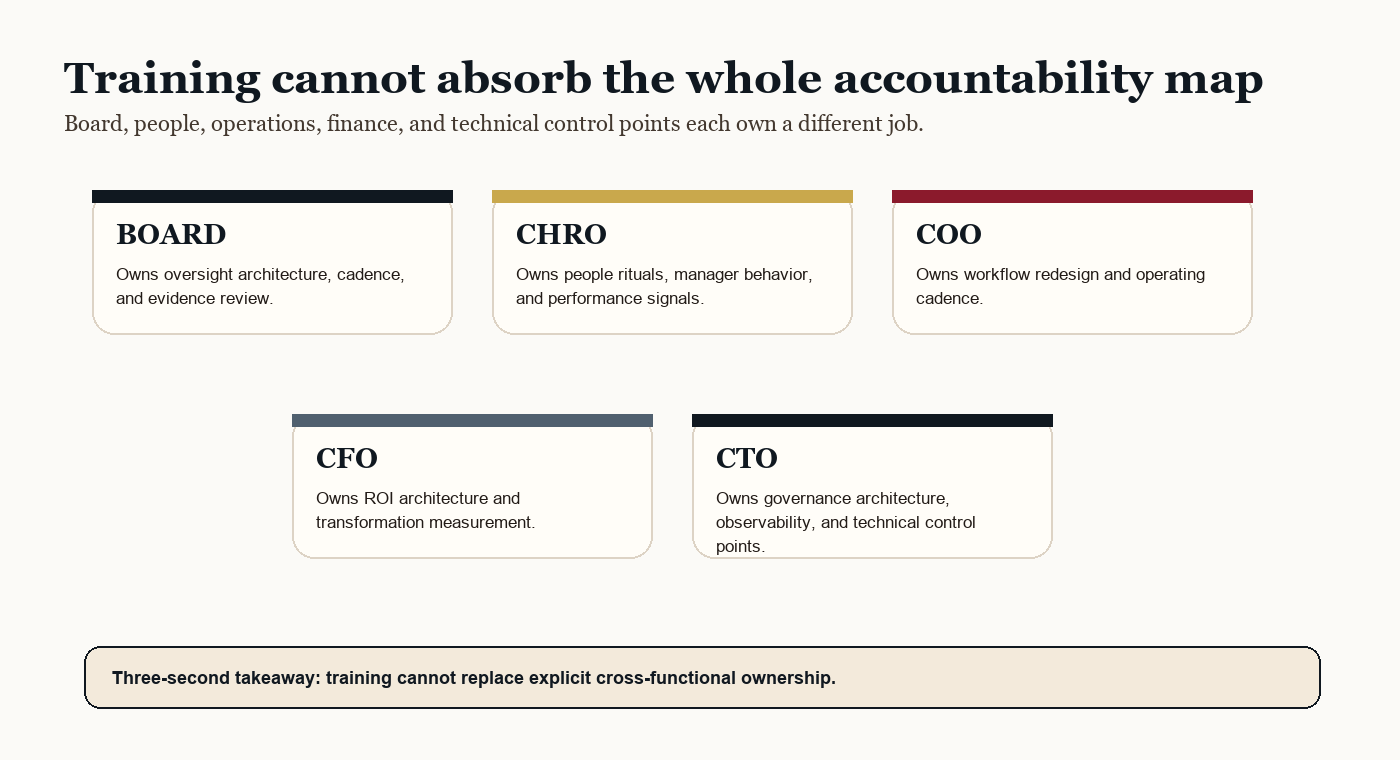
Once AI becomes operationally significant, different leaders own different parts of the change. The board owns the oversight architecture. The CHRO owns the people rituals and performance signals. The COO owns workflow redesign and operating cadence. The CFO owns the ROI architecture and measurement discipline. The CTO owns governance architecture, observability, and technical control points.
That is the Accountability Contract Model in practice. Responsibility is explicit, bounded, and reviewable.
Training cannot replace that structure. It cannot decide which board committee owns AI oversight. It cannot create a clean escalation path from management reality to board review. It cannot redesign the performance review so AI-augmented collaboration is rewarded rather than treated as invisible labor. It cannot create the financial architecture that distinguishes usage statistics from real return.
This is where the Governance Boundary Principle matters. The board governs the oversight architecture. Management governs the execution system. When executives collapse those jobs into a generic culture initiative, they create the appearance of motion while leaving the accountability map unresolved.
An organization can train thousands of employees and still avoid the real work if no one has been required to name the rituals, owners, and reporting cadence that make AI use governable.
The Proof Is Cadence, Not Adoption
The wrong proof is a workshop count, a prompt library, or a dashboard that shows how many people opened the tool last month.
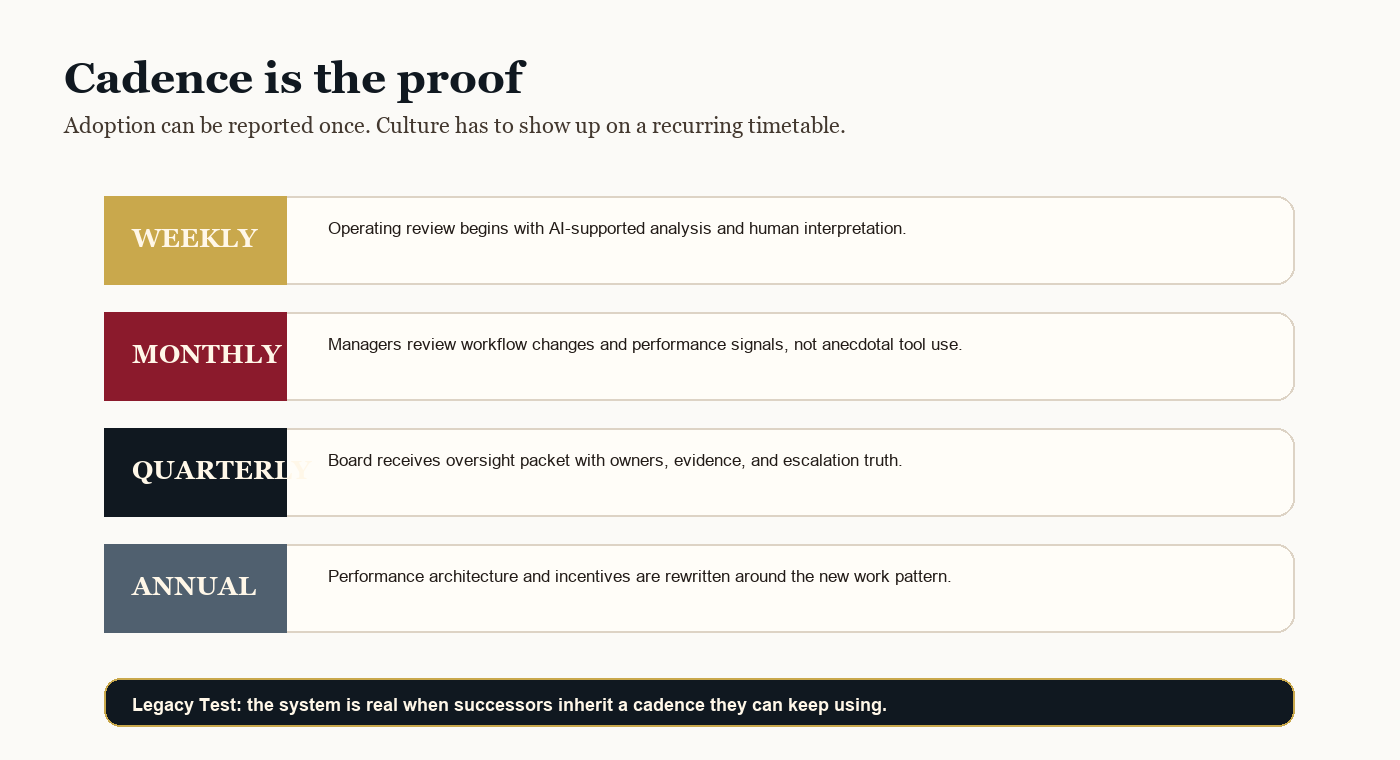
The stronger proof is cadence.
What happens every week that did not happen before. What management review now begins with AI-generated intelligence and human interpretation. What monthly operating conversation now tests workflow redesign rather than anecdotal experimentation. What quarterly board review now receives a structured evidence packet. What annual performance architecture now rewards the behaviors the organization claims it wants.
That is how an AI-first culture becomes visible. Not as enthusiasm. As recurring proof.
The source base makes the implication clear across functions. The CFO paper argues that AI spend without ritual redesign yields usage metrics, not ROI. The CHRO paper argues that manager behavior and performance architecture are the real transmission system. The COO paper argues that operating reviews and workflow maps are where transformation depth is won. The CTO paper argues that governance architecture and observability must exist before scale. None of those claims can be solved by awareness training alone.
Training still matters. It helps people participate in the redesigned system. It just is not the system.
The organization that understands this early builds a culture that can survive leadership turnover because the work pattern is embedded in cadence, not charisma. That is the Legacy Test. The leaders who redesign the rituals before the pressure arrives leave behind an operating system their successors can build on, not a training archive they have to reinterpret.
Use the AI-First Culture white papers to test the governance argument, then move into the function-specific architecture for finance, people, operations, and technical leadership.