
Authority Is a Queue
Culture is the routing system for authority. AI increases velocity. Leadership must increase clarity.
Leadership was never only vision. Leadership is the system that decides what moves, what waits, and what counts as proof.
That system exists whether you designed it or inherited it. It lives in your recurring meetings, your approval gates, your operating reviews, and your performance conversations. Those rituals form an invisible queue of authority.
AI does not change the definition of leadership. It changes the speed at which your leadership system is tested.
Culture is the queue you built
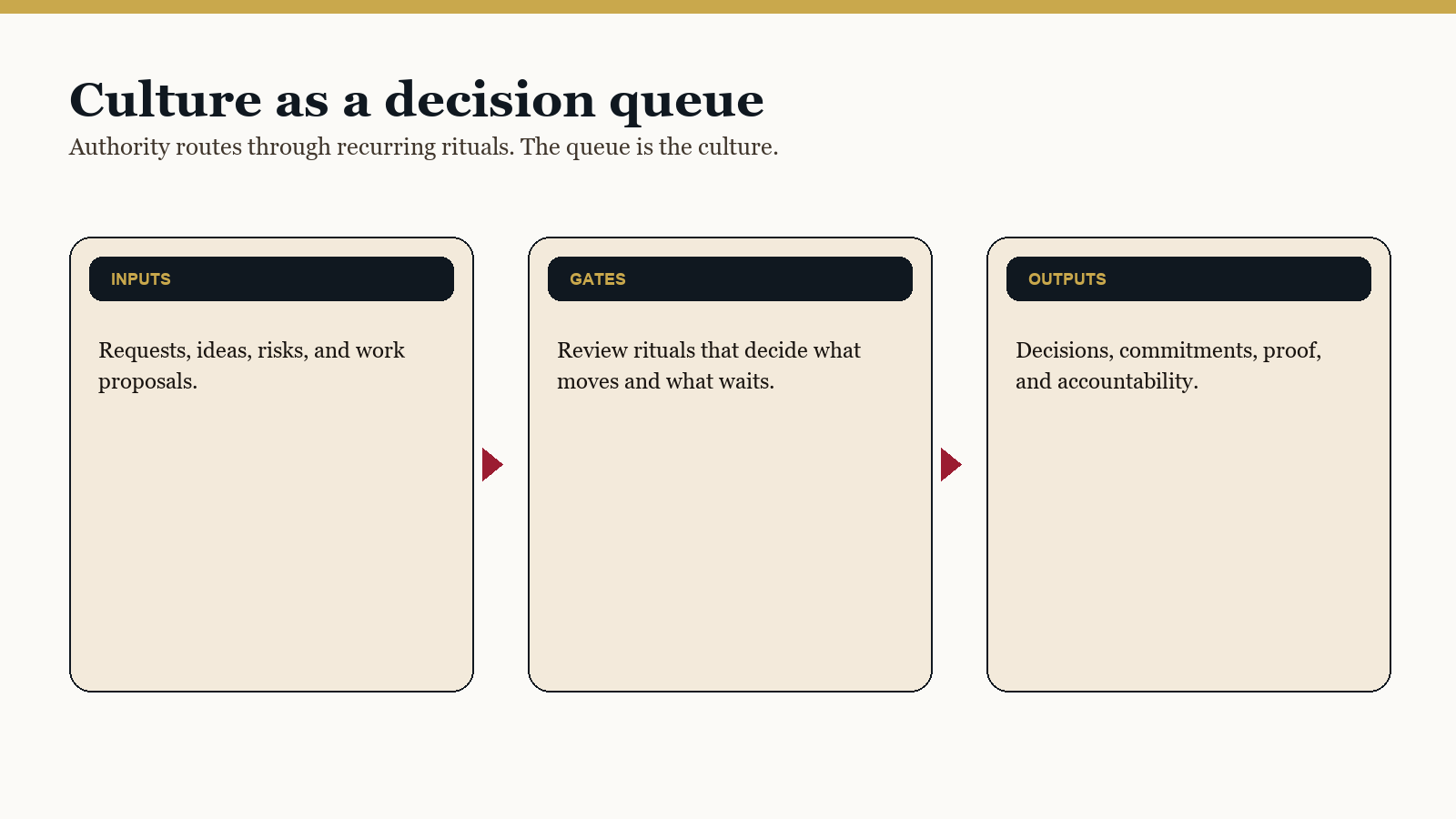
Most leaders describe culture as values. In practice, culture is the routing logic of the organization. Who can decide. What requires review. Which work is rewarded. What gets escalated. What dies quietly in the middle.
If you want to understand your culture, do not start with the posters. Start with the queue. Which decisions can be made in one meeting, and which require five. Which risks get owned, and which get distributed until nobody is accountable. Which teams can ship, and which teams must ask permission to breathe.
Rituals are not soft. They are the infrastructure that carries your authority across time. When the infrastructure is misaligned, strategy becomes theater.
Delegated cognition collapses the distance between idea and action
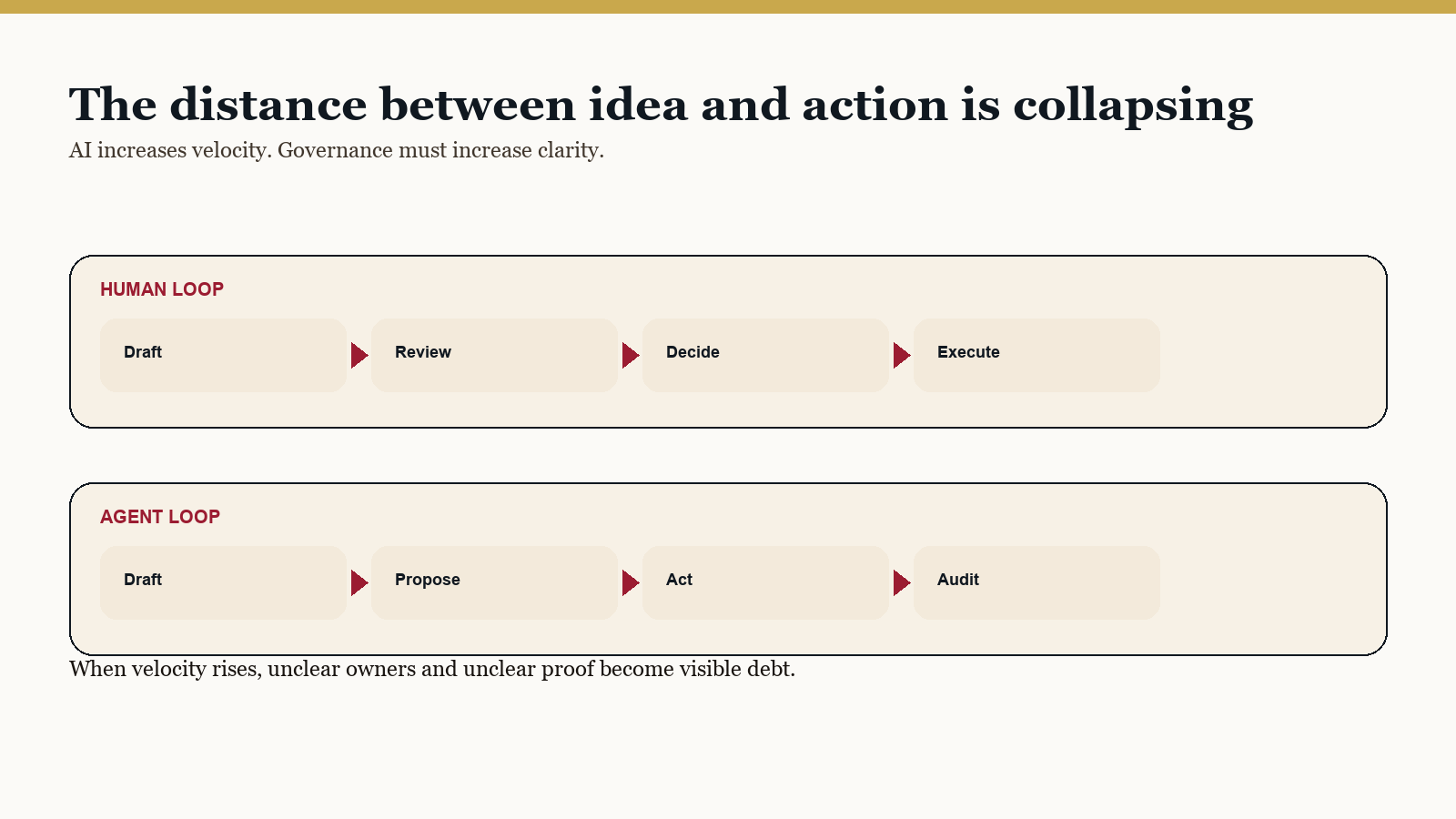
In the human era, many organizations survived with a slow queue. Time hid the cost. A late approval felt like inconvenience, not a structural failure. A vague owner felt like politics, not risk.
Delegated cognition removes the delay that used to cover your seams. When a system can draft, summarize, propose, and execute at machine speed, the bottleneck is no longer effort. The bottleneck is governance. The queue becomes the product.
This is why AI-first culture is not a tool story. It is an operating model story. The question is not whether your people can use AI. The question is whether your authority system can absorb higher velocity without losing trust.
If you cannot answer that cleanly, your AI program will become a culture conflict. Not because the model is wrong. Because authority is unresolved.
The executive move is ritual redesign, not tool deployment
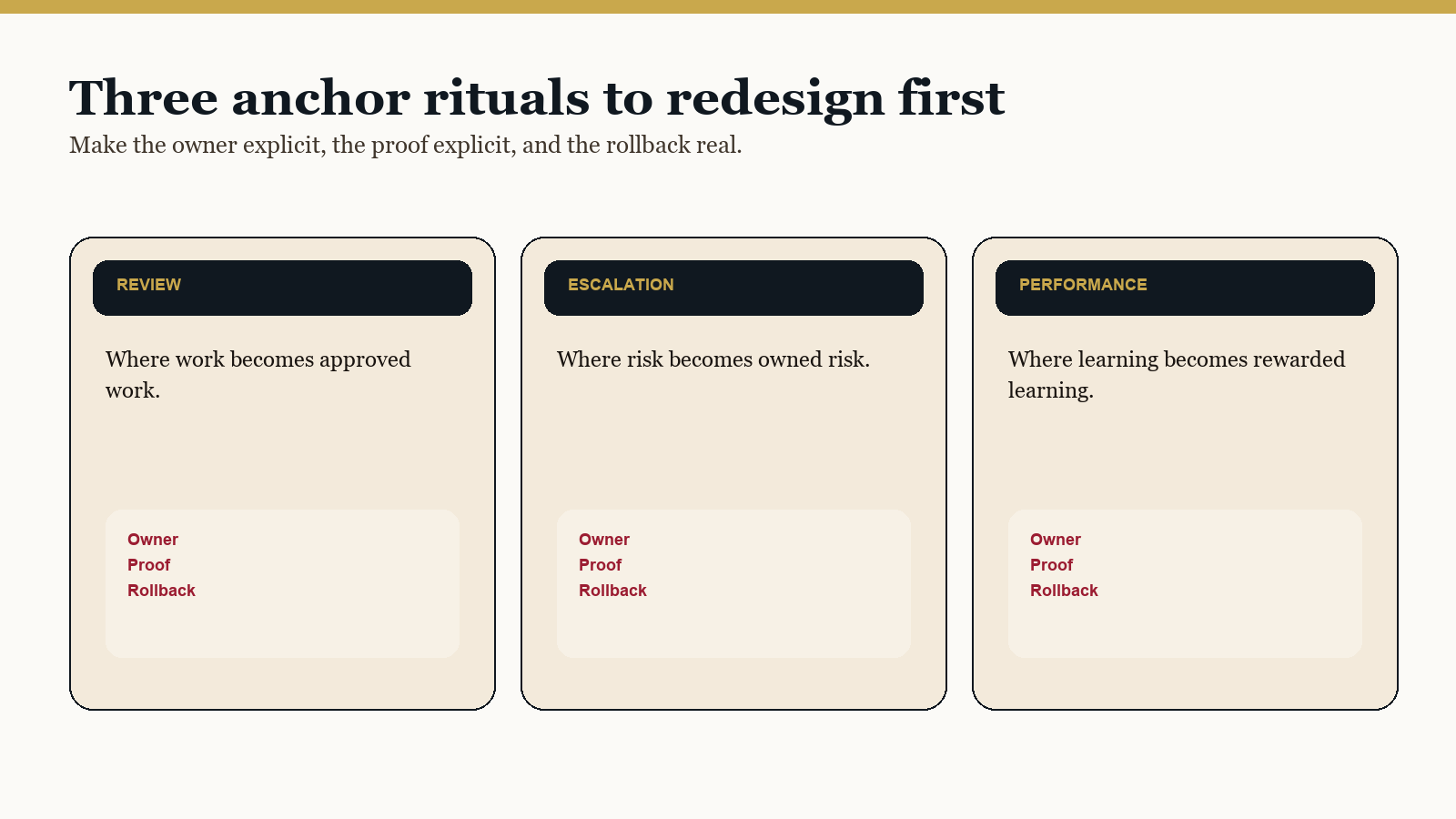
When leaders say they want an AI-first culture, they often mean adoption. What they need is coherence. The shortest path to coherence is to redesign the small set of rituals that govern how work is reviewed, rewarded, and escalated.
Begin with the rituals that happen most frequently and carry the highest consequence. A weekly operating review. A performance conversation. A risk escalation ritual. A product approval gate. A sales call preparation cadence. Pick three. Redesign them for human and AI collaboration. Make the proof explicit. Make the owner explicit. Make the rollback path real.
Tool deployment without ritual redesign becomes a new layer of output on top of an old system of authority. You get more drafts, more dashboards, and more motion. You do not get more trust. Trust is earned when the organization can see who decided, on what basis, with what evidence, and with what ability to reverse course when reality disagrees.
That is the permanence test for this era. Not whether you adopted AI. Whether your leadership system became worthy of higher velocity.
If your AI program is creating culture conflict, the fix is not more prompts. It is ritual redesign. The white papers explain the CAIRO framework and the governance questions boards should ask first.