Proxy Season Just Turned AI Oversight Into Board Architecture.
When AI oversight moves into committee design, escalation protocol, and disclosure mechanics, boards can no longer treat AI culture as a management talking point.
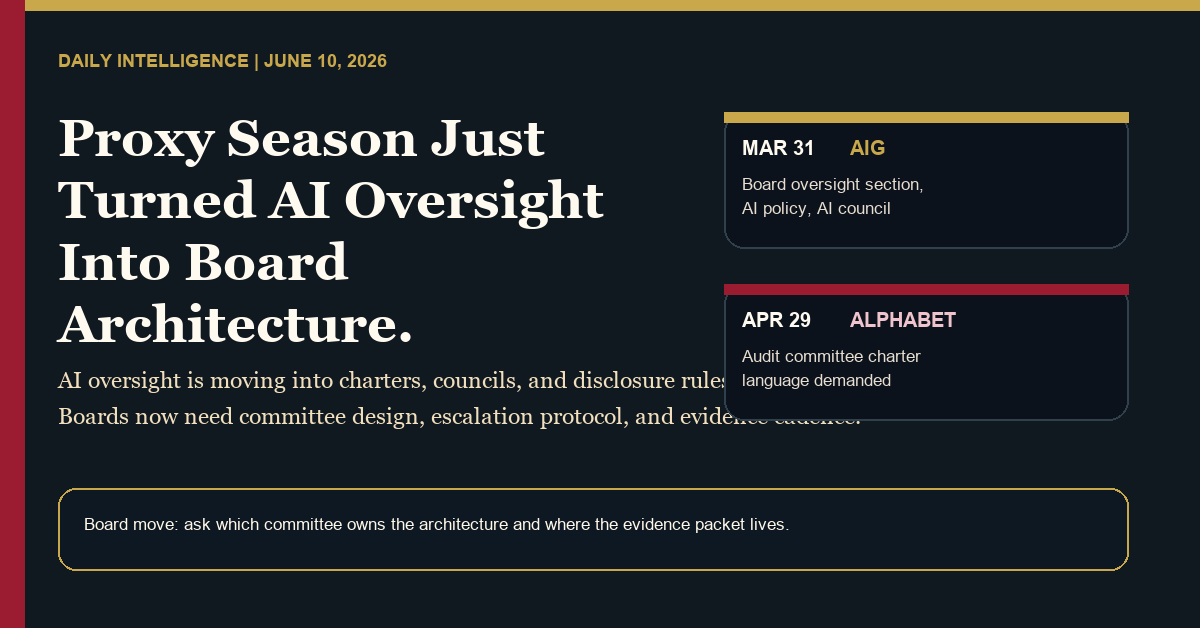
Proxy Language Is Moving from Intention to Machinery
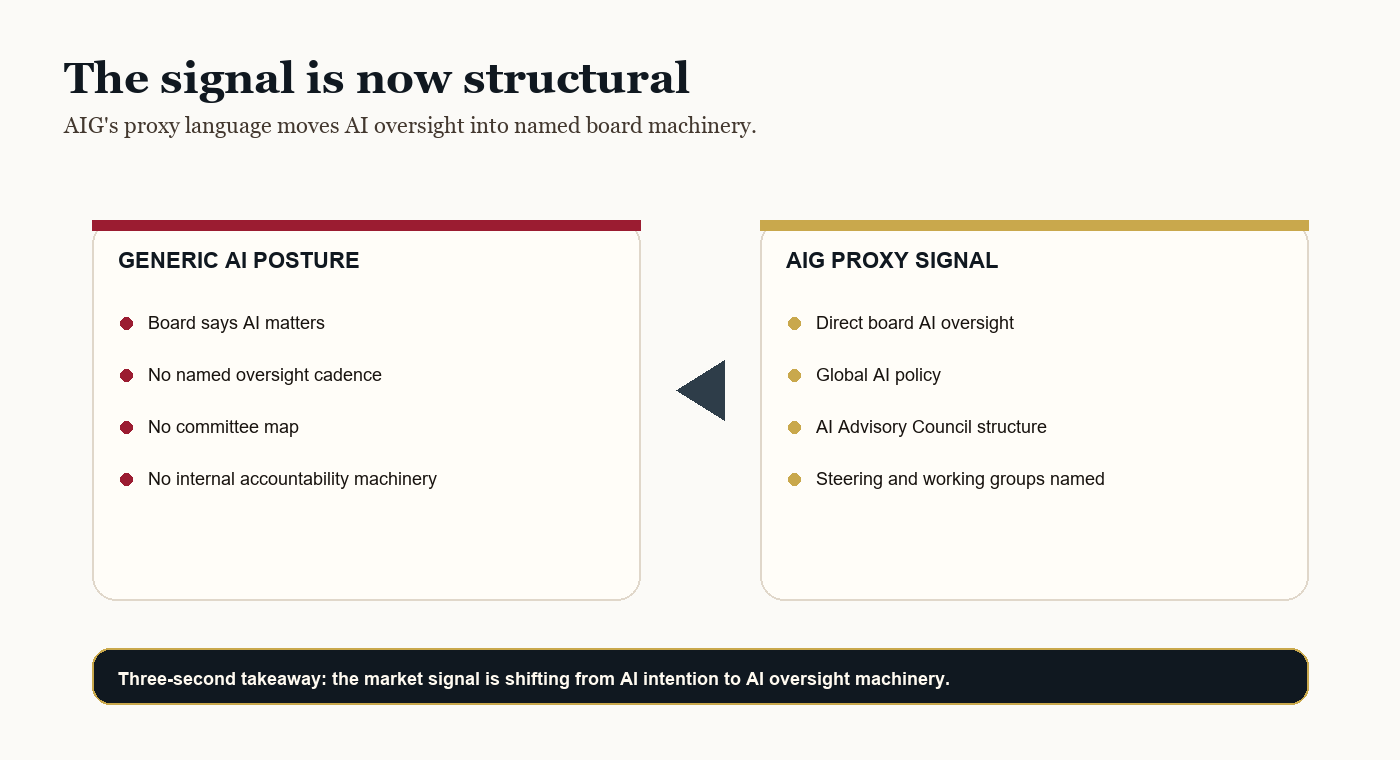
The strongest AI governance signal this spring did not come from another keynote or another software launch. It came from proxy-season language.
In its March 31, 2026 proxy statement, AIG added a section titled “Board Oversight of Artificial Intelligence.” The filing says the board has direct oversight of AI because AI may affect strategy, competition, cybersecurity, risk management, and data privacy. It goes further than that. It describes a global AI policy and an internal AI Advisory Council with a Steering Committee and Working Group.
That is the part boards should notice.
The signal is not simply that AIG thinks AI matters. Most issuers already say some version of that. The signal is that AI oversight is being described through structure: policy, council, committee layer, and explicit board accountability. Proxy language is moving from AI intention to AI machinery.
Touch Stone’s AI-First Culture work has argued that disclosure without governance ritual is exposure, not fulfillment. Proxy season is now making the same distinction legible in public-company language. Once AI reaches the proxy in structural terms, the board no longer gets to treat the topic as a management update with a glossy slide attached.
The Real Fight Is About Chartered Accountability
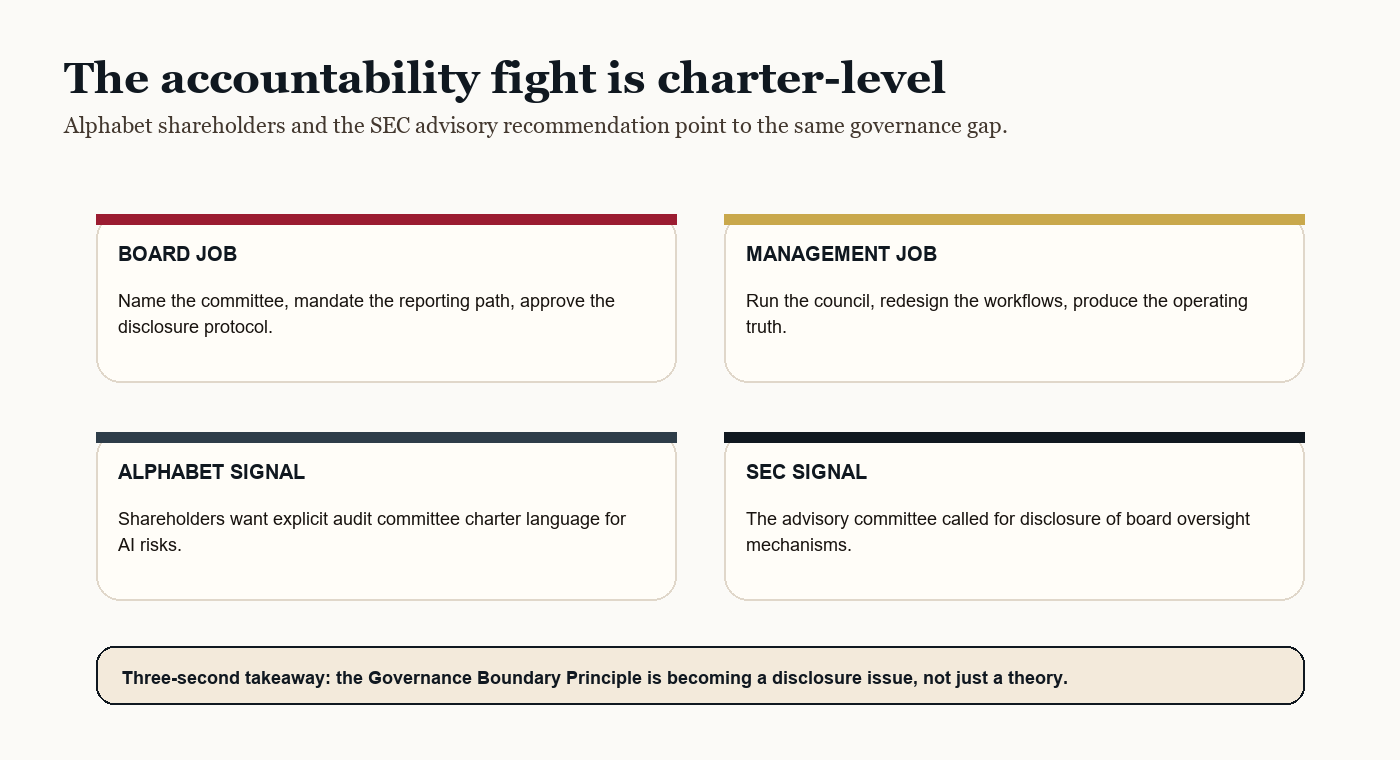
The next signal makes the accountability issue even clearer.
In an exempt solicitation filed on April 29, 2026, Alphabet shareholders asked the company to update its Audit and Compliance Committee Charter to state explicit oversight responsibility for AI-related risks. Their argument was not philosophical. It was operational. They said AI oversight responsibilities were fragmented across board committees and internal teams, which reduces transparency and diffuses accountability.
That filing matters because it names the actual board-level problem: fragmentation.
The board cannot govern AI through enthusiasm alone. It needs a clean line between who governs the oversight architecture and who runs the operating system underneath it. That is the Governance Boundary Principle in practice. The board names the committee owner, reporting path, escalation expectations, and disclosure review threshold. Management runs the policy, the council, the workflow redesign, and the evidence production.
The SEC’s own Investor Advisory Committee draft recommendation from December 4, 2025 pushed in the same direction by calling for disclosure of board oversight mechanisms related to AI and by distinguishing internal AI deployment impacts from customer-facing AI use. That is not a final SEC rule. It is still an institutional marker. The burden of explanation is moving toward explicit oversight design.
Boards should read these three signals together. AI governance is no longer a loose declaration problem. It is a charter, cadence, and disclosure mechanics problem.
The Board Packet Now Matters More Than the AI Posture Statement
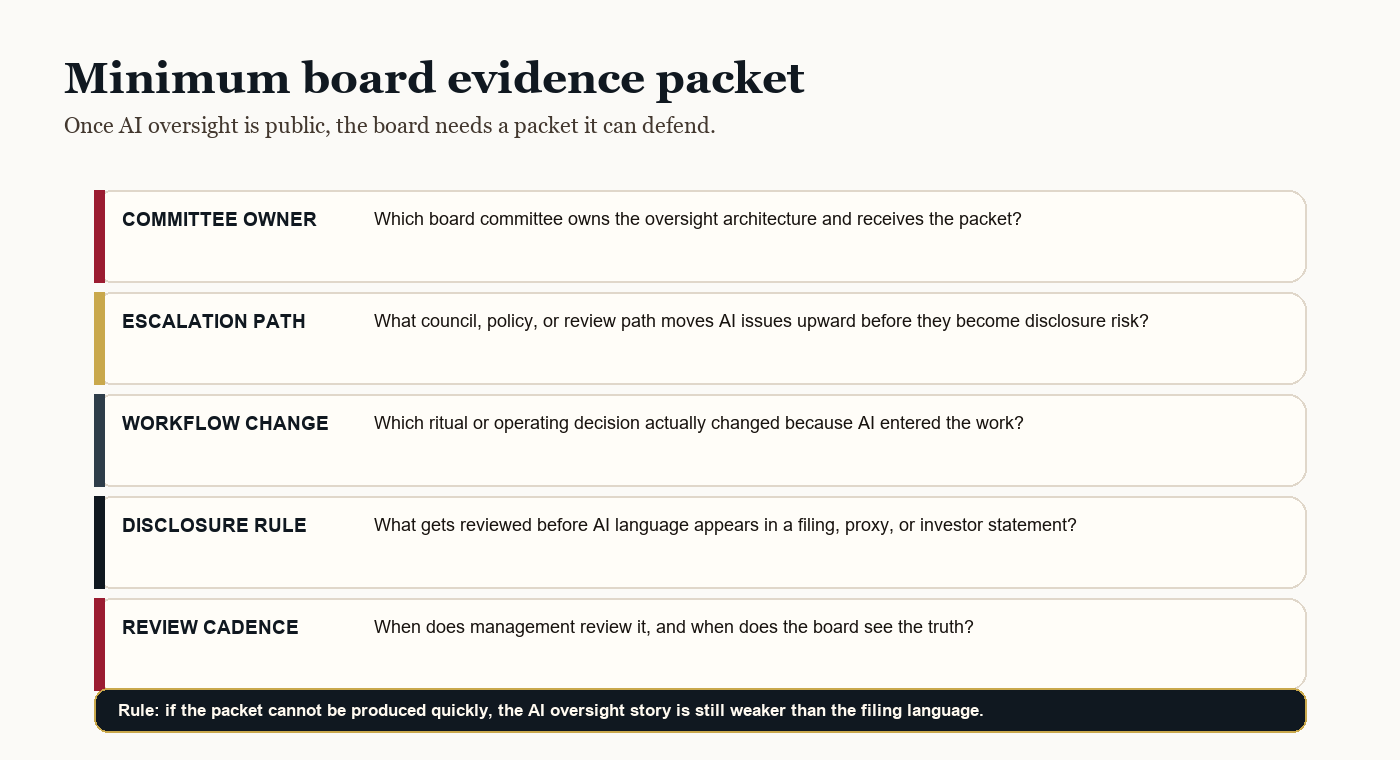
This is where the AI-First Culture source base becomes commercially and operationally useful.
The board white paper argues that disclosure without governance ritual is a fiduciary gap. The playbook extends the point into management practice: if the board is going to speak publicly about AI, management has to produce an evidence packet that shows what structure exists beneath the statement.
The minimum packet is not complex. Which committee owns the oversight architecture. Which management body or council escalates issues upward. Which workflow or ritual changed because AI entered the work. Which disclosure rule governs what can be said externally. When management reviews the issue and when the board sees the truth.
That is the threshold between AI theater and AI oversight.
If management cannot produce that packet quickly, the AI program may still be real, but the governance architecture is not mature enough for confident public language. If the board accepts a posture statement without the packet, it is relying on aspiration where it should be relying on mechanism.
Proxy season did not finish the AI governance argument. It clarified where the argument is headed. The board that builds the architecture before the first disclosure challenge arrives has built something its successors will benefit from. That is what governance architecture looks like when it is not built in response to failure.
The board brief is the free entry point. The role-specific white papers extend the governance, workforce, and operating implications for directors and C-suite leaders who need the full architecture.