AI-First Culture Does Not Begin With a Tool. It Begins With the Leader Who Rewrites the Ritual.
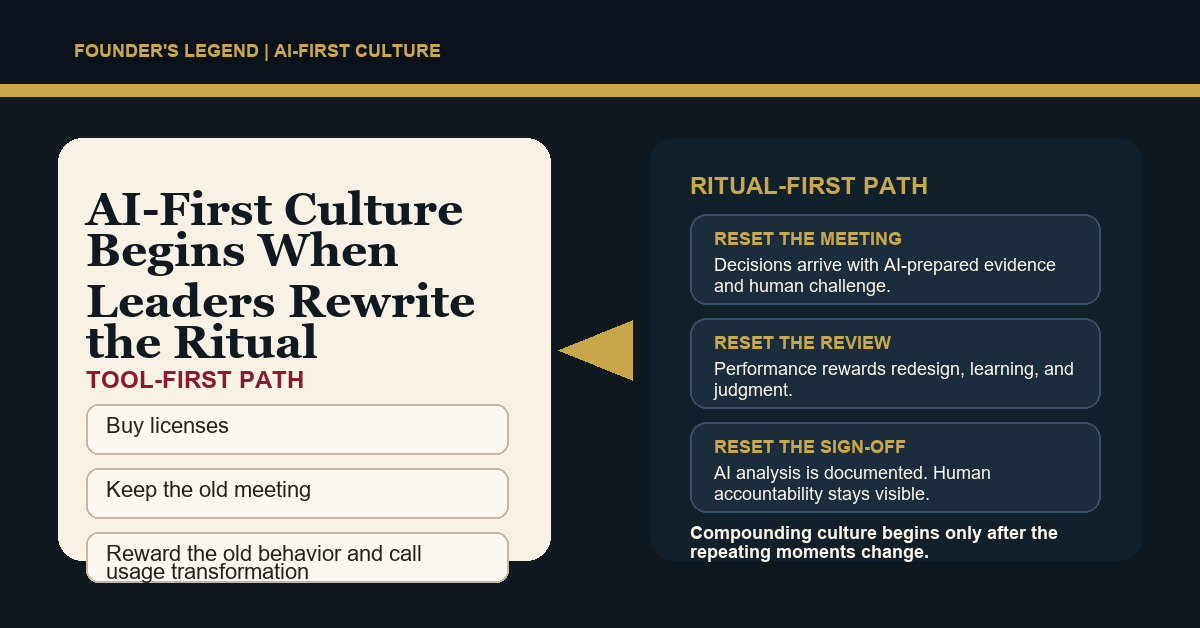
If the weekly meeting, the performance review, and the sign-off ritual still reward the old way of working, no AI program has changed the culture.
Tools Do Not Teach an Organization What to Value
I have watched leaders mistake activity for change for too many years to believe the current AI conversation is different by default.
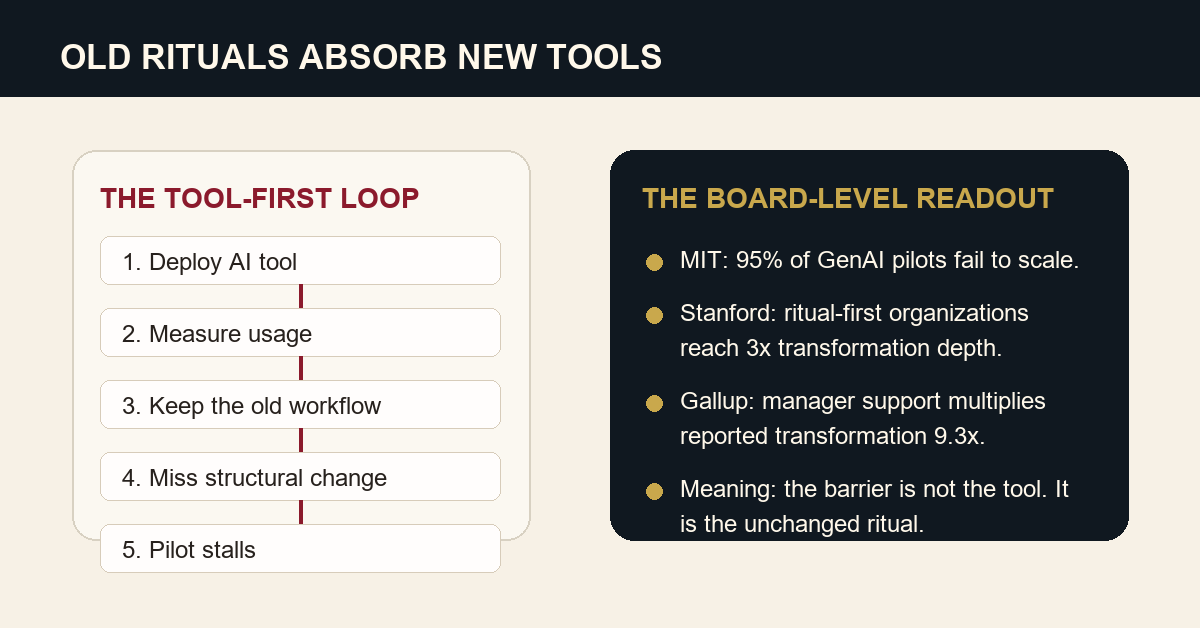
The pattern is familiar. A new system arrives. Licenses are purchased. usage climbs. dashboards fill. the board gets a slide that says adoption is strong. Then six months later the work still moves through the same bottlenecks, the same approval habits, the same weak performance conversations, and the same fear of doing anything that disrupts the old definition of a good employee.
That is not transformation. That is an old culture learning how to wear a new tool.
The evidence in the AI-First Culture research base is plain. MIT's NANDA initiative found that 95% of generative AI pilots fail to scale. Stanford's Digital Economy Lab found that organizations that map workflows and redesign how work is actually done before they choose the tool achieve three times the transformation depth of the tool-first crowd. Gallup found that workers with direct manager support for AI use are 9.3 times more likely to say AI changed their work.
Those numbers do not describe a software problem. They describe a leadership problem.
An organization learns what matters by watching what repeats. The weekly operating meeting teaches. The performance review teaches. The sign-off ritual teaches. The escalation path teaches. If those moments still reward speed without judgment, individual heroics instead of shared learning, and compliance with the old process instead of redesign of the work, the culture has already answered the AI question. It does not matter what the CEO said at the town hall.
That is why I do not believe a leader can delegate AI-first culture to the technology team, or to HR, or to a one-time change program. Culture is not declared at kickoff. It is encoded in repetition.
The Leader's Real Job Is to Reset the Repeating Moments
The leader who understands this has a different job from the one most executives give themselves.
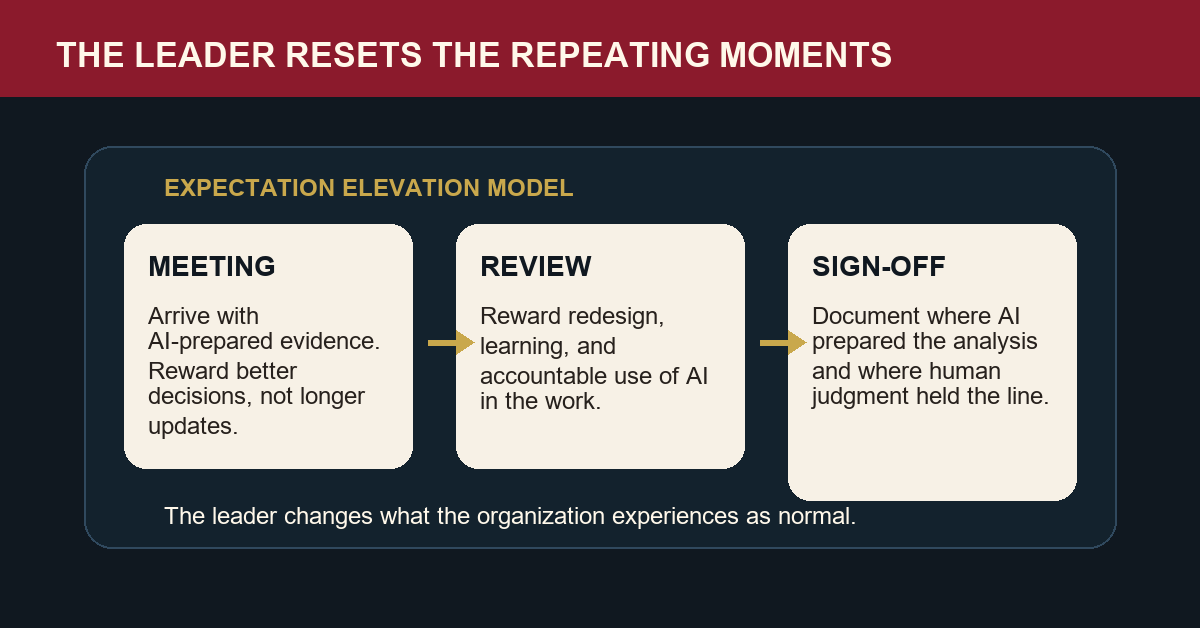
The job is not to urge people to experiment harder. The job is to decide which recurring moments teach the company how work will now be done, and then rewrite those moments with enough clarity that no one misses the signal.
This is where the Expectation Elevation Model matters. A serious leader raises expectations by changing what the organization experiences as normal. The Monday meeting stops rewarding the person who arrives with the most slides and starts rewarding the team that used AI to surface the strongest decision evidence before the room opened. The performance review stops praising volume and starts asking whether the manager redesigned the work so judgment improved, learning accelerated, and unnecessary handoffs disappeared. The approval ritual stops acting as a ceremonial delay and starts documenting where AI prepared the analysis, where a human challenged it, and where accountability stayed visible.
Notice what changed there. Not the language. The ritual.
I think that is why so many AI programs disappoint good leaders. They are trying to persuade people into a future that the operating rhythm still punishes. Workers are told to rethink the work, then measured by standards designed for the old work. Managers are told to support experimentation, then blamed when short-term output dips during redesign. Boards are told the company is becoming AI-first, then receive reports that measure tool adoption instead of decision quality, workflow compression, or governance discipline.
No mature organization survives long under that contradiction.
The leader has to remove it. That is not inspirational work. It is structural work. It is deciding that the repeating moments of the organization will no longer teach caution without learning, or speed without interpretation, or automation without ownership.
BOQ Group is useful public evidence here. What matters is not that Copilot saved time. What matters is that recurring workflows compressed when AI entered the operating cadence. A risk review moved from three weeks to one day. Report sign-off moved from four weeks to one week. That is what leaders should look for: not whether people touched the tool, but whether a repeating piece of work became faster, clearer, safer, and more accountable.
What Your Successor Inherits Is the Only Honest Score
This is where most leadership conversations become too shallow for me.
They stop at results while the current leader is still in the chair.
That is not the final test.
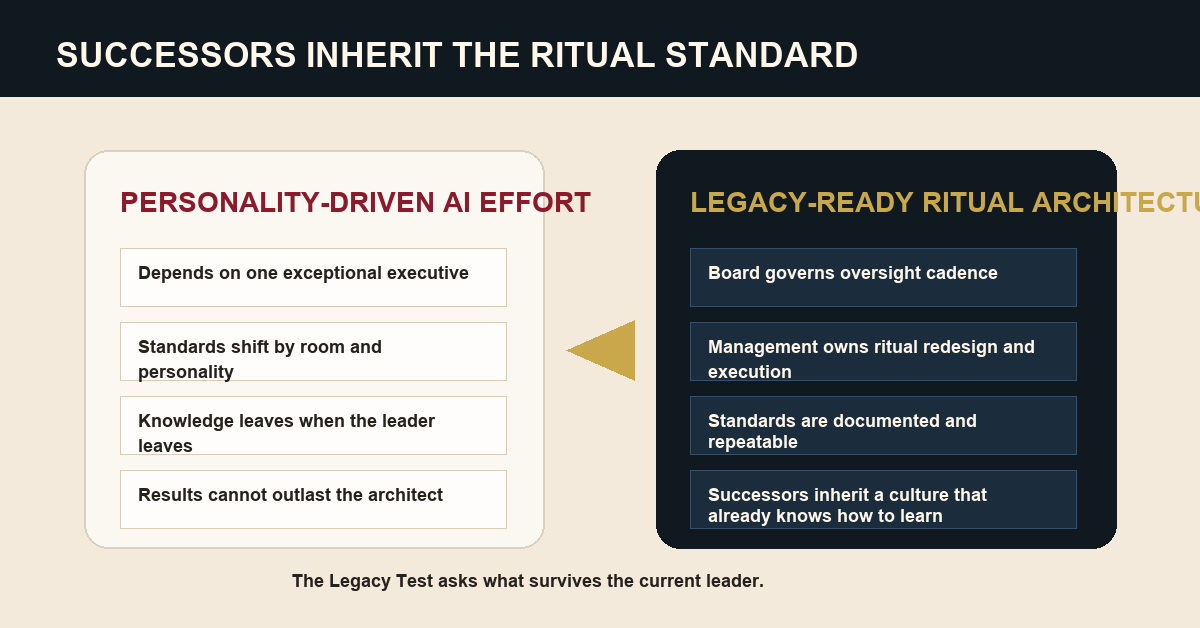
The final test is whether the culture still knows what to do after the architect leaves. If AI capability depends on one unusually curious executive, one unusually forgiving manager, or one exceptional project team, then nothing durable has been built. The organization has borrowed performance from personalities. It has not built a culture.
That is why the Governance Boundary Principle also matters even in a Founder's Legend piece like this one. The board must govern the architecture of oversight. Management must redesign and run the rituals of execution. When those lines are clear, the organization can learn at speed without losing accountability. When those lines blur, AI becomes one more place where everyone is active and no one owns the standard.
So I come back to the same question I would ask any CEO: if I sat in your most important recurring meeting tomorrow morning, what would I learn about what your company now expects from people who work with AI?
If the answer is unclear, the culture is unclear.
If the answer depends on who is in the room, the culture is fragile.
If the answer cannot survive the current leadership team, the culture is not ready for legacy.
The leader who rewrites the ritual before the failure arrives has built something successors will benefit from. That is what governance architecture looks like when it is not built in response to drift, disappointment, or crisis.
That is the Legacy Test. It is also the only form of AI-first culture worth building.
The board brief is the free entry point into the AI-first culture architecture. The role-specific white papers extend the argument for boards, CFOs, CHROs, COOs, CTOs, and CROs.