
The three best organizational change readiness frameworks are the Prosci ADKAR Model, Kotter’s 8-Step Process, and McKinsey 7-S Framework. The ADKAR Model emphasizes individual transformation for broader change. Kotter’s Process is a strategic guide through change complexities, stressing urgency and stakeholder engagement. The McKinsey 7-S Framework harmonizes strategy, structure, and culture. Each offers distinct advantages in aligning elements for effective change. Discover how these frameworks can enhance your organization’s transformation journey.
Key Takeaways
- The Prosci ADKAR Model emphasizes individual transformation to support organizational change through stages like Awareness and Reinforcement.
- Kotter’s 8-Step Process focuses on creating urgency and building coalitions to navigate complex change effectively.
- McKinsey 7-S Framework aligns organizational elements such as strategy, structure, and systems for cohesive change.
- These frameworks enhance team alignment and address both immediate challenges and long-term organizational transformation.
- The role of environment is crucial in facilitating stakeholder engagement and effective communication during change initiatives.
Prosci ADKAR Model

The Prosci ADKAR Model serves as a structured framework designed to facilitate effective organizational change by focusing on individual transformation. This model emphasizes the importance of aligning change management strategies with the ADKAR stages: Awareness, Desire, Knowledge, Ability, and Reinforcement. Each stage represents a critical milestone in an individual’s change journey, ensuring that personal shifts align with broader organizational goals. By strategically addressing these stages, organizations can mitigate resistance and enhance the success rates of change initiatives. Effective communication is crucial in ensuring that these stages are successfully navigated, reinforcing the model’s emphasis on human factors. The model’s analytical approach allows for precise identification of barriers at each stage, enabling targeted interventions. Persuasively, the ADKAR Model underscores that sustainable change management requires understanding and addressing human factors, making it an indispensable tool for leaders aiming to drive transformation effectively.
Kotter’s 8-Step Process for Leading Change
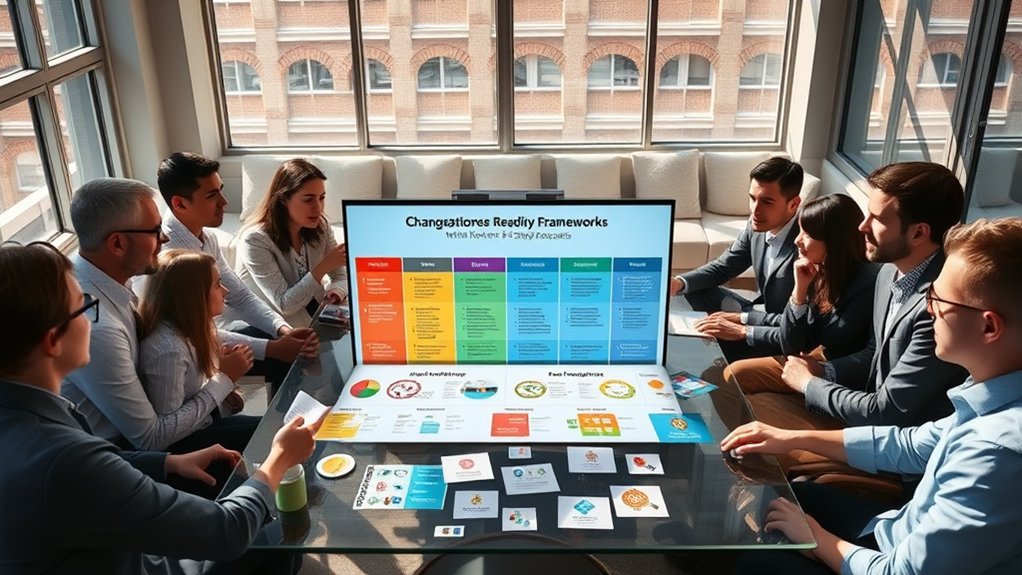
Renowned for its strategic approach to organizational transformation, Kotter’s 8-Step Process for Leading Change offers a thorough framework that guides leaders through the complexities of change management.
This model emphasizes the importance of change leadership, starting with creating a sense of urgency and building a guiding coalition. By crafting a compelling vision and effectively communicating it, leaders can align their teams toward common goals.
The framework also underscores the significance of stakeholder engagement, guaranteeing that all affected parties are involved and invested in the process. Quick wins are generated to build momentum, and changes are consolidated to guarantee long-term success.
Kotter’s methodical approach not only addresses immediate challenges but also institutionalizes changes, making it a robust tool for sustainable transformation.
In addition, the role of environment is crucial in supporting the adoption of organizational change, as it can either hinder or facilitate the progress of new initiatives.
McKinsey 7-S Framework

A holistic approach to organizational analysis, the McKinsey 7-S Framework provides a thorough tool for evaluating and aligning key internal elements to facilitate change. By focusing on seven interconnected areas—strategy, structure, systems, shared values, style, staff, and skills—it guarantees extensive team alignment with strategic goals. This framework is instrumental for organizations intent on adapting to dynamic environments. Consider the following benefits of employing the McKinsey 7-S Framework:
- Enhanced Team Alignment: Guarantees all team members are strategically aligned with organizational objectives.
- Holistic Evaluation: Offers a systemic view by integrating both hard (strategy, structure) and soft (style, shared values) elements.
- Strategic Goal Synchronization: Aligns all aspects of the organization to achieve strategic goals effectively.
This method fosters sustainable growth and competitive advantage. Using frameworks like the DISC framework can further enhance team dynamics by tailoring communication strategies to suit different personalities.
Final Thoughts
In evaluating organizational change readiness frameworks, each offers unique strengths. The Prosci ADKAR Model emphasizes individual transformation, Kotter’s 8-Step Process prioritizes leadership and momentum, while McKinsey’s 7-S Framework aligns organizational elements. Remarkably, research indicates that 70% of change initiatives fail, underscoring the critical need for a strategic approach. Selecting an appropriate framework tailored to organizational needs can substantially enhance the probability of success, turning potential obstacles into structured pathways for sustainable change.