The CFO Who Measures AI ROI Before Ritual Redesign Is Measuring Activity, Not Return.
AI ROI is a deployment-sequence problem before it is a reporting problem. If workflow redesign and transformation-depth evidence are missing, finance is measuring activity instead of return.
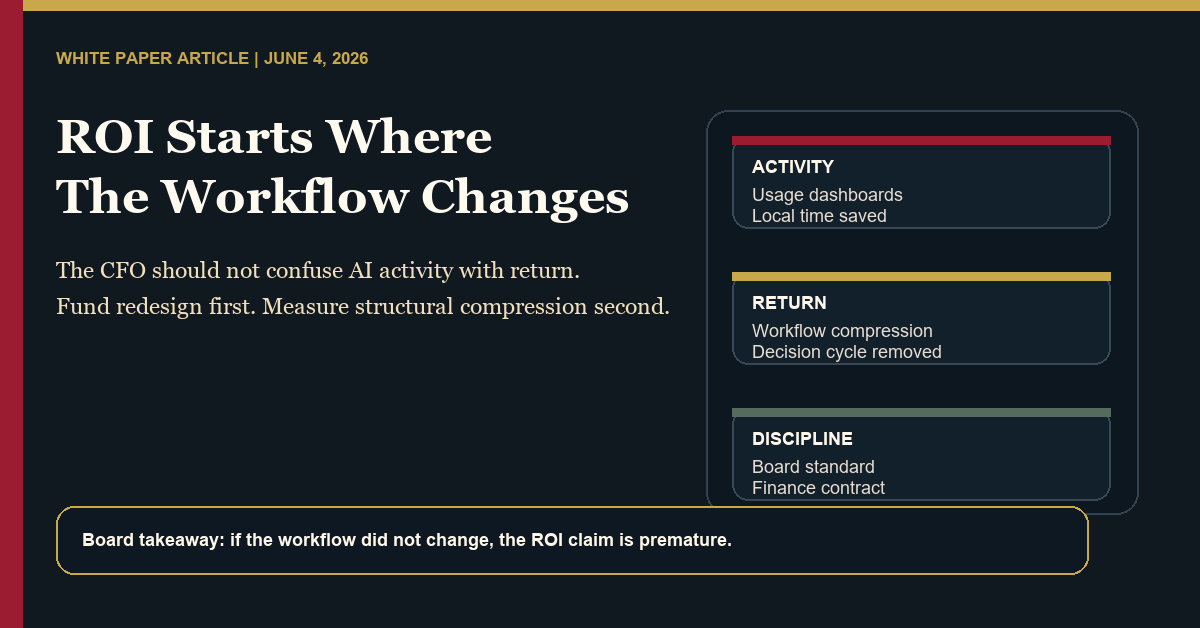
Most CFOs are being asked to measure AI ROI before the institution has changed anything important enough to produce a return.
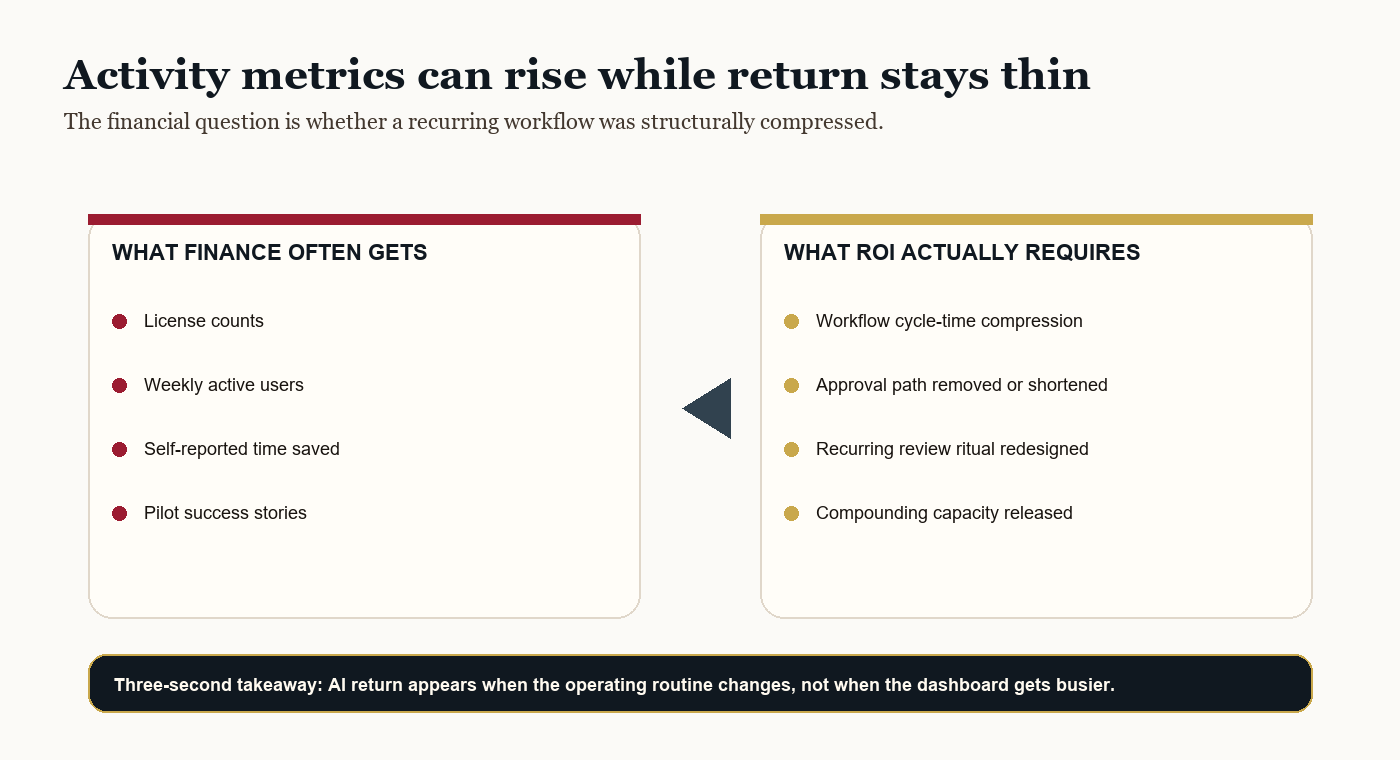
They receive usage dashboards, license counts, and local productivity stories. What they do not receive is evidence that the recurring workflow changed, that the review ritual changed, or that a structural cost was removed from the operating model.
That is why so much AI reporting sounds financially disciplined while remaining economically thin. The organization is measuring activity before it has funded the redesign that could create a return worth measuring.
The AI-First Culture source base makes the financial sequence plain: workflow mapping first, ritual redesign next, tool deployment after that, and transformation-depth measurement throughout. Anything else is cost with a better narrative.
Usage Data Is Not The Same Thing As Return
The CFO white paper opens with the right diagnosis: AI spend without ritual redesign yields usage metrics, not ROI. The playbook sharpens the mechanism behind that statement. Stanford’s Digital Economy Lab found that enterprises that map workflows and redesign rituals before selecting technology achieve three times the transformation depth of tool-first organizations. MIT NANDA’s July 2025 research then explains why this matters financially: most generative AI pilots never scale into enterprise transformation at all. They produce local gains inside old structures and stop there.
That is why usage statistics are so often misread. A team can open the tool every day and still leave the operating model untouched. A department can report time saved and still preserve the same approval path, the same review cadence, and the same managerial proof standard that made the old process slow in the first place. When that happens, the organization has purchased acceleration at the edge while leaving cost, friction, and decision latency in the core.
The source base gives one of the clearest counterexamples available. BOQ Group’s Microsoft-documented case is not interesting because it shows enthusiastic AI use. It is interesting because it shows structural compression: business risk reviews moved from three weeks to one day, report sign-off from four weeks to one week, and other recurring workflows shifted from episodic effort to redesigned routine. That is the line the CFO should care about. Time savings reported by individuals are anecdotes. Structural cycle-time compression in core workflows is return.
The Investment Architecture Has A Governance Boundary
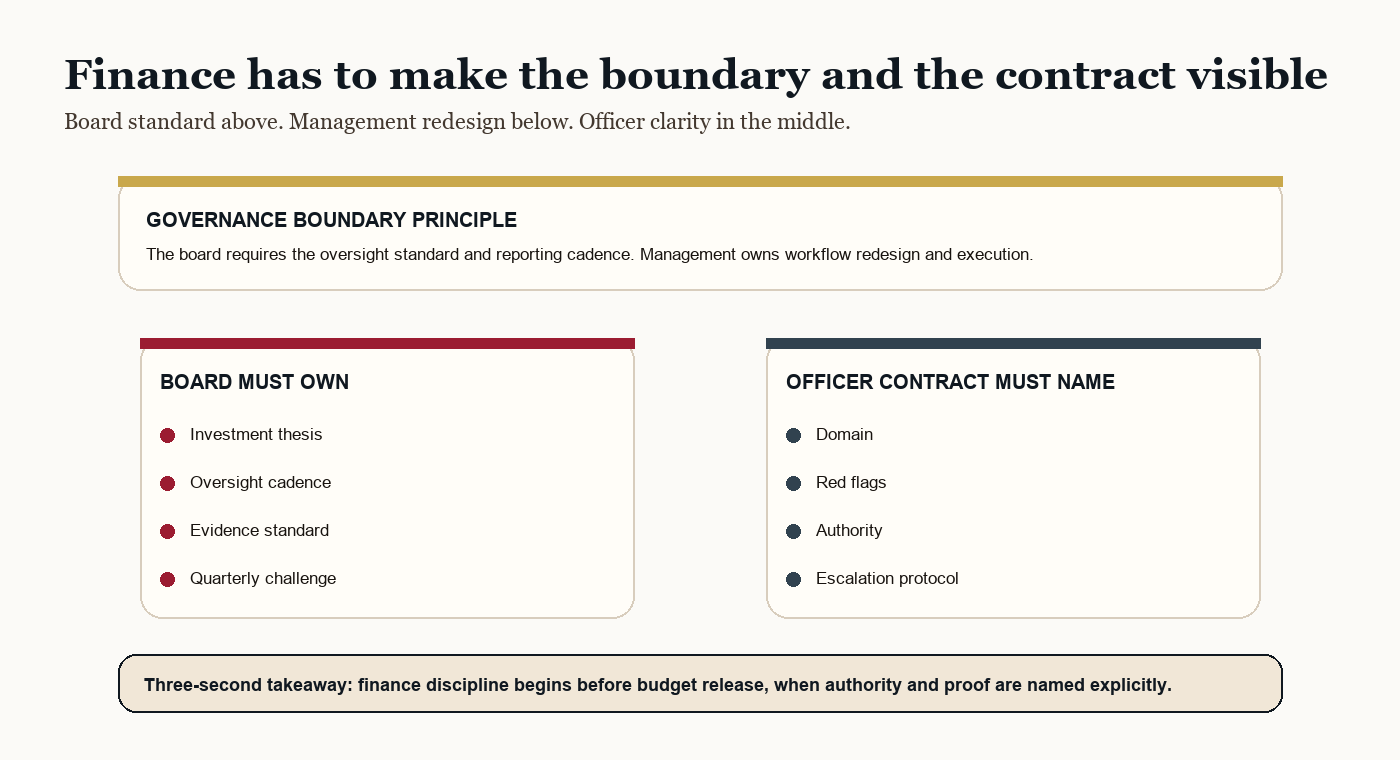
This is where the Governance Boundary Principle belongs in the article. The board governs. Management manages. In AI investment, that means the board should require an investment thesis, a reporting cadence, and evidence that transformation is being governed as an enterprise change. Management then owns workflow mapping, ritual redesign, deployment sequencing, and operating execution. When the board starts choosing tools, it has crossed downward. When management asks for budget without redesign logic or governance evidence, it has crossed upward by asking the board to fund faith instead of architecture.
The CFO is the officer who can keep that boundary honest. Finance is the place where enthusiasm should become sequence, allocation, and proof. The CFO white paper makes the capital allocation point directly: ritual redesign investment precedes and enables AI tool investment. The playbook adds the measurement rule: transformation depth is the leading indicator, not tool usage. Together they define the financial governance job. Budget should not be released as if software procurement and organizational redesign were the same line item.
The Accountability Contract Model also applies here. Before approving meaningful AI spend, the CFO should force a four-question officer conversation across finance, operations, technology, and people leadership: What domain is being redesigned. What red flags will show the workflow is not changing. What authority is granted to change the ritual rather than merely add a tool. What escalation protocol applies if the deployment produces usage without transformation. Without that conversation, the organization is not making an investment decision. It is financing ambiguity.
The First Finance Moves That Separate Return From Theater
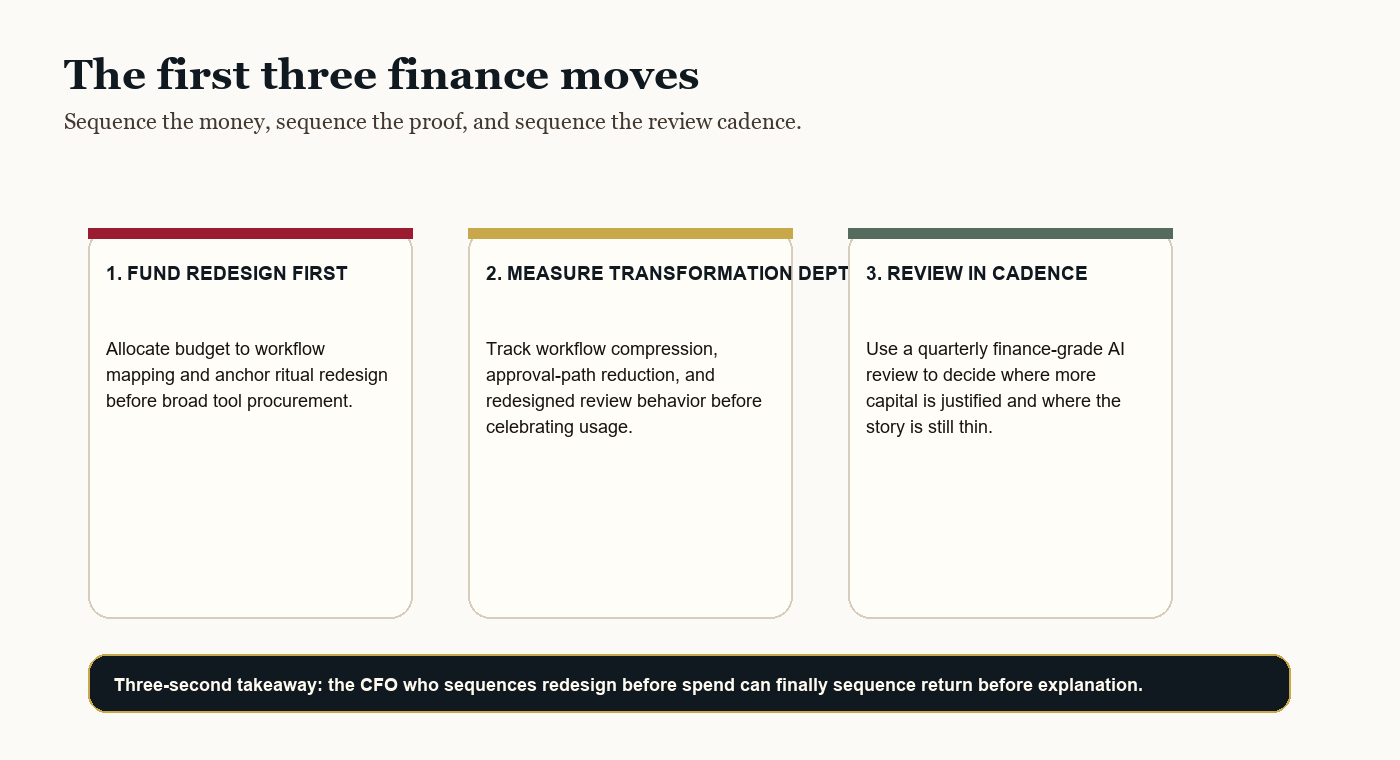
The first move is to restructure the AI budget so workflow mapping and anchor ritual redesign are funded before broad tool procurement. That is not anti-technology. It is how technology becomes economically legible. If Stanford is right that redesign-first organizations achieve materially deeper transformation, then the redesign budget is not overhead. It is the multiplier on the technology investment.
The second move is to build a transformation-depth scorecard into the reporting architecture. Management should report workflow compression, approval-cycle reduction, decision-quality evidence, manager adoption of new rituals, and the degree to which recurring operating reviews now rely on AI-shaped intelligence. The CFO should still care about usage, but only as a secondary indicator. The primary question is whether the institution now works differently in a way that compounds.
The third move is to make the quarterly AI review a finance-quality discipline rather than a theater event. Require management to show which workflows entered redesign, which ones reached new steady state, where resistance remains, and what the next release of capital depends on. The architecture for that discipline is developed in the Executive Leadership Playbook: AI-First Culture, then translated into board, CFO, COO, CHRO, CRO, and CTO lenses through the white paper series.
The organization that builds this financial governance architecture before the failed pilot, credibility gap, or board challenge arrives has built something its next leadership generation will benefit from. That is what governance architecture looks like when it is not built in response to a loss.
If your AI reporting still sounds more certain than your workflow evidence, start with the AI-First Culture white papers. They make it easier to see whether the real problem sits in board oversight, finance architecture, operating cadence, or manager behavior before the next dollar is spent defending the wrong story.
Sources
# Sources (primary-first within source base)

Internal source base
- Touch Stone Publishers, *Executive Leadership Playbook: AI-First Culture*, May 2026.
- Touch Stone Publishers, *AI-First Culture: The CFO's ROI Architecture Problem*, May 2026.
- Touch Stone Publishers, *AI-First Culture: The Fiduciary Governance Imperative*, May 2026.
- Touch Stone Publishers, *Research Brief: AI-First Culture*, May 10, 2026.

Institutional and cited research embedded in the source base
- Stanford Digital Economy Lab, enterprise AI deployment findings cited in the AI-First Culture playbook.
- MIT NANDA, *The GenAI Divide*, July 2025, cited in the AI-First Culture playbook.
- BCG 2026 research on AI value concentration in core business workflows, cited in the CFO white paper.
- Microsoft documentation and Work Trend Index 2026 findings cited in the AI-First Culture source base.
- BOQ Group case evidence cited in the CFO white paper and AI-First Culture playbook.

Touch Stone analytical frames applied in this article
- The Governance Boundary Principle.
- The Accountability Contract Model.
- The Legacy Test.
The white paper series separates board oversight, finance architecture, operating cadence, and manager behavior so leaders can see why AI spend is not yet compounding and what has to change first.