The Organization That Calls Culture a Training Issue Has Already Missed the AI Shift.
AI-first culture is not built by persuading people to use better tools. It is built by redesigning the recurring rituals that decide what work counts, who has authority, and what proof the organization trusts.
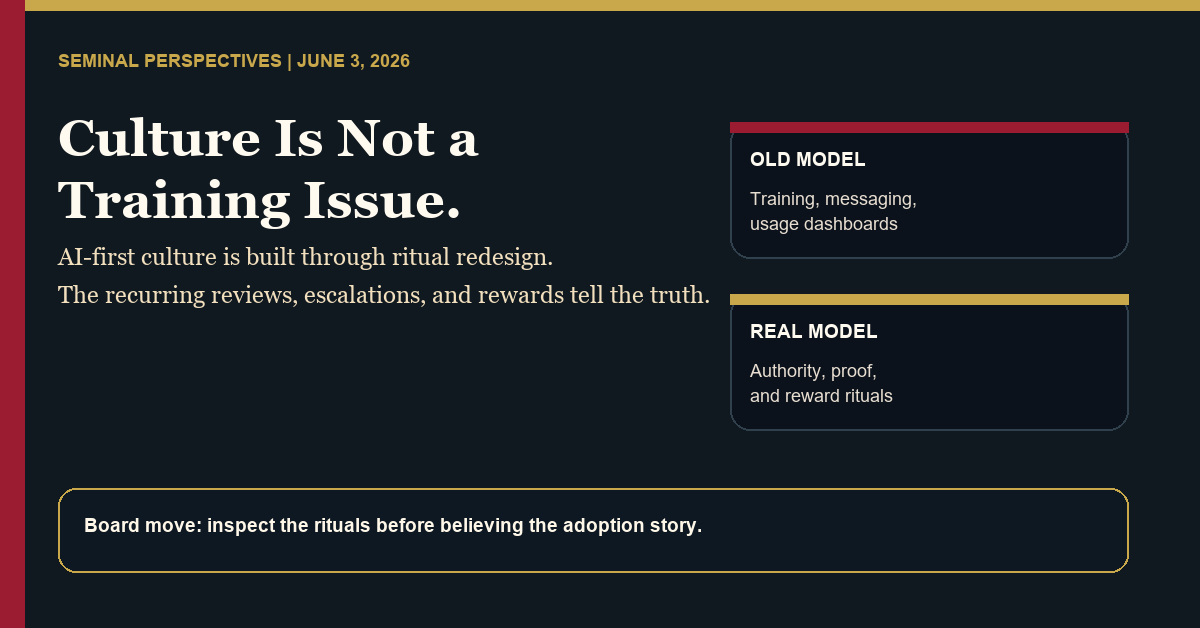
Most organizations still talk about culture as if it were a communication problem.
They launch values language. They hold training sessions. They explain the promise of AI. Then they wait for behavior to change.
It almost never does, because culture is not what the organization says about work. Culture is what the organization repeatedly rewards, reviews, escalates, and protects.
That is why AI-first culture is not a messaging exercise. It is a ritual redesign exercise.
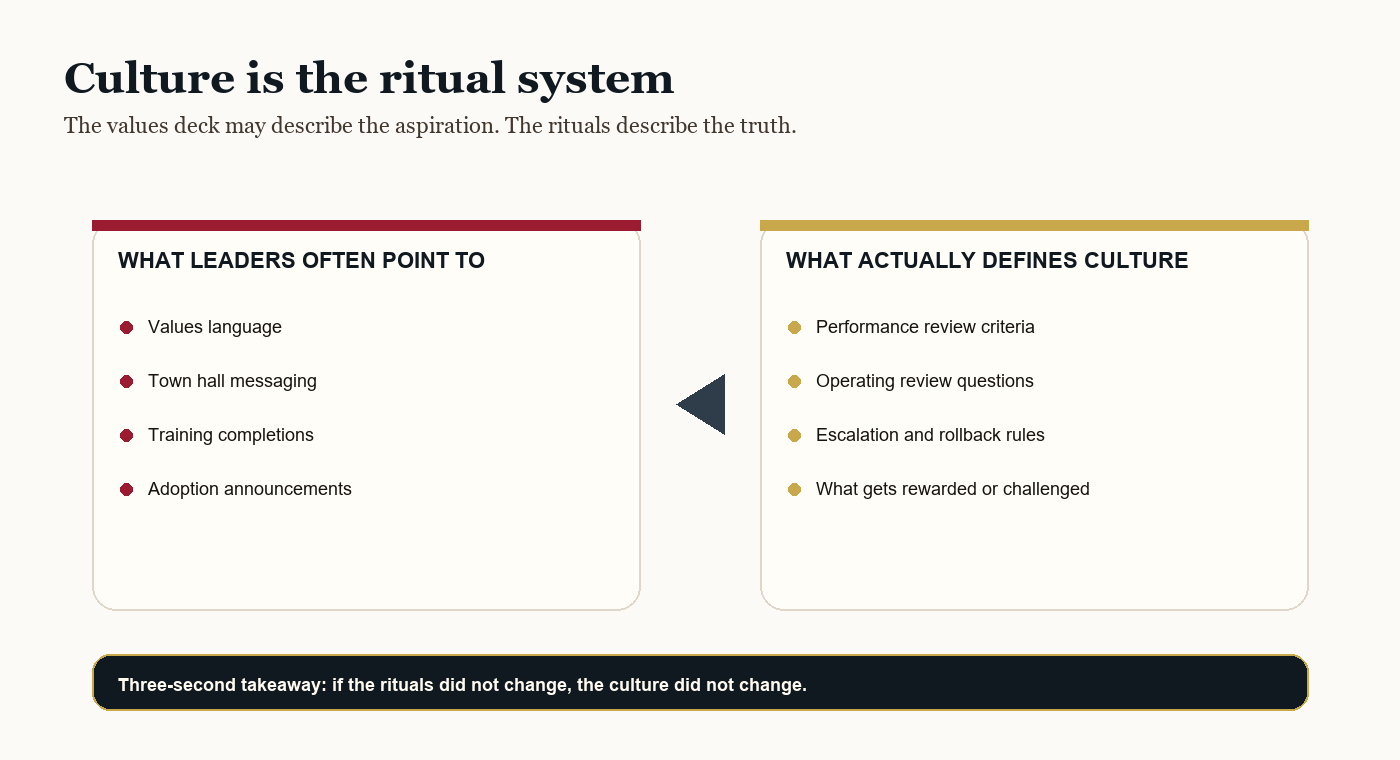
Culture Lives in the Rituals, Not the Deck
The AI-First Culture playbook makes the core finding explicit: AI transformation fails when organizations deploy new tools into old behavioral structures. The technology changes. The operating rituals do not. Performance reviews still reward the same heroics. Weekly operating meetings still ask the same questions. Escalations still travel through the same vague channels. The organization talks about an AI future while governing people through a pre-AI past.
That is why so many AI programs produce visible usage and invisible transformation. The wrong thing gets measured because the old ritual remains in place. The wrong behavior gets praised because the old review language survives. The wrong decisions keep rising because the approval structure still reflects the world that existed before delegated cognition compressed the cycle from draft to action.
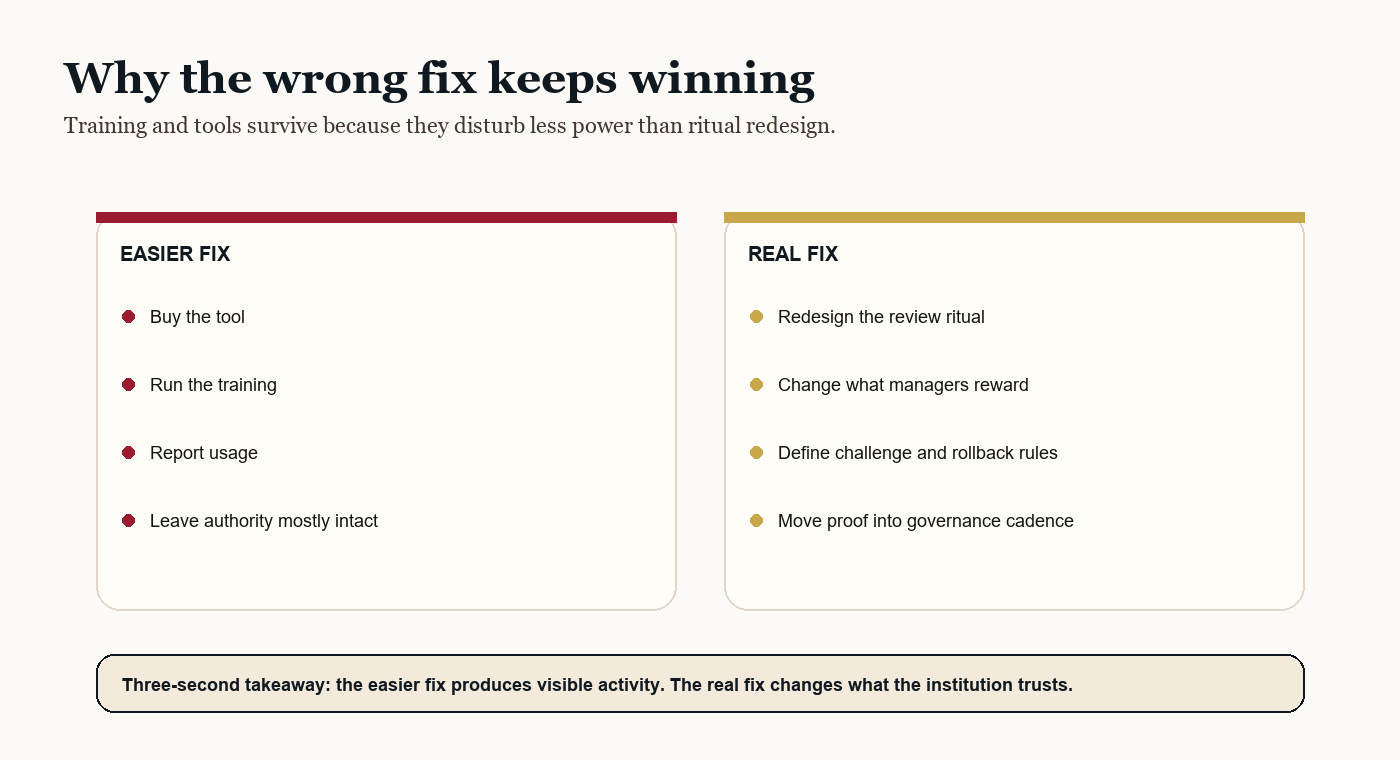
Why Intelligent Leaders Still Choose the Wrong Fix
This is the mechanism layer that most AI commentary skips. Leaders do not choose training and tool deployment first because they are unserious. They choose it because it is the least politically expensive move available inside an unchanged institution.
Tool procurement looks modern without forcing a board to ask what oversight cadence is now required. Training looks responsible without forcing a CHRO to redesign the performance review ritual. Usage dashboards look measurable without forcing a CFO to ask whether the investment changed a workflow or only increased activity. A values campaign looks unifying without forcing the executive team to make authority, proof, and rollback rules painfully explicit.
Ritual redesign is harder because it touches the places where institutional truth is actually produced. It changes what managers ask in one-on-ones. It changes what shows up in operating reviews. It changes what the board receives as proof. It changes who can approve, challenge, or reverse AI-shaped work. In other words, it changes power. That is why smart people keep reaching for the easier fix. The easier fix leaves the old power map mostly intact.
The result is predictable. AI becomes an accessory to the old operating model instead of a force that rewrites it. The organization gains output but not coherence. It gains speed but not trust. It gains dashboards but not evidence.
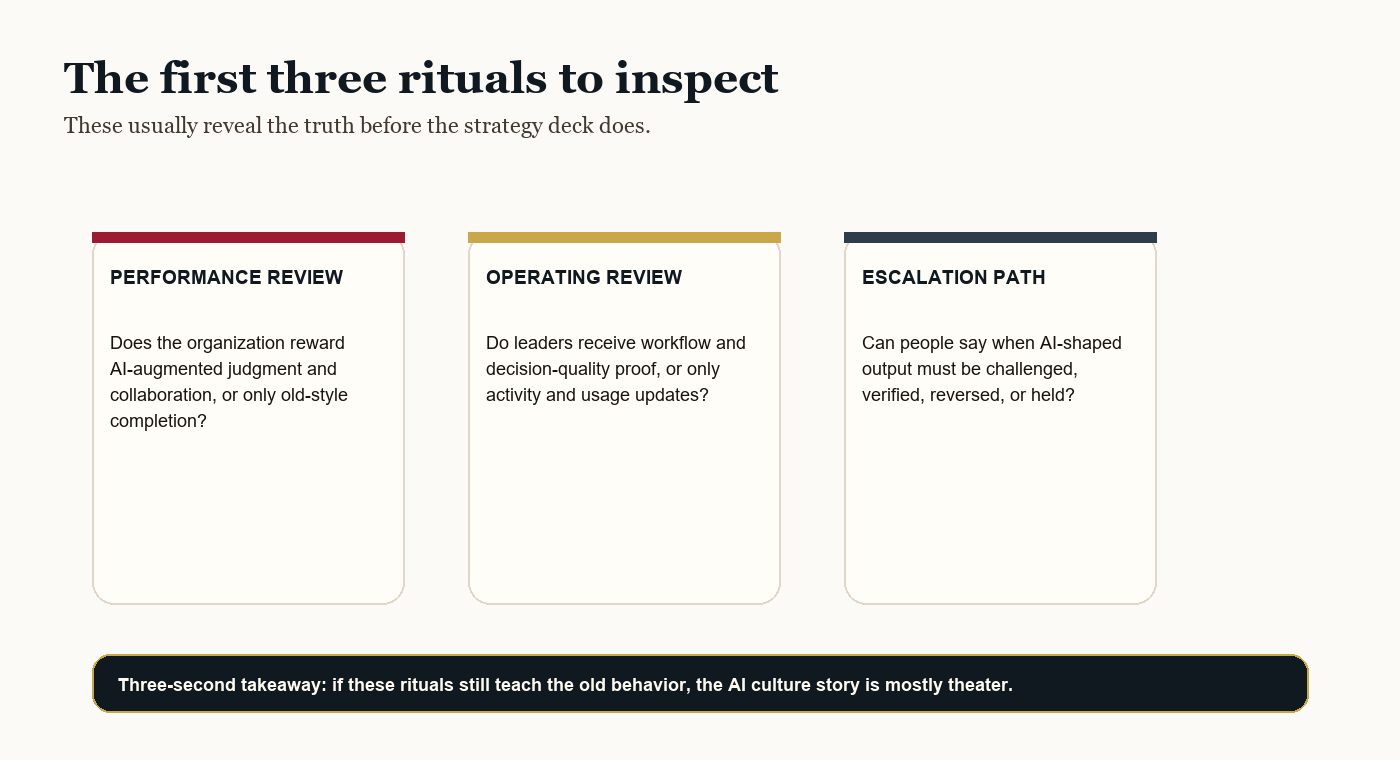
The First Rituals That Tell You Whether the Change Is Real
In most organizations, the fastest way to tell whether AI-first culture is real is to inspect three recurring rituals.
Start with the performance review. If the organization still rewards individual completion more than AI-augmented judgment, learning, and collaboration, then the culture remains pointed backward. Move next to the operating review. If leaders still receive activity updates rather than decision-quality evidence, the organization is measuring motion instead of transformation. Then inspect the escalation path. If people cannot say clearly when AI-shaped output must be challenged, verified, or reversed, trust has not been designed. It has been outsourced to hope.
This is where the AI-First Culture white papers become commercially useful. The board paper makes the governance ritual requirement explicit. The CFO paper reframes ROI as a deployment-sequence problem rather than a reporting problem. The CHRO paper names the manager layer and the performance review ritual as the actual transmission mechanism of culture. Together they point to the same conclusion: AI-first culture is not a belief system waiting to be announced. It is an operating system waiting to be redesigned.
That is also why the Legacy Test matters here. The organization that redesigns these rituals before the pressure event arrives builds something its successors can inherit as institutional strength. The organization that waits until a failed deployment, a disclosure problem, or an executive credibility gap forces the redesign is not building culture. It is paying for delay.
The leaders who understand this will stop asking whether their people believe in AI. They will ask a more serious question: which recurring rituals still teach the organization to work as if AI has changed nothing? That is where the real transformation begins.
The white papers translate the argument into board governance, ROI architecture, and manager-level culture design so executives can identify where their AI program is still running on the old operating system.