AI Disclosures Are Governance Claims
Treat AI oversight as a disclosure control: charter the lane, standardize the packet, and review claims against real governance artifacts.
Every AI sentence in a 10-K is now a governance claim.
Not because a new rule exists, but because the market has moved: AI is being disclosed as a material risk at scale, and regulators are explicitly asking for oversight mechanisms.
If the board cannot describe a repeatable AI oversight ritual, disclosure becomes a liability surface.
The disclosure baseline moved. The governance baseline has not
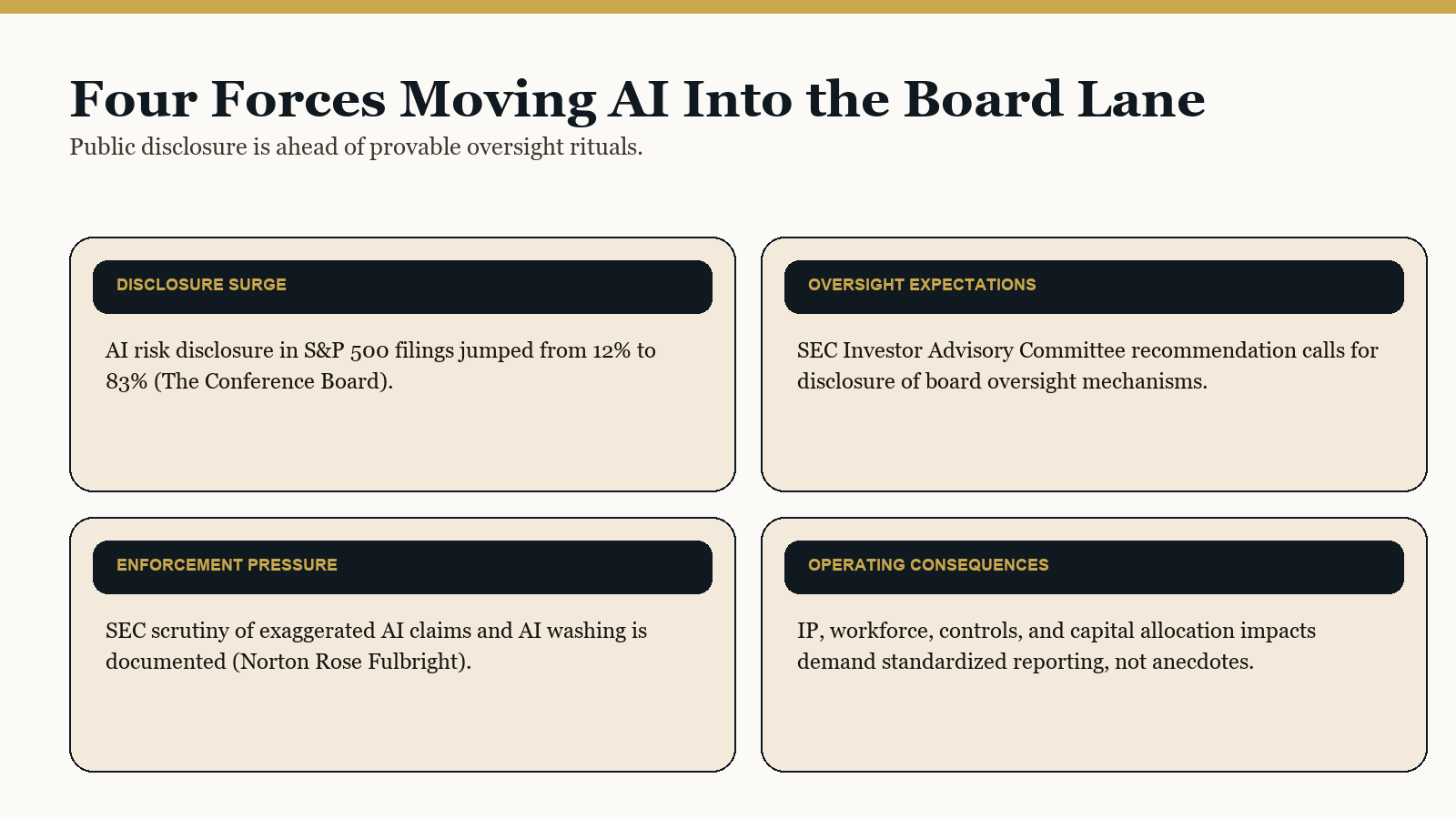
The Conference Board’s benchmarking shows the speed of the shift: AI risk disclosure in S&P 500 filings jumped from a low baseline to the vast majority in two reporting cycles. Board AI “expertise” disclosure is rising too, but from a low base.
The more important point: disclosure is public and timestamped. A board that discloses AI risk is implicitly stating that oversight exists. Investors and regulators will eventually ask what the oversight ritual is.
In December 2025, the SEC’s Investor Advisory Committee recommendation made the direction explicit: disclose board oversight mechanisms, if any, for AI deployments. Even without a new rule, enforcement attention on exaggerated AI claims and “AI washing” is already documented.
Treat AI oversight as a disclosure control
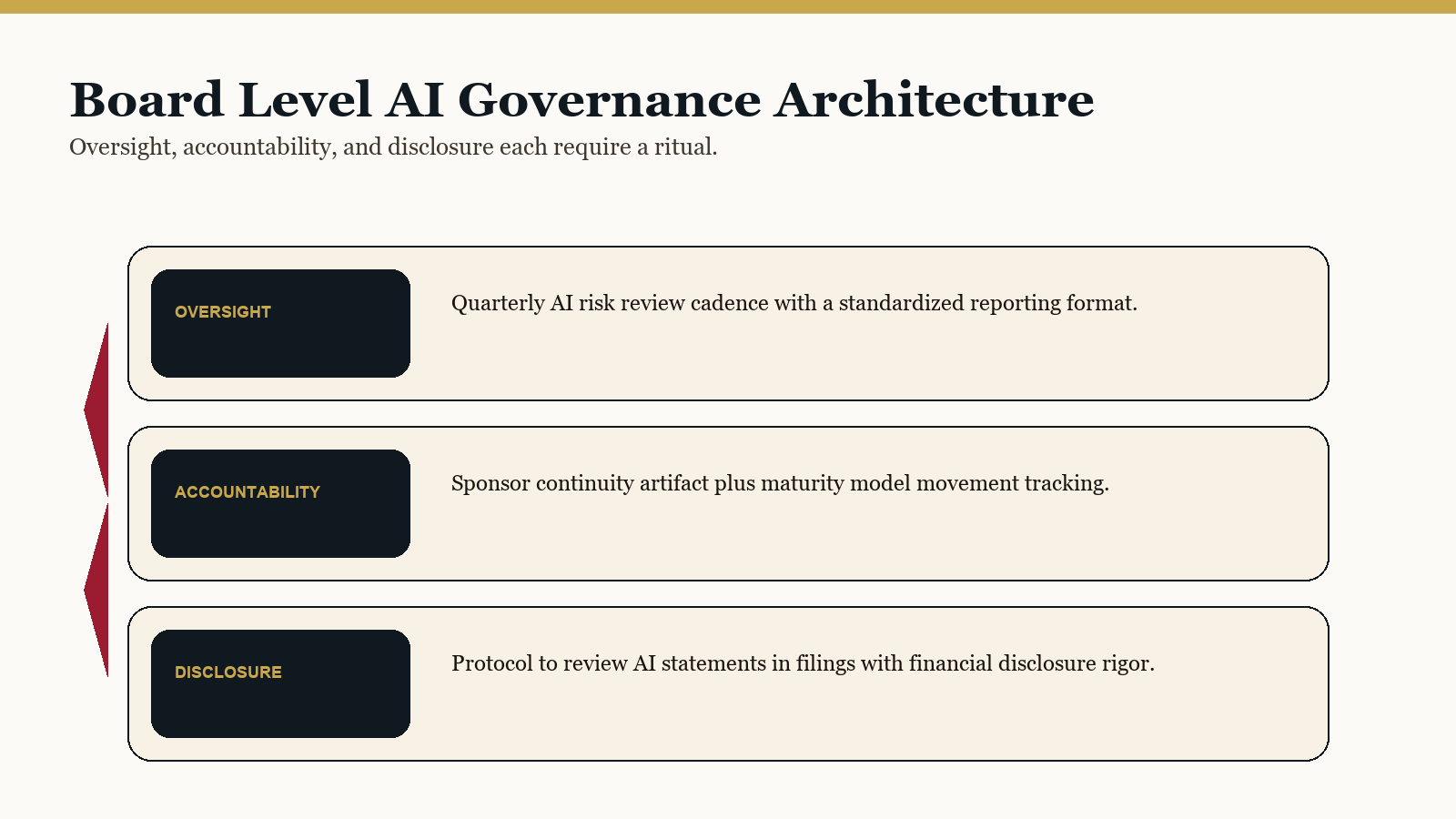
The board does not “govern AI.” It governs operating consequences: controls, workforce effects, IP exposure, regulatory posture, and capital allocation.
That requires three layers of ritual:
Oversight: a quarterly AI risk review cadence with a standardized reporting format. Not anecdotes. Not a vendor update. A repeatable board packet.
Accountability: a documented sponsor commitment plus a maturity model that measures transformation depth, not tool usage.
Disclosure: a protocol that treats AI statements in public filings with the same rigor as financial disclosures. If the institution says “we oversee,” the board needs the artifact that proves it.
The exposure stack is MECE. One missing ritual creates multiple risks
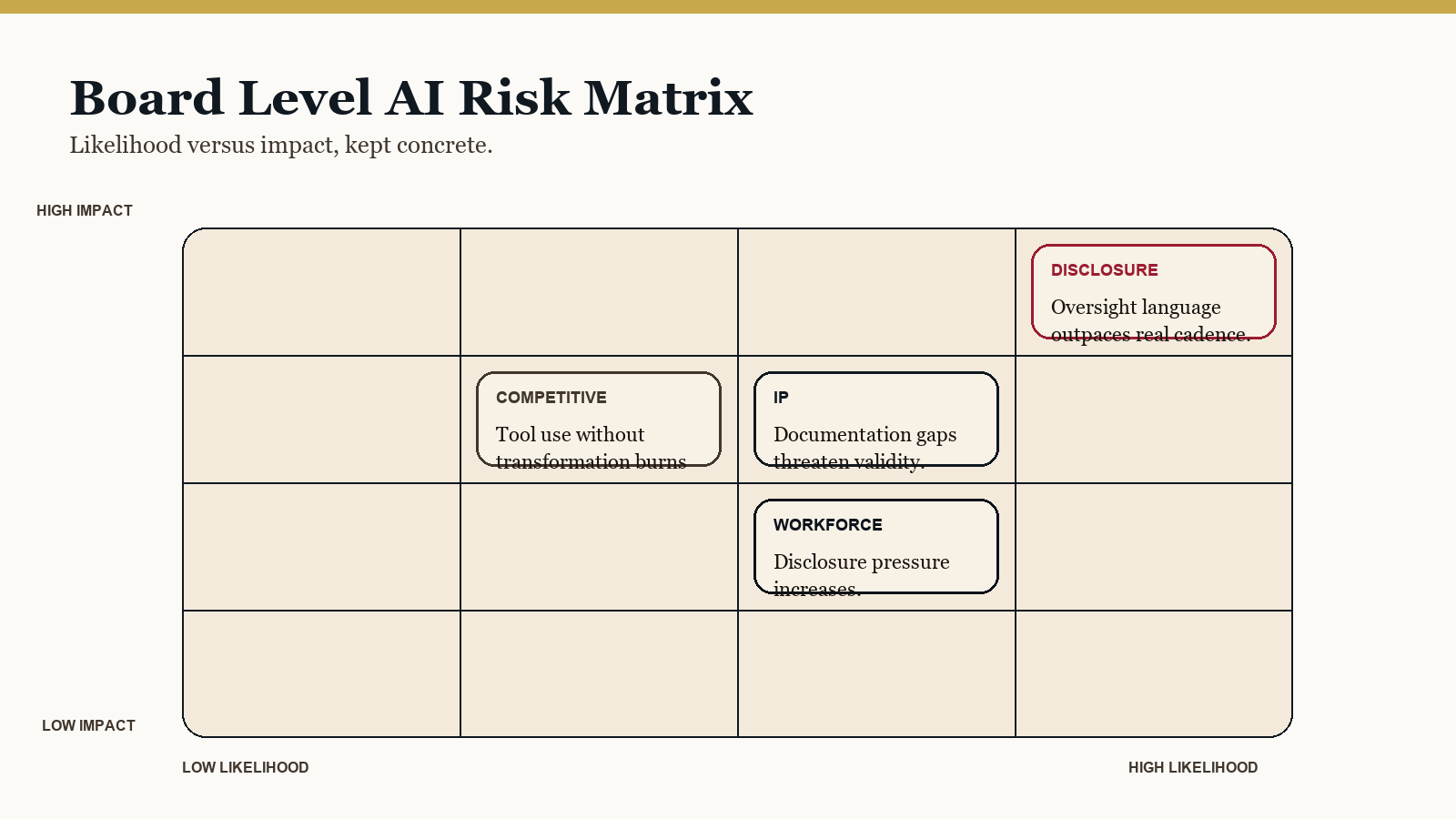
Disclosure risk: AI oversight language that outpaces actual cadence creates securities-law and credibility exposure.
IP risk: the USPTO’s revised inventorship guidance for AI-assisted inventions elevates documentation discipline. Weak conception documentation becomes downstream validity risk.
Workforce risk: legislation is moving toward more explicit measurement and disclosure expectations around AI’s role in workforce decisions.
Competitive risk: without a maturity model and outcome metrics, boards cannot distinguish tool adoption from operating transformation. That is how capital burns while the organization stays the same.
The 30-day board play
1) Charter the oversight lane. Create an AI Committee charter or a formal mandate inside an existing committee. Define what is reviewed, on what cadence, in what format, and who owns the reporting.
2) Standardize the quarterly packet. Require a single reporting format that covers controls, workforce effects, maturity movement, and material risks. If the packet cannot be repeated quarter after quarter, it is not a ritual.
3) Install a disclosure review protocol. Every AI-related claim in public filings should be checked against the governance artifacts that make it true.
Sources
The Conference Board press summary: Disclosure of AI Risks Surges (2026).
SEC Investor Advisory Committee AI disclosure recommendation PDF (draft for Dec. 4, 2025 meeting): SEC IAC recommendation.
Norton Rose Fulbright note: SEC heightens enforcement for AI related disclosures.
USPTO bulletin: Revised inventorship guidance for AI-assisted inventions.
Congress bill text PDF: S.3339, AI Workforce PREPARE Act.
If your organization is disclosing AI risk, the board needs the governance cadence that makes those disclosures defensible. The AI First Culture white papers include board-level governance structures, reporting architecture, and maturity model guidance.