Bank Supervision Just Moved Model Risk. AI Agents Moved The Boundary.
Treat agentic workflows like models: maintain a decision inventory, validate the highest-consequence use cases, monitor drift and outcomes, and make governance inspectable through a repeatable oversight ritual and artifacts.
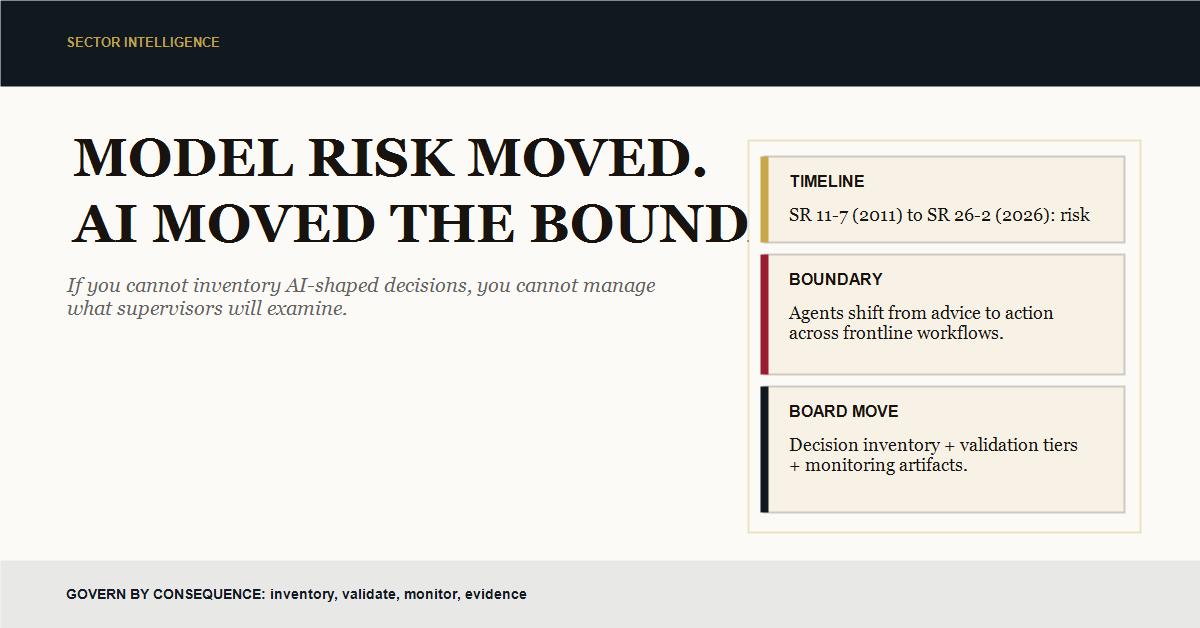
Sector Intelligence for Monday, May 18, 2026. Banking supervision just modernized model risk guidance. At the same time, agentic AI moved the practical boundary of what counts as a model. If you cannot inventory where AI shapes decisions, you cannot manage the risk the new guidance is talking about.
SR 26-2 turns model risk into an enterprise governance test
SR 26-2 is not an AI memo. It is a model risk memo. But in a bank, model risk is where AI becomes real. It is the supervisor’s language for decision automation: what can go wrong, who owns it, how it is validated, and what evidence proves you control it.
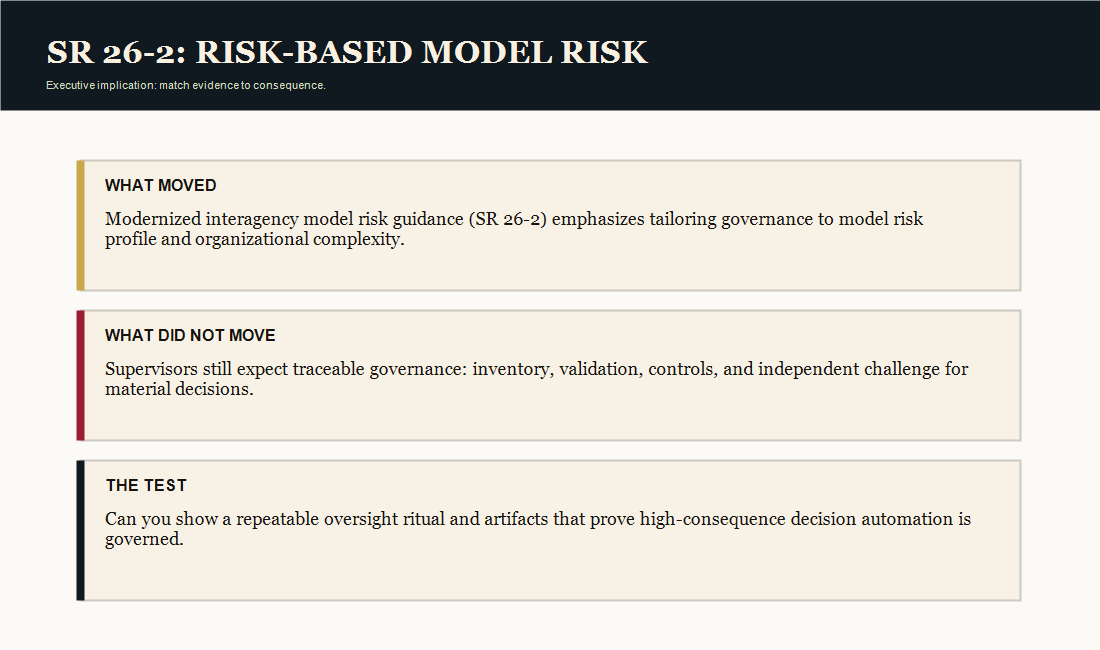
The executive implication is straightforward. A risk-based approach does not mean you do less. It means you can prove you know which decisions matter most, and you govern them with artifacts that match the consequence.
AI agents moved the boundary from models to operating decisions
In many banks, “AI” is already embedded in high-frequency workflows: customer service, underwriting assist, collections triage, fraud detection, compliance monitoring, marketing personalization, and analyst work. Agentic patterns push the boundary further. The system does not only recommend. It drafts, routes, escalates, and sometimes initiates action.
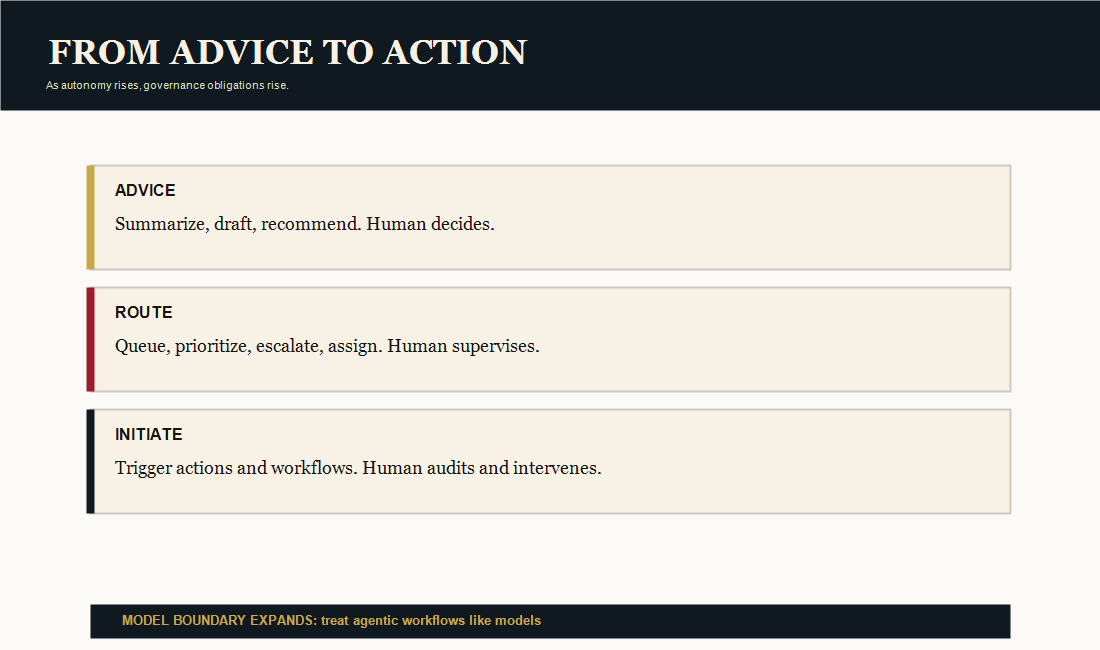
This is why “model risk management” becomes the natural home for AI governance in financial services. When a system shapes a decision, it inherits the governance burden of that decision. The organization needs a decision inventory, not an AI tool list.
A 90 day ritual upgrade that makes governance inspectable
The fastest path is not an AI policy PDF. It is a repeatable oversight ritual that produces artifacts. If governance is real, it is inspectable. In regulated sectors, that means you can answer three questions on demand: what decisions are affected, what controls protect them, and what monitoring proves the controls still hold.
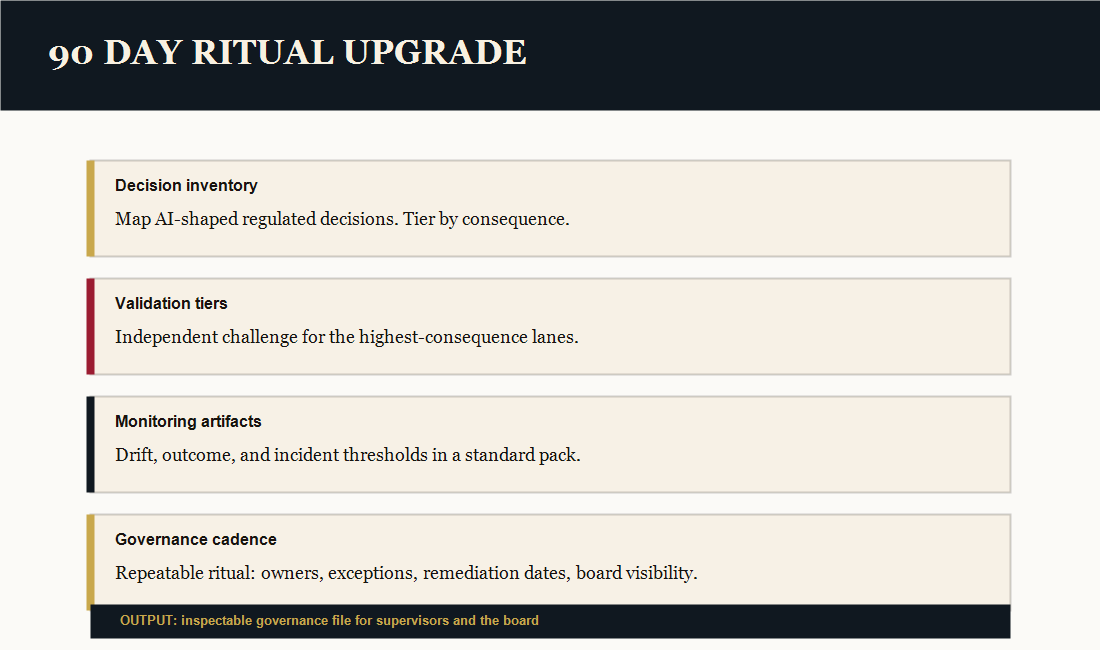
- Decision inventory: map where AI influences customer outcomes, credit outcomes, compliance outcomes, and material financial reporting inputs. Categorize by consequence.
- Validation tiers: reserve the strongest validation and independent challenge for the highest-consequence decisions. Require documentation that a supervisor would recognize as serious.
- Monitoring artifacts: define drift signals, outcome signals, and incident thresholds. Build a recurring reporting pack with a single standard format.
- Governance cadence: install an executive rhythm that produces evidence: owners, exceptions, remediation dates, and board visibility for the material lanes.
If you want a fast way to locate the highest-priority governance gap, start with the AI-First Culture diagnostic. If you want the board-grade architecture, download the Board Brief and use it as the packet for your next oversight conversation.
Sources
# Sources (primary first)

## Banking supervision and model risk

- Federal Reserve: Supervisory Letter SR 26-2 (April 17, 2026), Revised Guidance on Model Risk Management. https://www.federalreserve.gov/supervisionreg/srletters/SR2602.htm
- Federal Reserve: SR 11-7 Attachment (April 4, 2011), Supervisory Guidance on Model Risk Management (PDF). https://www.federalreserve.gov/bankinforeg/srletters/sr1107a1.pdf

## Risk management baseline

- NIST: Artificial Intelligence Risk Management Framework (AI RMF 1.0) (PDF). https://nvlpubs.nist.gov/nistpubs/ai/nist.ai.100-1.pdf

## Disclosure signal (cross-sector)

- SEC: Investor Advisory Committee Recommendation on Disclosure of Artificial Intelligenceâ?Ts Impact on Operations (approved December 4, 2025) (PDF). https://www.sec.gov/files/approved-artificial-intelligence-disclosure-recommendation-120425.pdf

## Touch Stone source base

- Touch Stone Publishers: AI-First Culture Executive Leadership Playbook (May 2026). `C:\\Users\\jedi4332\\OneDrive - Touch Stone Publishers Limited\\08 - Active Projects\\TSP_2026-019_ai-first-culture\\Playbook\\executive_playbook_ai-first-culture.docx`
If your organization is deploying AI into regulated decisions, governance has to become inspectable. Start with the Board Brief, then use the diagnostic to locate the highest-priority control and accountability gap.