
Signal Date: February 1, 2026, Sector: Semiconductors (Cross-Industry Impact), Confidence Level: 90%, High Certainty
The Lead: What Boards Need to Know Now
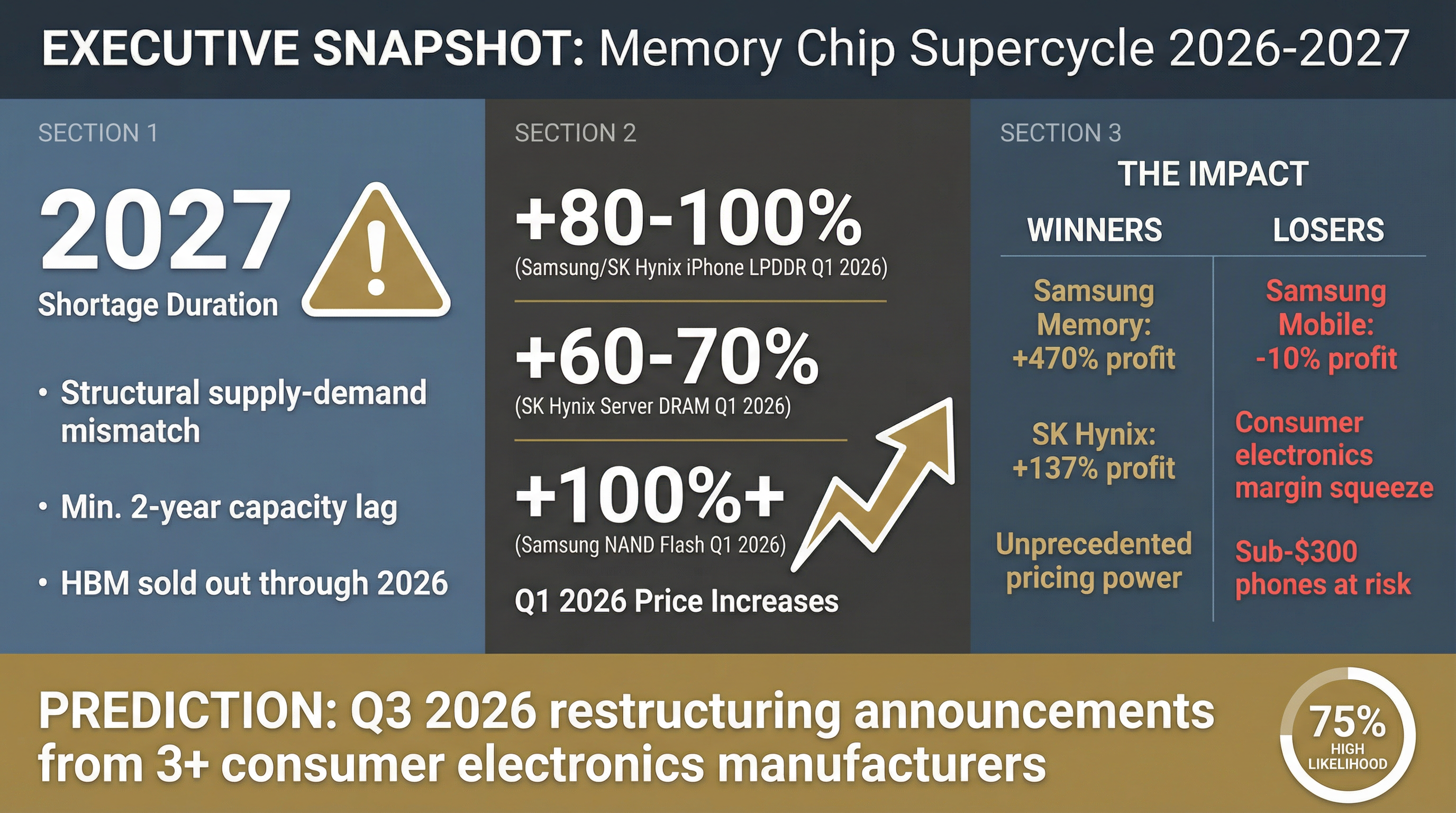
The global memory chip shortage will persist through 2027, driving price increases of 60-100% in Q1 2026 alone and creating a historic bifurcation in corporate profitability: memory chipmakers are experiencing unprecedented pricing power and record margins, while every downstream industry—from smartphones to data centers to automotive—faces immediate margin compression that will force strategic recalibration of product pricing, supply chain partnerships, and capital allocation decisions.1
The Three Pillars
Pillar One: The Supply-Demand Chasm Is Structural, Not Cyclical
The current memory chip shortage represents a fundamental departure from historical semiconductor cycles. Samsung Electronics, the world's largest memory chipmaker, reported Q4 2025 operating profit of 20.1 trillion won ($13.98 billion)—more than triple the prior year—with its memory business alone generating 16.4 trillion won and comprising over 80% of total company profit.2 This is not a temporary supply disruption; it is a structural mismatch driven by the AI infrastructure boom consuming memory capacity faster than manufacturers can expand production.
Sassine Ghazi, CEO of Synopsys—a critical semiconductor design tool company whose customers include every major chipmaker—stated unequivocally that the chip "crunch" will continue through 2026 and 2027, with a minimum two-year lead time before new manufacturing capacity comes online.3 Samsung's memory division executive Kim Jaejune reinforced this timeline, forecasting that "a significant shortage of memory products across the board is expected to continue for the time being," with limited supply expansion possible in 2026-2027 while AI-related demand remains strong.2
The mathematics are unforgiving. High-bandwidth memory (HBM)—the specialized chips required for AI data center servers—is sold out through all of 2026 at both Samsung and SK Hynix.24 SK Hynix reported that its HBM revenue more than doubled in 2025, yet demand continues to outpace supply far.4 This has created a cascading shortage: as memory manufacturers divert production capacity toward high-margin HBM for AI applications, conventional DRAM and NAND supplies for consumer electronics, PCs, and electric vehicles are being "starved," in Ghazi's words.3
While memory manufacturers are accelerating fab construction—SK Hynix has moved the completion of its Yongin facility to May 2027, three months ahead of schedule—these investments will not materially impact supply until 2028. Micron's $24 billion Singapore NAND expansion won't begin production until H2 2028, and even SK Hynix's accelerated Yongin fab will require 12-18 months of production ramp after completion before reaching meaningful output volumes.56
Pillar Two: Price Acceleration Is Unprecedented and Accelerating
The price increases now hitting the semiconductor industry represent the most aggressive repricing event in modern memory market history. Samsung and SK Hynix have completed negotiations with Apple to raise Q1 2026 pricing for iPhone low-power DRAM (LPDDR) by 80-100%—Samsung's increase exceeds 80%, while SK Hynix's approaches a full doubling.7 Samsung has raised NAND flash supply prices by more than 100% for Q1 2026, following a 70% increase in DRAM prices already implemented.7 SK Hynix plans to increase server DRAM prices by 60-70% in Q1 2026 compared to Q4 2025.7
These are not isolated actions by individual companies. The entire semiconductor value chain is experiencing synchronized price increases:
Foundry Services: Taiwan Semiconductor Manufacturing Company (TSMC) announced its fourth consecutive year of price increases, with advanced process nodes (7nm and below) rising 3-10% in 2026.7 China's SMIC and Taiwan's Vanguard International Semiconductor both raised 8-inch BCD process platform prices by 10% in December 2025.7
Packaging and Testing: ASE Technology, the world's largest semiconductor packaging company, is implementing price increases of 5-20% for backend wafer packaging and testing services in 2026.7 Memory-focused packaging specialists are raising prices by 30%, with capacity utilization approaching full capacity and order backlogs extending continuously.7
Passive Components: The price surge has cascaded to passive components, with Resonac (Japan) raising copper-clad laminate and bonding film prices by 30% effective March 1, 2026, driven by copper foil and glass cloth supply constraints.7 Chinese component maker Fenghua High-Tech raised prices 5-30% across magnetic beads, varistors, ceramic capacitors, and thick film circuits due to silver, tin, copper, bismuth, and cobalt price surges.78
Counterpoint Research forecasts memory prices will increase 50% in Q1 2026 alone, characterizing 2026 as a "Golden Era" for memory manufacturers.9 Heungkuk Securities analyst Sohn In-joon projects Samsung's Q1 2026 profit will surge fivefold year-over-year to approximately 35 trillion won, driven primarily by accelerating memory price increases.2
Pillar Three: The Winners and Losers Are Already Determined
The memory shortage is creating a zero-sum redistribution of value across the technology ecosystem. Memory chipmakers have achieved what Tobey Gonnerman, president of semiconductor distributor Fusion Worldwide, describes as an "enviable position of being able to dictate price, terms, etc more than ever" because "there is ample robust demand, and they can't possibly fill it all."2
The Winners: SK Hynix posted record Q4 2025 revenue of 32.827 trillion won ($23 billion), up 66% year-over-year, with operating profit surging 137% to 19.17 trillion won—beating analyst estimates by 8%.4 For full-year 2025, SK Hynix achieved record revenue of 97.147 trillion won (up nearly 50%) and operating profit of 47.206 trillion won (more than doubled).4 The company announced additional dividends of 1 trillion won and treasury share cancellations worth 12.24 trillion won to return value to shareholders.4 SemiAnalysis analyst Ray Wang characterizes SK Hynix as "one of the biggest AI winners in Asia, driven by its leadership in HBM and strong overall memory competitiveness."4
The Losers: Samsung's Mobile Experience division—despite being part of the world's largest technology conglomerate—saw operating profit decline 10% in Q4 2025 to 1.9 trillion won, squeezed by surging chip prices from its own memory division.2 Samsung co-CEO TM Roh described the chip shortage as "unprecedented" and did not rule out raising smartphone prices to offset memory costs.2 The company's mobile and display divisions warned of a "challenging year" as they face cost pressures from memory price hikes, with customers simultaneously pushing for price cuts.2
Lenovo CFO Winston Cheng stated the company is "very confident that the cycle would be such that we could pass on the cost" of memory price increases to consumers, noting that price increases will "start hitting the lower end" of the electronics market first.3 Xiaomi, one of the world's largest smartphone manufacturers, announced expectations for mobile phone price increases in 2026.3 Apple warned that rising memory chip prices have started to pressure profitability in the current quarter.10
The strategic implication is clear: companies with pricing power and premium brand positioning can pass costs through to consumers; companies competing in price-sensitive segments will face margin compression or market share loss.
The Proprietary Prediction
Forecast: By Q3 2026, at least three consumer electronics manufacturers with annual revenue exceeding $5 billion will announce one or more of the following actions: (1) discontinuation of product lines in sub-$300 smartphone or sub-$500 laptop categories, (2) facility closures or production capacity reductions of 20%+ in memory-intensive product segments, or (3) strategic exits from price-sensitive geographic markets (e.g., India, Southeast Asia, Latin America). This is driven by a 400-800 basis-point margin compression, making these products unprofitable at current specifications and pricing.
Convergence:
•
Memory prices rising 60-100% in Q1 2026 [Samsung, SK Hynix earnings data]
•
Lower-end electronics "hurting" and will be "hit first" by price increases [Lenovo CFO statement]
•
Consumer device segment already experiencing "price demand" pressure [Lenovo CFO]
•
Minimum 2-year lag before capacity relief [Synopsys CEO]
Probability Score: 70% High Likelihood
The Alpha Hedge: The primary variable that could invalidate this prediction is an unexpected collapse in AI infrastructure spending in H2 2026, which would rapidly free up memory capacity for consumer applications and trigger price normalization. However, current AI capital expenditure commitments from hyperscalers (Microsoft, Google, Amazon, Meta) extend through 2027, making this scenario unlikely. A second variable is demand destruction: if 60-100% increases in memory prices translate into 15-30% increases in consumer electronics prices, price-sensitive consumers may delay purchases or shift to used/refurbished devices. While this could ease supply constraints, historical data from the 2017-2018 memory shortage (when DRAM prices rose 47%) show that demand destruction was limited to <15% in budget segments, which is insufficient to ease shortages materially.
The C-Suite Impact:
•
Consumer Electronics CEOs: Immediate strategic choice required—raise prices and risk volume loss, or maintain prices and accept margin compression of 300-500 basis points.
•
Supply Chain Officers: Memory procurement has become a strategic capability; companies with long-term supply agreements locked in 2024-2025 pricing have an 18-24-month competitive advantage.
•
CFOs: Working capital requirements for memory inventory will increase 60-100%; companies must secure additional credit facilities or reduce inventory turns.
•
Product Leaders: Specifications for 2026-2027 product roadmaps must be redesigned to account for memory constraints—either by reducing RAM configurations or by shifting to older, more widely available memory technologies.
The Complementary Analysis
McKinsey & Company published "Hiding in plain sight: The underestimated size of the semiconductor industry" on January 15, 2026—two weeks before Samsung and SK Hynix released Q4 2025 earnings that would reveal the full extent of the supply crisis. Their analysis projected the semiconductor market will reach $1.6 trillion by 2030 (45-60% higher than consensus estimates), driven by AI and data centers, with "most growth" relating to "leading-edge chips and high-bandwidth memory."11
What Has Emerged Since: In the two weeks following McKinsey's publication, primary source earnings releases and industry announcements have revealed a supply-side crisis that creates a critical complementary layer to McKinsey's demand-focused forecast. While McKinsey's analysis highlights the long-term growth trajectory, the immediate, actionable intelligence for boards lies in the supply chain dynamics that will dictate profitability and market share in 2026-2027.
The Strategic Gap: McKinsey tells boards, "the semiconductor market will reach $1.6 trillion by 2030." The actionable intelligence is: "Memory suppliers will capture disproportionate value in 2026-2027 due to structural supply constraints, while device manufacturing margins face immediate compression." One is a long-term growth story; the other is a strategic warning for Q1 2026 decision-making.
Data Anchors
Call to Action
As memory chipmakers dictate terms with unprecedented pricing power while downstream industries face margin compression that will reshape product portfolios and competitive positioning, the strategic question for every board is not whether to respond, but whether they have already secured the supply relationships and pricing strategies that will determine who survives the next 18 months with profitability intact—or will your company be among those announcing restructuring programs by Q3 2026?
Footnotes
1.
This analysis primarily reflects global and Western market dynamics. China's domestic market may exhibit distinct supply-and-demand dynamics, driven by domestic memory manufacturers (YMTC for NAND, CXMT for DRAM) and potential preferential allocation to domestic customers. However, these manufacturers account for <10% of global capacity and face technology gaps at advanced nodes and in HBM. ↩
2.
Samsung Electronics Q4 2025 Earnings Report, January 29, 2026. Official Release | Reuters Coverage ↩ ↩2 ↩3 ↩4 ↩5 ↩6 ↩7 ↩8
3.
"Memory chip shortage to last through 2027: Synopsys CEO," CNBC, January 26, 2026. Article ↩ ↩2 ↩3 ↩4
4.
SK Hynix Q4 2025 Earnings Report, January 28, 2026. CNBC Coverage ↩ ↩2 ↩3 ↩4 ↩5 ↩6
5.
"Samsung and SK Hynix warn memory chip crunch to continue until 2027," Nikkei Asia, January 29, 2026. ↩
6.
"Micron to invest $24 billion in Singapore plant as AI boom strains global memory supply," CNBC, January 27, 2026. ↩
7.
"Semiconductor Industry 'Bombarded' by Price Hikes at the Start of 2026," 36kr, January 30, 2026. Article ↩ ↩2 ↩3 ↩4 ↩5 ↩6 ↩7 ↩8 ↩9
8.
Chinese company price increase data reported by 36kr; company financial performance verified through Shenzhen/Shanghai Stock Exchange filings, but specific price increase notices not independently confirmed by primary sources. ↩
9.
"Micron Stock Rises. Samsung Signals a 'Golden Era' for Memory Chips," Barron's, January 29, 2026. ↩
10.
"Apple warns memory costs are starting to bite as Samsung, SK Hynix warn squeezed chip supplies," Reuters, January 29, 2026. ↩
11.
"Hiding in plain sight: The underestimated size of the semiconductor industry," McKinsey & Company, January 15, 2026. Article ↩