

In digital-first leadership, active listening leverages neurobiological trust pathways, enhancing team dynamics. When you engage in active listening, it triggers oxytocin release, fostering emotional connection and trust. This neurochemical response influences stress modulation, emotional resilience, and trust-forming behaviors. Active listening further involves the auditory cortex and decision-making circuits, optimizing cognitive engagement and social perception. Learn how this cognitive engagement translates into improved leadership and cohesive team environments through the neuroscience of listening.
Key Takeaways
- Active listening enhances emotional connections by engaging neural pathways, facilitating trust in digital-first leadership.
- Oxytocin release during active listening strengthens trust biologically, crucial for virtual team dynamics.
- Digital leaders using active listening improve communication, engaging biological trust mechanisms through consistent, high-quality strategies.
- Emotional intelligence in digital leadership is vital for building authentic trust and effective collaboration.
- Positive virtual interactions during active listening stimulate oxytocin, reinforcing trust and enhancing team cohesion.
The Neurobiological Foundations of Active Listening

Understanding the neurobiological foundations of active listening reveals a complex interplay of neural activity that distinguishes it from passive hearing. Active listening triggers distinct neural encoding patterns, with at least ten types of neuronal response changes.
These changes extend beyond mere auditory reception, involving attentional modulation across multiple brain levels. Attentional modulation isn’t confined to higher auditory centers; it influences lower-level auditory nuclei, showcasing a significant top-down regulatory mechanism. Attention levels influenced the majority of neuronal responses, highlighting the intricate relationship between cognitive engagement and sound processing.
This modulation supports the shift from mere sound perception to meaningful auditory comprehension, vital for effective communication. The auditory cortex collaborates with decision-making circuits, optimizing sensory processing and contextual responses.
Ultimately, active listening’s neural dynamics facilitate a deeper, more intentional engagement with auditory stimuli.
Reward Activation and Emotional Appraisal in Listening
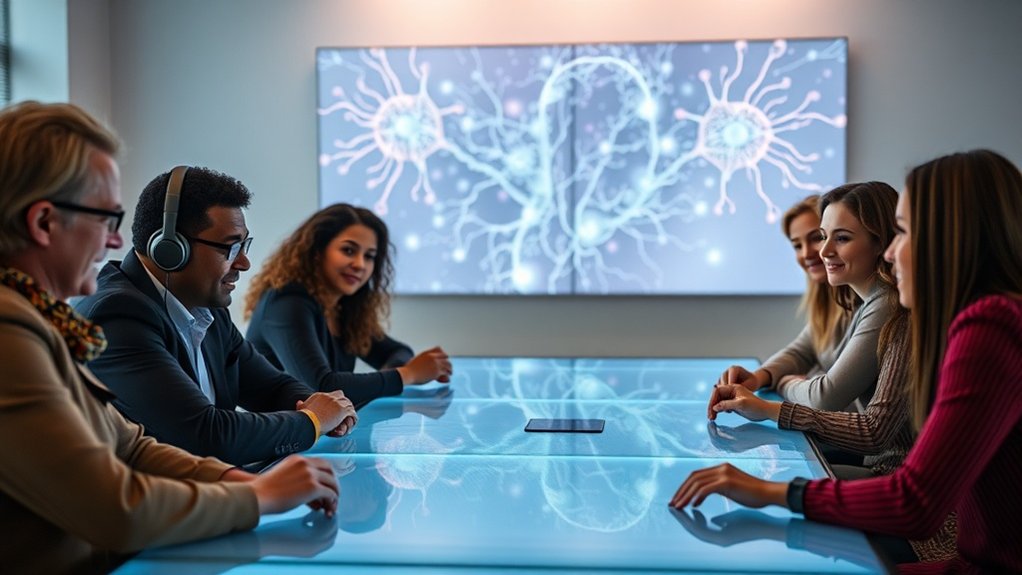
When you engage in active listening, your brain’s reward system, particularly the ventral striatum, activates, framing the experience as rewarding and fostering positive impression formation. This neural activation strengthens emotional connections by enhancing trust and openness, critical for effective leadership. The pleasure derived from this process is akin to the rewards of learning musical structure, as the brain processes expectation and surprise in both contexts, further solidifying the bond between listener and speaker.
Brain’s Reward System
As you engage in active listening, your brain’s reward system becomes markedly activated, particularly in the ventral striatum, signaling the processing of rewards. This activation is an indication of intricate brain chemistry where dopamine release plays a vital role. The reward processing not only enhances your emotional appraisal of experiences but also fosters a positive impression of those actively listening to you. Dopamine, a neurotransmitter involved in pleasure, motivation, and reinforcement of social behaviors, supports this process. Additionally, engaging fully with the speaker activates several areas of the brain, promoting empathy and understanding. It also facilitates the engagement of the prefrontal cortex, improving focus and cognitive control during communication. Neural activity shifts from passive hearing to active listening, reinforcing the perception of being valued and understood, which is essential for building trust in leadership.
Emotional Connection Boost
Active listening not only activates the brain’s reward system but also greatly boosts emotional connections through specific neural and physiological pathways. Emotional resonance during listening dynamics involves the right anterior insula, facilitating emotional reappraisal and reward integration. The medial prefrontal cortex (mPFC) and superior temporal sulcus (STS) engage mentalizing networks, vital for understanding a listener’s intent. Enhanced auditory-limbic connectivity, particularly involving the amygdala, supports emotional appraisal, increasing trust biologically. The frontal alpha asymmetry reflects emotional engagement and approach-related emotions, signaling dynamic emotional appraisal. Emotional contagion and implicit conditioning mechanisms further establish emotional connections, fostering trust through repeated active listening. Such neurophysiological processes underpin the emotional connection boost fundamental for effective digital-first leadership communication. Additionally, research shows that the nucleus accumbens, often referred to as the “hedonic hot spot,” is positively correlated with conscious pleasure, further emphasizing the biological basis of emotional connections during active listening.
Positive Impression Formation
Although understanding the neural mechanisms underlying positive impression formation during listening involves complex processes, it remains an important aspect of effective leadership communication.
The medial prefrontal cortex (mPFC) facilitates impression management by evaluating social traits and intentions, while the amygdala rapidly appraises emotional cues, vital for forming trust.
Your superior temporal sulcus (STS) dynamically updates impressions by processing social signals like facial expressions. Engaging the hippocampus helps retrieve past social memories, biasing ongoing perceptions.
The temporoparietal junction (TPJ) enhances perspective-taking, refining emotional appraisal. Reward activation in the ventral striatum and nucleus accumbens reinforces rapport through positive social feedback, aligning with motivational states.
Cognitive control from the lateral prefrontal cortex (LPFC) enables adaptive impression adjustment, supporting effective social perception and trust in leadership. Leaders with emotional intelligence are better equipped to manage their own emotions and influence others positively, contributing to improved leadership effectiveness and team dynamics.
Trust Pathways and Oxytocin Release in Social Interactions

In leadership, understanding oxytocin’s role as a neurobiological trust enhancer is vital for fostering strong social bonds and ensuring safety within teams. Oxytocin release during social interactions facilitates trust by modulating stress responses and enhancing emotional expressiveness, which are essential for effective communication. You can leverage this neurobehavioral mechanism to create a supportive environment where team members feel secure and motivated to engage collaboratively. Recent research has demonstrated that touch from a romantic partner enhances oxytocin release, which can be applied to leadership strategies that emphasize positive social interactions to strengthen team cohesion and trust.
Oxytocin’s Trust-Enhancing Effects
Trust in leadership hinges considerably on the neurochemical oxytocin, which plays a pivotal role in modulating neural pathways linked to social bonding and trust. Oxytocin release activates reward pathways in the nucleus accumbens, bolstering trust formation through social bonding and pleasure. Recent studies have shown that oxytocin’s role in establishing trust and social bonding extends beyond what was previously understood, highlighting its evolutionary significance in social living. It modulates stress, reducing cortisol levels, which enhances emotional regulation necessary for trust. Sensory processing adjustments via oxytocin increase social stimuli salience, aiding in trust signal interpretation. Its influence on memory enhancement strengthens social recognition, supporting trust networks by encoding social experiences. The amygdala’s modulation by oxytocin lowers fear, promoting approach behaviors. These mechanisms collectively underscore oxytocin’s significance in trust pathways, pivotal for effective digital-first leadership interactions, where adaptive trust mechanisms are continuously evolving.
Social Bonding and Safety
When evaluating social bonding and safety, oxytocin’s role in trust pathways emerges as a significant factor in social interactions. The amygdala, vital for emotional memory, processes trust and threat cues, modulating social memory and safety perception. Oxytocin’s influence on the medial amygdala enhances recognition and bonding with familiar individuals, reinforcing a sense of safety. Additionally, oxytocin acts as a neurotransmitter, binding to Oxytocin Receptors (OTRs), which modulate neural circuits involved in social behavior and emotional regulation. Disruptions in these pathways impair social recognition, diminishing perceived safety and increasing social anxiety. In addition, oxytocin optimizes the excitatory/inhibitory balance in neural circuits, promoting affiliative behaviors through enhanced social memory formation. These mechanisms are essential for recognizing trustworthy individuals, essential for social cohesion. Consequently, understanding oxytocin’s modulation of these pathways offers insights into enhancing emotional resilience and fostering secure social environments.
Neurobehavioral Trust Mechanisms
Although often overlooked, understanding neurobehavioral trust mechanisms is essential for comprehending how oxytocin release shapes social interactions.
Trust dynamics hinge on biological mechanisms involving brain regions like the medial prefrontal cortex and anterior insula. These areas facilitate trust formation through social cognition and interpersonal trust processes. Adolescents, for instance, demonstrate developmental patterns in trust that are context-dependent, showing varying trust levels towards friends, community members, and unknown peers.
Oxytocin, a vital player, enhances emotional intelligence and trust signaling by modulating the striatum and mPFC activity. It fosters social mindfulness, allowing you to reflect on others’ needs in decision-making processes.
Trust biases, influenced by oxytocin receptor gene polymorphisms, affect how you perceive and respond to social cues.
Ultimately, the intricate dance of neural circuits underpins trust pathways, guiding your interpretation of social intentions and influencing trust-based interactions.
Mechanisms of Speech Perception in Active Listening
Understanding the mechanisms of speech perception in active listening involves analyzing the neural architecture and processes that underpin this intricate cognitive function. Speech processing is facilitated by dual neural pathways originating from the posterior superior temporal cortex. The ventral stream focuses on meaning, progressing from perceptual input in posterior temporal areas to semantic comprehension in anterior regions. Meanwhile, the dorsal stream emphasizes articulatory processing. Speech perception converts acoustic signals into neural representations, with bilateral activation in the superior temporal gyrus during early processing. Active listening involves attentional modulation, altering neural encoding even at initial stages, thereby demonstrating plasticity. Feedback from higher cognitive areas influences auditory pathways, ensuring adaptive interpretation, especially when resolving ambiguities or encountering noise. Learning algorithms relying on prediction error signals may play a role in refining these adaptive processes, enabling the brain to adjust to new or distorted speech inputs effectively.
Digital Leadership and Virtual Trust-Building
To effectively engage biological trust pathways in digital leadership, you must utilize consistent and high-quality communication strategies that prioritize relational over task-focused interactions. Enhancing emotional connections in virtual environments requires leveraging digital tools to facilitate transparency and foster a sense of psychological safety. Organizations with highly engaged workforces can double their revenue, highlighting the importance of engagement levels in fostering trust in digital spaces.
Engaging Biological Trust Pathways
In the domain of digital leadership, engaging biological trust pathways is pivotal for fostering effective virtual trust-building. You can stimulate oxytocin release, a critical component in trust dynamics, through positive virtual interactions. This neurochemical not only enhances bonding but also reinforces trust. Mirror neuron systems facilitate empathetic engagement by mirroring perceived understanding, even in digital contexts. When you demonstrate active listening, you activate the prefrontal cortex, influencing social decision-making and trust judgments. Additionally, stress-reducing pathways, like decreased cortisol, are engaged when attentiveness is shown, promoting trust readiness. Neuroplasticity enables repeated positive interactions to strengthen neural circuits associated with trust, enhancing collaboration over time. Therefore, leveraging these biological pathways can greatly impact trust dynamics in virtual environments. Organizations with strong digital leadership experience significant growth, as digital leaders inspire employees to develop novel ideas and innovative solutions.
Enhancing Emotional Connections Virtually
While fostering emotional connections in virtual settings, digital leaders must leverage emotional intelligence to build authentic trust and collaboration. Prioritizing virtual empathy, you enhance team well-being and satisfaction, significant for remote collaboration. Implement structured emotional check-ins to maintain emotional awareness and prevent miscommunication, a fundamental connection strategy. Understanding digital body language, including emoji preferences, guarantees clear communication. By modeling vulnerability, you create psychological safety, crucial for genuine emotional expression. Brief reset breaks during tense discussions aid emotional self-regulation, reducing conflict. Consistently applying these emotional intelligence techniques boosts engagement, trust, and innovation despite physical distance. Emotionally intelligent leaders are known to have teams with lower burnout rates, further emphasizing the importance of maintaining human connection despite physical separation. As a leader, your self-awareness and adaptability to team needs are essential in decoding subtle emotional cues, fostering a productive virtual environment.
The Role of Empathy and Understanding in Digital Teams
Although digital teams operate in a virtual environment, empathy and understanding remain vital components of effective leadership. Empathy training enhances virtual collaboration by integrating emotional insight with technology, leading to a 45% improvement in brand reputation. Leaders who practice empathy digitally see increased team performance and job satisfaction. Statistical modeling confirms empathy’s indirect effect on team cohesion through high-quality interpersonal relationships (p < 0.001). Authentic empathy, perceived by 86% of employees as boosting morale, fosters psychological safety essential for digital transformation. Additionally, AI tools catalyze empathetic leadership by analyzing communication patterns, detecting disengagement, and supporting mental health. Companies with effective communication strategies outperform competitors by 3.5 times, showcasing the competitive advantage of blending empathy with technology. Consequently, empathy nurtures an inclusive culture, improves innovation by 85%, and facilitates mutual understanding, essential for effective virtual teamwork.
Neurocomputational Insights Into Trust and Social Learning
Neurocomputational research reveals that trust decisions are deeply influenced by the interaction of specific brain regions, particularly the ventromedial prefrontal cortex (vmPFC) and the amygdala. This neural coupling encodes implicit biases and social hierarchies, affecting trust learning by predisposing you to trust higher-status individuals more readily. The vmPFC and amygdala synergy modulates trust through prior biases, impacting how you integrate social cues before receiving feedback. Computational models illustrate how trust updating occurs via feedback mechanisms, with the reward network involving the ventral striatum evaluating trust outcomes. Social status significantly influences various life aspects, including trust dynamics by altering how neural responses guide decision-making. These models show how neural responses to social integration and feedback dynamically shape trust behavior. By understanding these processes, you can see how social hierarchies and neural coupling guide trust in digital interactions.
Enhancing Team Cohesion Through Listening Strategies
Active listening serves as a crucial foundation for enhancing team cohesion, driving trust and collaboration within organizational environments. By effectively employing techniques like paraphrasing, summarizing, and asking clarifying questions, you can greatly boost team engagement. These strategies confirm understanding and demonstrate genuine interest, essential for fostering a collaborative culture. Learning circles facilitate sharing insights and feedback among team members, further enhancing communication and understanding. Maintaining attentive body language and withholding judgment create an open environment where team members feel valued and understood, leading to a 60% improvement in cohesion. Biological trust mechanisms activated by active listening, such as increased oxytocin release, further strengthen interpersonal bonds, making your team more resilient and cohesive.
Emotional Regulation and Conflict Reduction in Leadership
Understanding emotional regulation is critical for reducing conflict in leadership settings. You need to leverage the anterior prefrontal cortex for reappraisal, boosting emotional resilience. This brain region helps reinterpret negative events, preventing emotional overwhelm and maintaining composure. Emotional regulation, involving attention control and impulse inhibition, is key for effective conflict management. Leaders with high emotional intelligence (EI) utilize neural pathways integrating cognitive and emotional processes, enhancing decision-making and conflict resolution. Techniques like cognitive reappraisal and emotion validation involve prefrontal and limbic brain regions, promoting empathy and controlling conflict escalation. Structured training in emotional regulation fosters executive function engagement, avoiding impulsive reactions. Leaders with high EI can create successful teams and navigate challenges effectively, further emphasizing the importance of emotional intelligence in leadership roles. Neuroscientific strategies underpin successful conflict management, ensuring leaders navigate stress and disagreements with poise.
Cognitive Engagement and Perspective-Taking in Communication
Building on the foundation of emotional regulation and its role in conflict management, leaders must also focus on cognitive engagement and perspective-taking to enhance communication effectiveness. Digital leadership fosters cognitive engagement through digital vision, strategy, and competence, promoting psychological adjustment and active participation. Mindful communication enhances cognitive engagement by encouraging perspective-taking and deeper cognitive processing, vital for effective decision-making.
| Digital Leadership | Mindfulness in Communication | Perspective-Taking |
|---|---|---|
| Digital Vision | Active Listening | Optimism |
| Digital Strategy | Presence | Resiliency |
| Digital Competence | Thoughtful Response | Flexibility |
Leaders should cultivate an environment of trust and open communication to increase team participation and mutual understanding. This approach supports organizational success and employee development, significant for thriving in knowledge-intensive roles.
Final Thoughts
As you explore the neuroscience of active listening, an intriguing question emerges: what if your leadership could transform by harnessing biological trust mechanisms? With oxytocin release and reward systems at play, digital-first leaders can cultivate trust in virtual spaces. Imagine enhancing team cohesion through strategic listening, reducing conflicts, and engaging cognitively with your team. The science is clear—embracing these techniques could revolutionize your leadership style. Are you ready to access this potential? Your next move is vital.