The Two-Trillion-Dollar Question
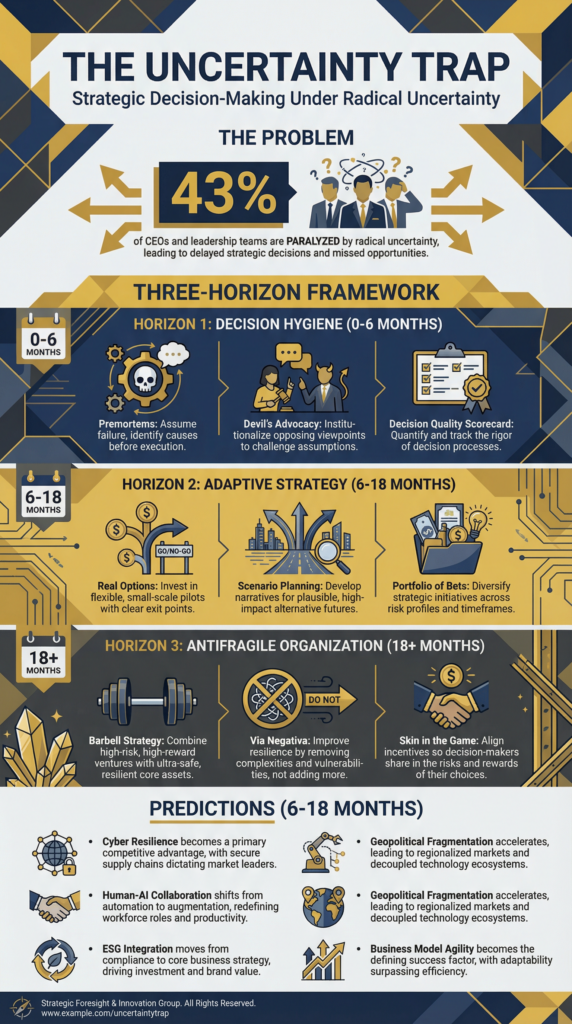
In January 2026, a landmark survey from The Conference Board sent a shockwave through the global business community. It found that 43% of US CEOs now rank "uncertainty" as their top economic threat, surpassing even the fear of a recession [1]. This isn't a temporary market fluctuation; it's a fundamental crisis of leadership. CEOs are admitting they are flying blind, and the traditional strategic playbook is failing them. This is the Uncertainty Trap, and it's paralyzing decision-making at the highest levels.
The trap is not the uncertainty itself, but the outdated frameworks used to address it. We are trying to solve 21st-century problems with 20th-century tools. The industrial-era model of "predict, plan, execute" is built on the assumption of a knowable future. In a world of radical uncertainty—where pandemics, geopolitical shifts, and technological disruptions defy prediction—this model is not just obsolete; it's dangerous.
The Six Cognitive Failures That Fuel the Crisis
Research from the Wharton School identifies six critical errors in human cognition that are exacerbated by uncertainty, leading to flawed strategic choices [3].
- Overconfidence Bias: We systematically underestimate the range of possible outcomes. Our "best-case" and "worst-case" scenarios are rarely sufficiently "best" or "worst."
- Complexity Blindness: We fail to appreciate how uncertainty compounds in complex systems. A simple supply chain with ten steps has exponentially more points of failure than one with three.
- Analysis Paralysis: The fear of making the wrong choice in an uncertain environment leads to an endless quest for more data, delaying decisions until the window of opportunity has closed.
- Outcome Bias: We judge the quality of a decision by its outcome. A good decision that leads to a bad outcome (due to bad luck) is punished, while a bad decision that leads to a good outcome (due to good luck) is rewarded. This systematically discourages intelligent risk-taking.
- Risk Aversion: The psychological discomfort of uncertainty leads us to undervalue high-potential but uncertain opportunities, favoring lower-yield but more predictable bets.
- Attribution Error: We credit success to our own skill and failure to external factors, preventing us from learning from our mistakes.
These biases, when combined with an outdated strategic framework, create a perfect storm of indecision and strategic drift.
The Three-Horizon Framework: A New Playbook for Radical Uncertainty
To escape the Uncertainty Trap, leaders need a new playbook. This framework, synthesized from research at McKinsey and Wharton, and from Nassim Nicholas Taleb's work, provides a structured approach to making high-stakes decisions when the future is unknowable.
Horizon 1: Decision Hygiene (0-6 Months)
Before you can make better strategic choices, you must stop making avoidable errors. The goal of this horizon is to clean up your decision-making process.
- Implement Premortems: For every major decision, conduct a formal exercise where you assume the project has failed spectacularly. This "premortem" helps the team identify potential threats and weaknesses that are often overlooked in optimistic planning sessions.
- Formalize Devil's Advocacy: Create a designated "Red Team" whose sole purpose is to challenge the assumptions and logic of a proposed strategy. This institutionalizes critical thinking and combats groupthink.
- Separate Decision and Outcome: Implement a "Decision Quality Scorecard" that evaluates a choice based on the process used to make it—the quality of data, the rigor of the analysis, the consideration of alternatives—entirely separate from the eventual outcome.
Horizon 2: Adaptive Strategy (6-18 Months)
With a clean process in place, the next step is to build an organization that can adapt as the future unfolds. The goal is not to predict the future, but to build a portfolio of options that will be valuable across multiple potential futures.
- Adopt Real Options Thinking: Treat strategic investments not as irreversible commitments, but as call options. Make small, initial investments to buy the right—but not the obligation—to make a larger investment later. This allows you to learn from the market before committing significant capital.
- Use Four-Level Scenario Planning: As outlined by McKinsey, identify which of the four levels of uncertainty you are facing [2]. For Level 2 (Alternate Futures) and Level 3 (A Range of Futures), develop a set of strategic postures—shaping, adapting, or reserving the right to play—that are robust across the most likely scenarios.
- Build a Portfolio of Bets: Balance your strategic initiatives across high-certainty, high-return projects and low-certainty, high-potential experiments. This diversification protects the organization from the failure of any single initiative.
Horizon 3: Antifragile Organization (18+ Months)
The ultimate competitive advantage in an age of uncertainty is to build an organization that not only survives shocks but also benefits from them. This is the concept of "antifragility" [4].
- Implement a Barbell Strategy: Concentrate your resources at the extremes. Keep the vast majority of your capital in extremely safe, predictable investments (the "safe" side of the barbell). Deploy a small, capped portion of capital to extremely high-risk, high-reward, experimental ventures (the "risky" side). Avoid the "mediocre middle" of medium-risk, medium-return projects, which are most vulnerable to uncertainty.
- Embrace Via Negativa: The most robust way to benefit from uncertainty is first to remove sources of fragility. This means aggressively paying down debt, simplifying complex processes, and eliminating single points of failure in your supply chain and operations.
- Demand Skin in the Game: Ensure that decision-makers bear the consequences of their choices. This aligns incentives and naturally filters out those unwilling to stand behind their decisions.
By adopting this three-horizon approach, leaders can transform uncertainty from a source of paralysis into the engine of their competitive advantage. The future will always be uncertain, but strategic failure is a choice.