
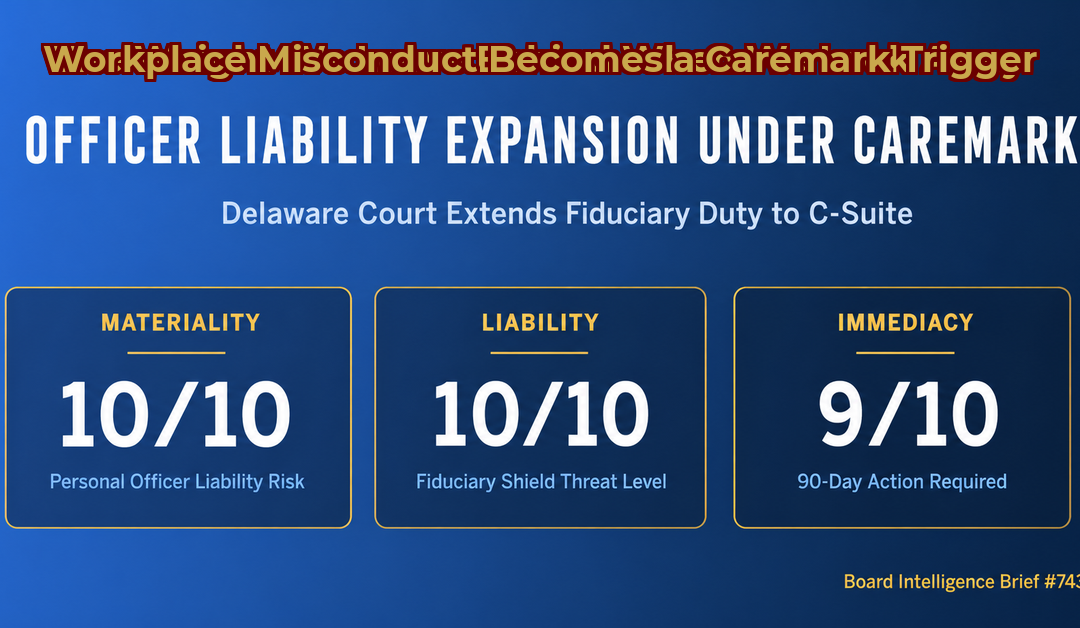
The Delaware Court of Chancery has held that a board's failure to respond in good faith to credible internal reports of workplace sexual assault constitutes a viable Caremark oversight claim, creating direct personal exposure for directors and officers at any company with a documented but inadequately remediated misconduct record. The stakes are immediate: boards that received internal red flags and took only nominal or delegated action are no longer insulated. The required posture is a governance-grade response to HR risk, not an HR-grade response to HR risk.
The Signal at a Glance
PRIORITY 9 | SILO: Judicial
Delaware Chancery, for the first time, has categorized workplace sexual misconduct as a "corporate trauma" sufficient to sustain Caremark oversight claims against both directors and officers, with the CEO separately named for a duty-of-loyalty breach.
The Deep Dive
The Signal
On January 16, 2026, Chancellor Kathaleen St. Jude McCormick denied motions to dismiss in Los Angeles City Employees' Retirement System v. Sanford, C.A. No. 2024-0998-KSJM (Del. Ch. 2026). The derivative complaint alleged that directors and officers of eXp World Holdings, Inc., a cloud-based real estate services platform, failed in good faith to respond to persistent internal reports of sexual assault at company events.
The court's ruling is the first Chancery decision to categorize workplace sexual misconduct as a "corporate trauma" in the Caremark analysis, a doctrinal category previously reserved for acute crises with clear legal-compliance dimensions such as food safety failures or opioid distribution. That categorization places the oversight obligation directly on the board as a governance function, not a management delegation.
The Evidence
Internal red flags surfaced as early as 2020: a viral social media post, a memo sent to company executives, and repeated disclosures by a whistleblower director at board meetings and to outside counsel. The board's response over multiple years included terminating one perpetrator (while continuing to pay him), allowing others to remain, and conducting internal investigations led by insiders.
Chancellor McCormick held that the plaintiffs pled sufficient facts to survive dismissal on two independent theories. First, the board failed to ensure that reasonable information and reporting systems existed to identify and prevent ongoing misconduct, the core Caremark oversight duty. Second, CEO Glenn Sanford separately breached his duty of loyalty by concealing information from the board and retaining implicated employees, an act falling within the duty of loyalty, not merely the business judgment rule.
Both theories survived. The CEO's exposure under the duty of loyalty is particularly significant: exculpatory charter provisions shield directors from liability for duty-of-care failures, but they do not shield against duty-of-loyalty breaches. An officer who actively conceals misconduct has no exculpation defense.
The Strategic Implication
Defensive Risk. Any board that has received credible internal reports of workplace sexual misconduct, through HR, legal counsel, a director, or a whistleblower channel, must now treat its investigative response as a formal governance record. Nominal responses, a single internal investigation, a directed-by-management review, a one-time disciplinary action without follow-up, are the precise fact patterns this opinion indicts. The board's documentation of its oversight steps, the independence of the review body, and the remediation decisions it made must be auditable.
Offensive Advantage. Boards that have already built independent third-party reporting mechanisms, audit committee oversight of workplace culture risk, and regular board-level briefings on misconduct patterns hold a governance differentiation signal that institutional investors and proxy advisors are positioned to value in the 2026 proxy season. ISS and Glass Lewis have both signaled governance quality as a vote-recommendation input. A documented governance-grade response to HR risk is not a legal defense alone: it is a competitive governance asset.
Tone at the Top
The Chancery Court has drawn a line that audit and governance counsel have long anticipated: workplace culture risk is not below the board's pay grade. The duty to oversee does not have a carve-out for matters that feel interpersonal.