
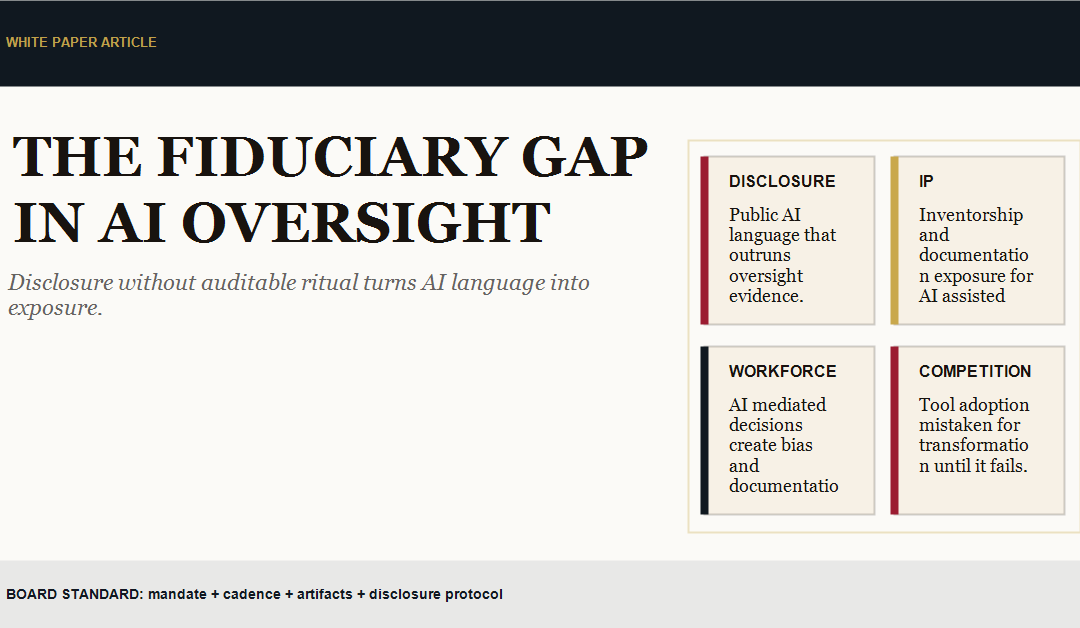
The Fiduciary Gap In AI Oversight
If your board discloses AI risk, governance has to become inspectable: an oversight mandate, standardized reporting, CEO sponsorship documentation, and a disclosure review protocol.
White Paper Article for Friday, May 15, 2026. Boards are disclosing AI risk at record rates. That is not the same thing as governing AI. Disclosure without ritual turns AI language into an unsupported public commitment.
The fiduciary gap is not technical
The fiduciary gap is calendar-shaped. If you cannot point to a recurring board ritual and the artifacts it produces, you do not have governance. You have intention.
The board-facing question is not: are we using AI. The board-facing question is: if an investor, regulator, or plaintiff asked how we govern AI, what repeatable ritual and evidence would we show.
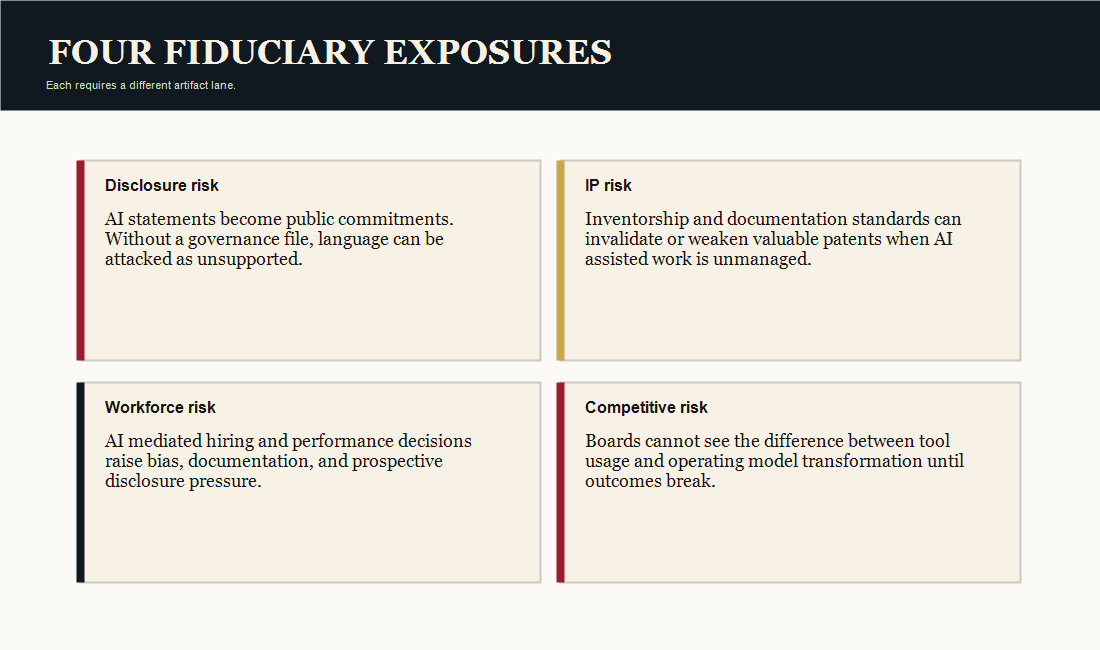
Four forces create board exposure
AI oversight exposure accumulates across four dimensions. These forces overlap, but they do not substitute for each other.
- Disclosure risk: public AI language in filings, earnings calls, or investor decks that is not supported by auditable oversight ritual.
- IP risk: inventorship and documentation rules that can invalidate or weaken patents when AI assisted work is not governed and recorded correctly.
- Workforce risk: AI mediated hiring, performance, and workforce decisions that create documentation, bias, or disclosure exposure.
- Competitive risk: a board that cannot distinguish tool adoption from real operating model transformation until it is too late.
Governance becomes inspectable through three artifact lanes
Boards do not need to own the technical build. They need a governance architecture that produces evidence. In AI First Culture, board governance operates through three lanes that create inspectable artifacts.
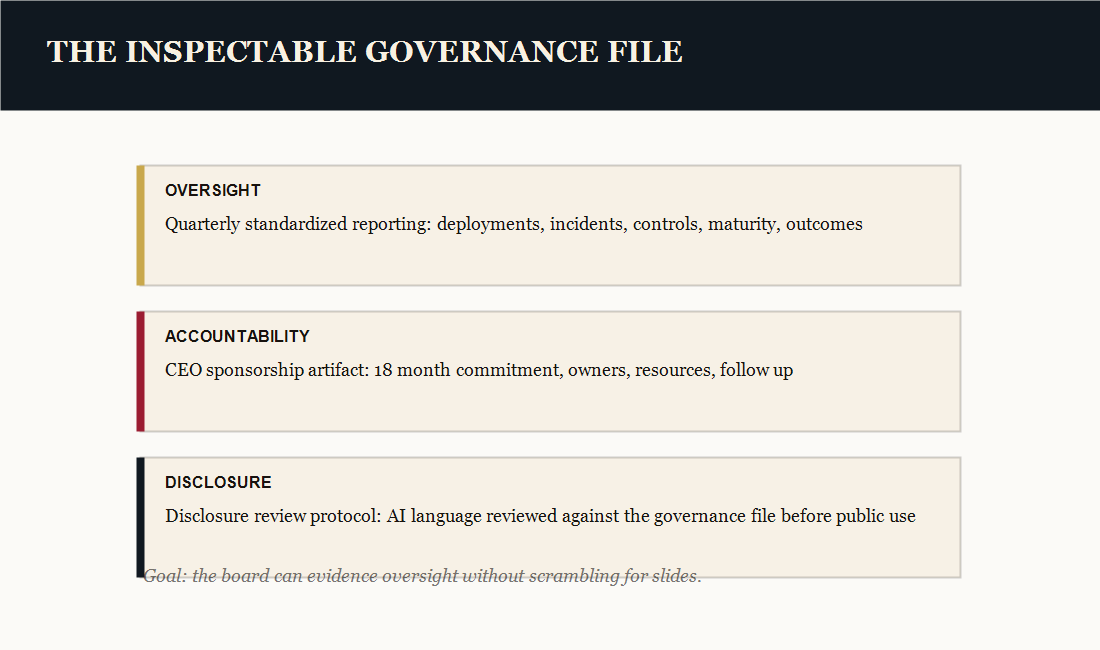
1) Oversight: standardized quarterly reporting on deployments, material incidents, controls, maturity level, and measurable business outcomes.
2) Accountability: documented CEO sponsorship for an 18 month transformation window with owners, resources, and follow up.
3) Disclosure: a review protocol that treats AI language like financial language: reviewed, evidenced, and approved before it becomes a public commitment.
A 90 day board plan that converts intention into ritual
Most boards do not need a new committee. They need a mandate, a reporting format, and a follow up loop that produces evidence.
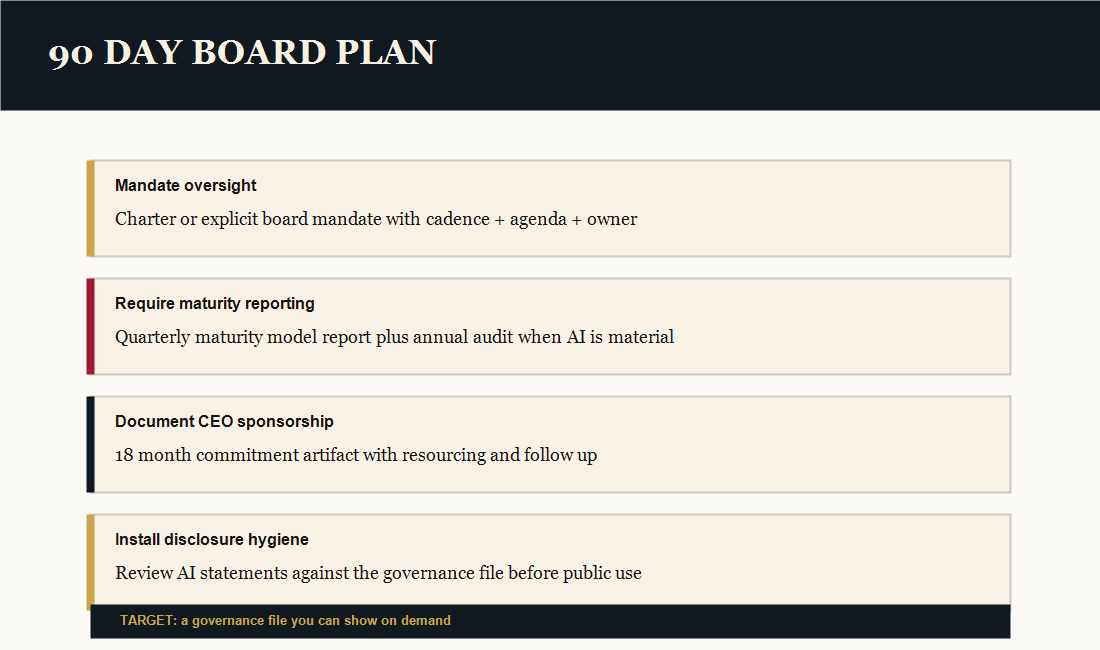
- Establish the oversight mandate: an AI Committee Charter or an explicit board mandate that defines what is reviewed, at what cadence, and in what format.
- Mandate the maturity report: require a standardized maturity model report every quarter, plus an annual maturity audit when AI is material.
- Require CEO sponsorship documentation: a board reviewed artifact that makes the 18 month sponsorship commitment explicit and governable.
- Install disclosure hygiene: require that AI statements in public materials are reviewed against the governance file so language stays aligned to reality.
If you want a fast way to locate the highest priority governance gap, start with the AI First Culture diagnostic. If you want the full board architecture, download the Board Brief and use it as the board packet for your next AI oversight conversation.
Sources
# Sources (primary-first)

Internal source base
- Touch Stone Publishers, "AI-First Culture: The Fiduciary Governance Imperative" (Board of Directors White Paper), May 2026.

Primary and institutional sources to verify / cite
- SEC Investor Advisory Committee, AI disclosure and board oversight recommendations (December 2025 meeting materials and recommendations).
- U.S. Patent and Trademark Office, inventorship guidance related to AI-assisted inventions (revised guidance cited as November 2025 in the source base).
- U.S. Congress bill record: S.3339, "AI Workforce PREPARE Act" (workforce disclosure posture cited in the source base).
- The Conference Board, reporting on AI risk mentions in S&P 500 annual reports (press summary cited in the source base).
- Norton Rose Fulbright, documentation of SEC enforcement posture on AI-related disclosures under existing rules (used only as corroboration, not as the primary source).
If your board is disclosing AI risk, you need the ritual infrastructure that makes oversight inspectable. Start with the Board Brief, then use the diagnostic to locate the highest-priority governance gap.