NIST Just Expanded the AI Argument. Safety Is No Longer Enough.
NIST and GAO are converging on the same point: AI competitiveness is not model access alone. It is governance, human capital, measurement, and operating discipline.
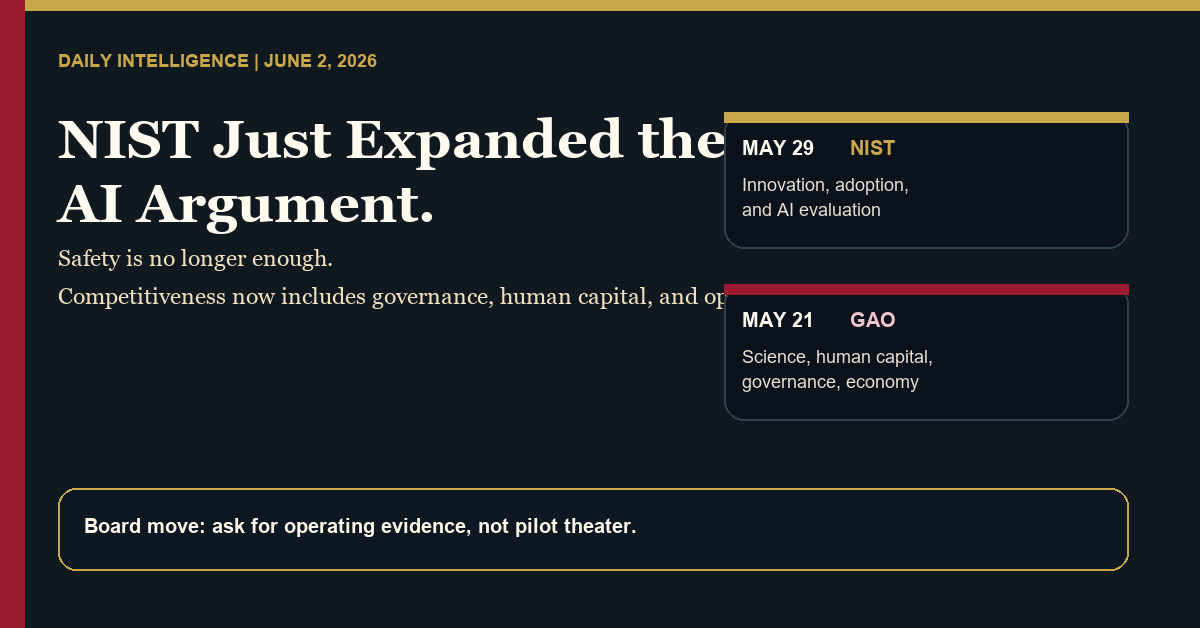
Two federal signals landed within eight days of each other, and together they move the AI conversation into a more serious place.
On May 29, 2026, NIST renamed and expanded its former AI Safety Institute Consortium into the NIST AI Consortium, explicitly shifting the work toward AI innovation, adoption, and measurement. On May 21, 2026, GAO published a national framework for AI competitiveness built on four pillars: Science and Technology, Human Capital, Governance, and Economy. The throughline is clear. Serious institutions are no longer treating AI as a narrow tooling race.
They are treating it as an operating system question.
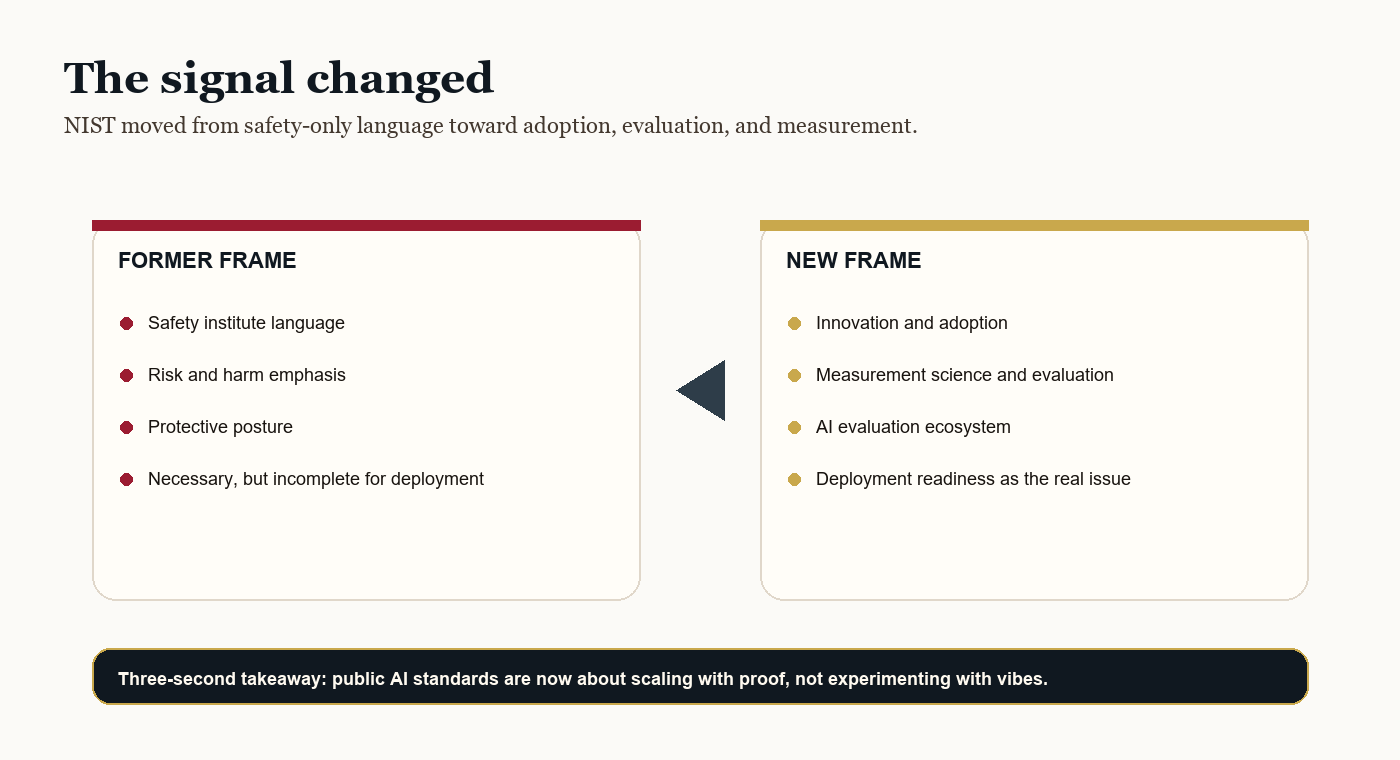
Safety Was Only the Opening Frame
NIST’s May 29 announcement matters because it changes the center of gravity. The renamed consortium will now focus on AI innovation and adoption, and NIST said six task groups will work on AI measurement science and evaluation. That is a different posture from treating safety as a side constraint on a model program. It implies that trustworthy deployment, measurement, and adoption readiness now belong inside the main operating discussion.
For executives, that means the hard question is no longer whether the model is impressive. The harder question is whether the organization can evaluate, govern, and absorb what it is deploying. An enterprise that cannot do that does not have an AI strategy yet. It has an experimentation habit.
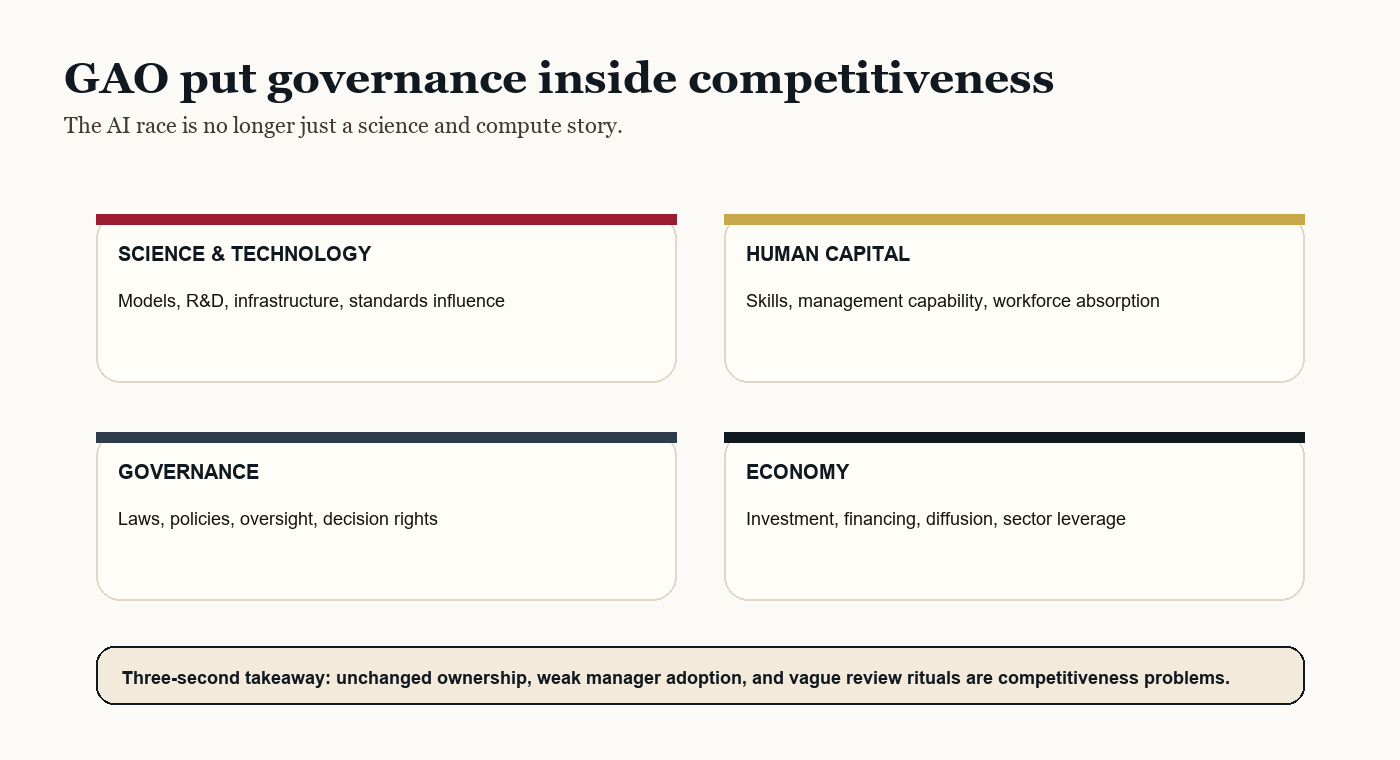
Competitiveness Now Includes Governance
GAO made the second move. Its May 21 framework for assessing U.S. AI competitiveness organizes the issue into four pillars: Science and Technology, Human Capital, Governance, and Economy. That matters because it rejects the lazy view that competitiveness is mainly about model quality, compute, or vendor access.
If governance and human capital are pillars of competitiveness, then unchanged reporting rituals, vague ownership, weak manager adoption, and invisible decision rights are not soft issues. They are competitiveness failures. This is exactly where most AI programs leak value. They buy the tool, keep the old meeting structure, keep the old performance signals, keep the old escalation ambiguity, and then wonder why usage rises but transformation does not.
The AI-First Culture research base reached this conclusion earlier from a different direction: ritual redesign is the multiplier on the technology investment. The federal apparatus is now catching up to that operating truth.
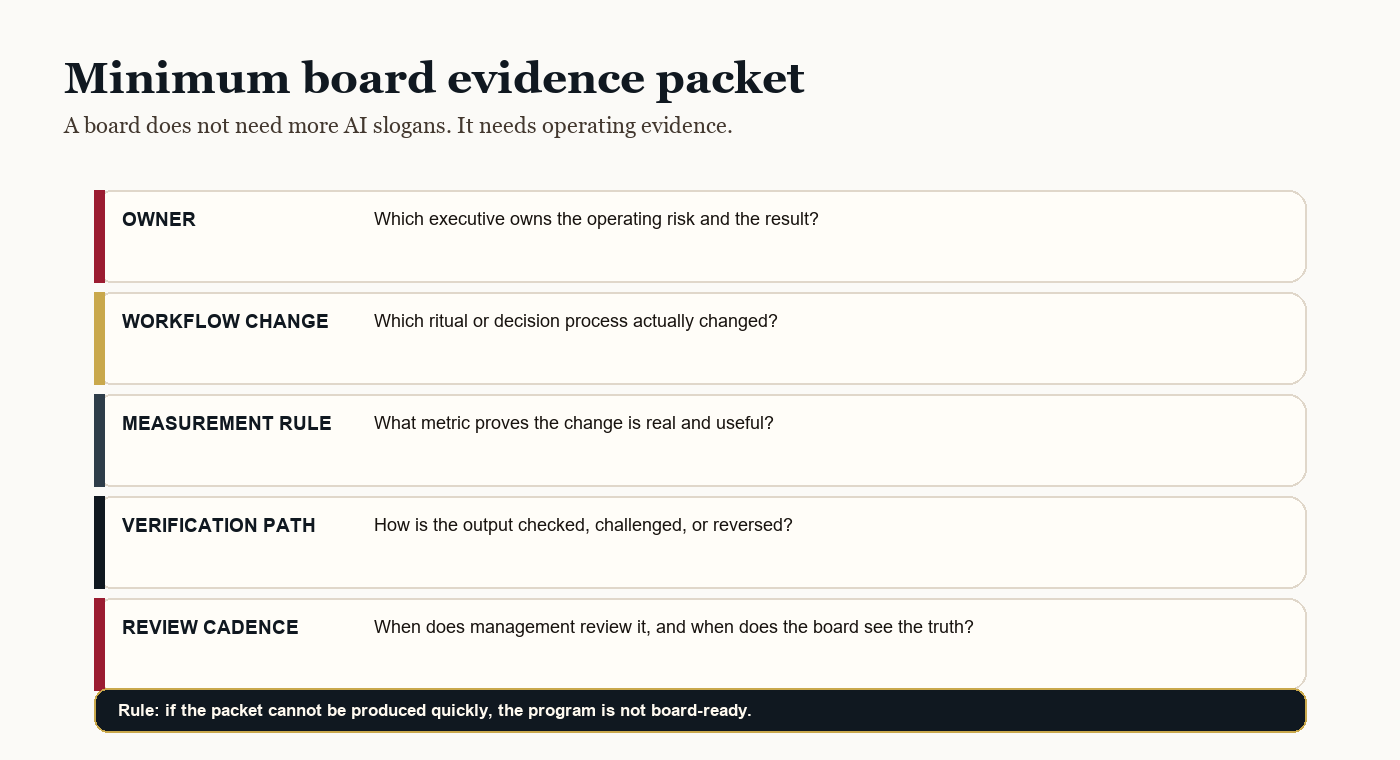
The Board Should Ask for Operating Evidence
The right near-term response is not a new AI steering slogan. It is a minimum evidence packet. Under the Governance Boundary Principle, the board does not redesign management’s workflows itself. The board does require proof that management has done so. That proof should name the executive owner, the workflow or ritual that changed, the measurement rule, the verification path, and the review cadence.
In plain language: what decision ritual changed, who owns it, what counts as proof, and how often does the board see the truth? If those answers are vague, the program is still in theater mode no matter how many licenses are active.
NIST’s adoption turn and GAO’s competitiveness framework do not create a new law. They do something more useful. They remove the excuse that AI can still be treated as a narrow technical program. The board that asks for operating evidence now will build something its successors will benefit from. That is what governance architecture looks like when it is not built in response to failure.
The white papers turn this signal into a board-ready operating question: which rituals changed, who owns the evidence, and what cadence proves the change is safe and real.