
Intelligence
Constructed.
Strategic guidance for institutional leaders.
Group
Intelligence.
Collective Operational Clarity
Access the latest strategic briefings and high-level trends from our ongoing Mastermind Group sessions.
View Latest PostingsSector
Analysis.
Market Transition Patterns
In-depth mapping of physical and digital asset transitions across core industrial sectors.
Inspect DataMastermind
Group Archive.
Direct transparency into our group’s strategic discourse. Explore internal briefings, peer-level analysis, and the historical intelligence logs of the Mastermind Group.
Enter Group Archive
The 80/20 Inversion Crisis
The Wholesale Trade sector faces a pivotal regulatory inflection as federal authorities enforce new compliance standards with a Q3 2025 deadline. These mandates introduce rigorous operational requirements that will reshape cost structures, revenue models, and risk management protocols across the sector. Senior leaders must integrate these compliance imperatives into strategic planning to safeguard margins and maintain competitive positioning. This analysis quantifies the financial impact, explores operational shifts, and highlights critical indicators to monitor as firms adapt to this evolving regulatory landscape.

The Intelligence Scan
Executive News Summary Across 11 Sectors
The CIO Scapegoat: Why the “CIO Mandate Gap” is a Failure of CEO Leadership
The CIO Scapegoat: A Contrarian Whitepaper The CIO Scapegoat Why the “CIO Mandate Gap” is a Failure of CEO Leadership A Contrarian Whitepaper by Touch Stone Publishers | February 13, 2026 Executive Summary The prevailing narrative in boardrooms and business journals…

Navigating New Retail Compliance: Strategic Imperatives for 2026 and Beyond
Federal regulators have introduced stringent new compliance standards for the Retail sector, with full implementation required by Q3 2026. These regulations impose enhanced operational protocols, data security mandates, and consumer protection measures that will reshape retail business models. Retailers face an average compliance-related cost increase of 2.8% of annual revenue, with smaller operators experiencing up to 4.5%. Margins will contract by approximately 60 basis points on average, pressuring profitability in an already competitive environment. This regulatory shift demands immediate strategic recalibration, particularly in capital allocation, supply chain management, and IT infrastructure. Senior retail leaders must prioritize compliance integration while optimizing cost structures to sustain growth and protect brand equity. Monitoring key metrics such as compliance spend, inventory turnover, and consumer confidence will be critical in navigating this evolving landscape.
The Intelligence Scan
Cross-Sector Reconnaissance: February 12, 2026
Navigating New Federal Compliance Standards Reshaping Wholesale Trade Operations
The Wholesale Trade sector faces a pivotal regulatory inflection as federal authorities enforce new compliance standards with a Q3 2025 deadline. These mandates introduce rigorous operational requirements that will reshape cost structures, revenue models, and risk management protocols across the sector. Senior leaders must integrate these compliance imperatives into strategic planning to safeguard margins and maintain competitive positioning. This analysis quantifies the financial impact, explores operational shifts, and highlights critical indicators to monitor as firms adapt to this evolving regulatory landscape.
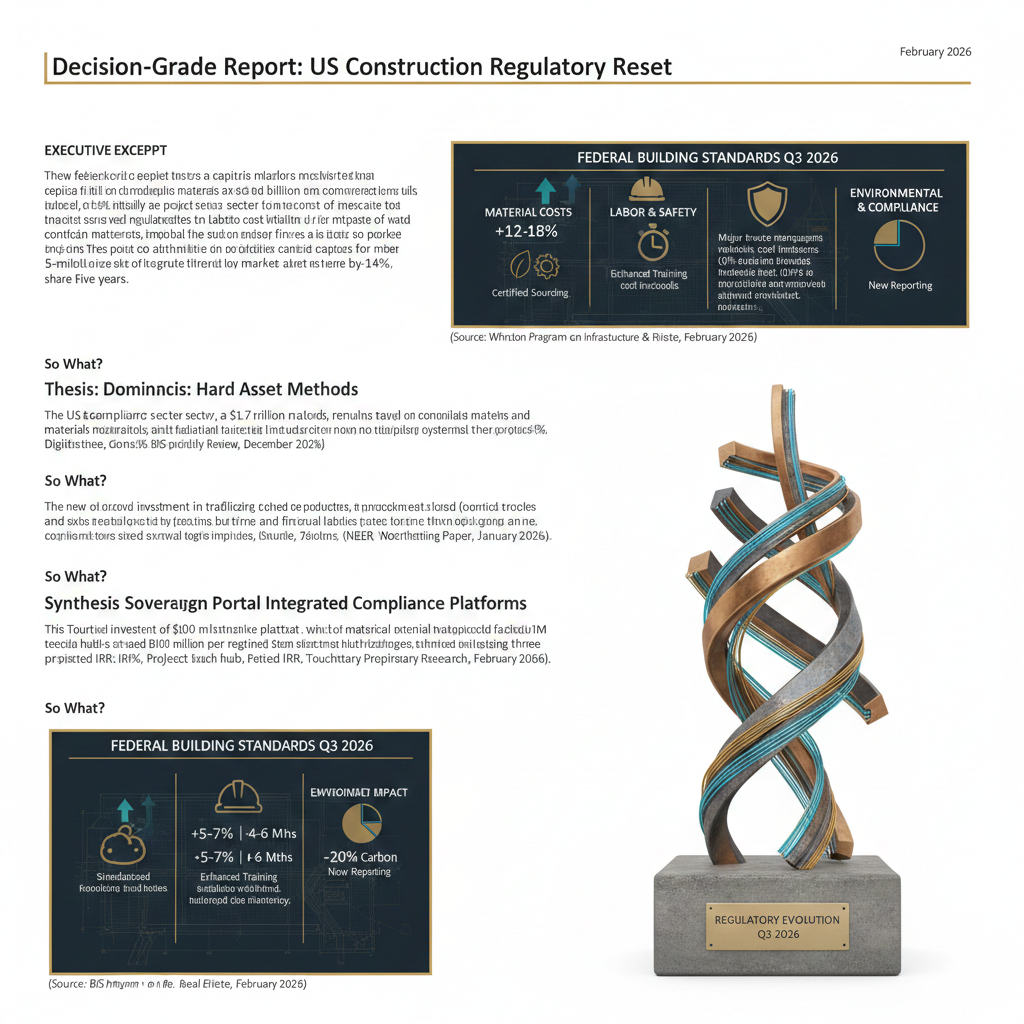
New Federal Compliance Standards Set to Reshape US Construction Operations by Q3 2026
Federal regulators announced new compliance requirements for the US construction sector, mandating full implementation by the third quarter of 2026. These standards introduce enhanced environmental, safety, and materials usage protocols that will directly affect operational costs and project timelines. Mid-to senior-level construction leaders must anticipate a **3-5% increase in direct operating expenses** and a **2-4% margin compression** in the near term. Capital allocation strategies require recalibration toward compliance investments, with **upfront expenditures estimated between $1 billion and $1.5 billion industry-wide** in 2026 alone. These changes will ripple across the value chain, impacting suppliers, subcontractors, and clients. Executives should prioritize compliance readiness, supplier vetting, and contract renegotiations to mitigate financial exposure and maintain competitive positioning.

New Federal Compliance Standards Set to Reshape Utilities Operations by Q3 2026
Federal regulators have introduced stringent new compliance requirements for the Utilities sector, with a mandated implementation deadline in the third quarter of 2026. These standards recalibrate operational protocols, environmental reporting, and infrastructure resilience mandates, directly impacting utilities’ cost structures and capital allocation. Utilities face a projected **5-8% increase in compliance-related operating expenses** and a recalibration of capital spending priorities toward grid modernization and emissions monitoring technologies. The regulatory weight of this initiative, scoring **9.0/10**, marks it as a pivotal factor in near-term sector strategy. Senior executives must prioritize compliance integration to avoid penalties and leverage this transition as a catalyst for operational efficiency and competitive differentiation.

New Federal Compliance Standards Signal Major Shift for Agriculture Sector
Federal regulators announced new compliance requirements for the agriculture sector, with a mandated implementation deadline in the third quarter of 2026. These standards introduce rigorous operational protocols designed to enhance environmental stewardship, chemical usage tracking, and labor practices across farms and related operations. The changes will increase operational costs by an estimated 5 to 8 percent for mid-sized farms, compressing average profit margins by up to 3 percentage points in the first two years post-adoption. Compliance will require significant capital expenditure on monitoring technologies and workforce training, fundamentally altering cost structures and capital allocation priorities. This shift presents both challenges and strategic opportunities: leaders must accelerate investments in digital compliance tools while optimizing supply chain partnerships to mitigate margin pressures. Monitoring crop price fluctuations, input cost volatility, and regulatory enforcement activities will be critical over the next 12 months. This article provides a detailed analysis of these new requirements and their implications for financial performance, value chain dynamics, and sector leadership.
THE NEW COST CURVE OF INTELLIGENCE
Current cloud-centric architectures are structurally insolvent. As sensor input fidelity increases and edge devices proliferate, the energy and financial costs of moving data to centralized models exceed the cost of executing inference at the source. The centralization of intelligence has created a bottleneck of cognitive latency that is unacceptable for sovereign-grade infrastructure.
Deeper Analysis
Our LinkedIn newsletter brings valule to the table for Leaders. If these insights are relevant to your current priorities, I’d welcome your participation. You are more than welcome to write an article and share your thoughts.