
The Art and Science of Leadership Blog
The Talent Concentration Reality: Why Your AI Operating Model Is Not Optional
Senior enterprise AI talent is concentrated among approximately ten firms. This is not a recruitment problem—it is a mathematics problem that mandates your operating model. Most boards are asking the wrong question. They ask: “How do we hire senior AI talent?” They should ask: “Who has hire-and-fire authority over the engineers building the models that move our committed P&L lines?” The answer determines whether your AI program delivers or fails quietly.
The Policy Illusion: Why Behavioral AI Governance Fails at the Architecture Level: What Boards Must Demand Instead
Enterprise AI governance built on behavioral controls and policy documents cannot discharge the fiduciary duties that agentic AI deployment now creates. The Law of Deterministic Containment, which moves every control function that cannot afford to fail out of the LLM’s decision authority and into deterministic systems, is the only structurally adequate response. Boards that defer this architecture are not delaying cost. They are compounding it.
The Policy Illusion: Why Behavioral AI Governance Fails at the Architecture Level: What Boards Must Demand Instead
Enterprise AI governance built on behavioral controls and policy documents cannot discharge the fiduciary duties that agentic AI deployment now creates. The Law of Deterministic Containment, which moves every control function that cannot afford to fail out of the LLM’s decision authority and into deterministic systems, is the only structurally adequate response. Boards that defer this architecture are not delaying cost. They are compounding it.
The Policy Illusion: Why Behavioral AI Governance Fails at the Architecture Level: What Boards Must Demand Instead
Enterprise AI governance built on behavioral controls and policy documents cannot discharge the fiduciary duties that agentic AI deployment now creates. The Law of Deterministic Containment, which moves every control function that cannot afford to fail out of the LLM’s decision authority and into deterministic systems, is the only structurally adequate response. Boards that defer this architecture are not delaying cost. They are compounding it.
Why Most Boards Will Fail the 2026 AI Governance Test — And What to Do Before Proxy Season Ends
Board-level AI governance has become the defining accountability standard of the 2026 proxy season, yet fewer than one in three S&P 100 companies disclose both a board oversight structure and a formal AI policy. Institutional investors and proxy advisors are now demanding documented, enforceable frameworks — not policy statements. Governance professionals and board directors who cannot demonstrate credible AI oversight architecture face measurable reputational and regulatory exposure before this proxy season concludes.
The Policy Illusion: Why Behavioral AI Governance Fails at the Architecture Level: What Boards Must Demand Instead
Enterprise AI governance built on behavioral controls and policy documents cannot discharge the fiduciary duties that agentic AI deployment now creates. The Law of Deterministic Containment, which moves every control function that cannot afford to fail out of the LLM’s decision authority and into deterministic systems, is the only structurally adequate response. Boards that defer this architecture are not delaying cost. They are compounding it.
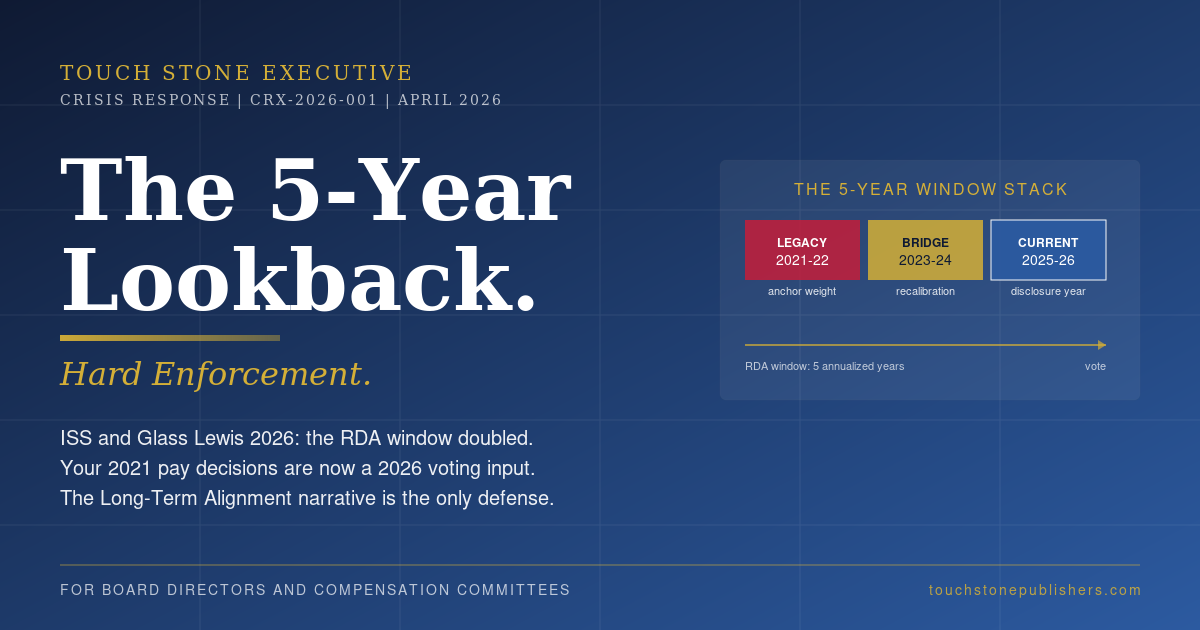
The 5-Year Lookback: Why Your 2021 Pay Decisions Are Now a 2026 Voting Input
ISS and Glass Lewis 2026 doubled the pay-for-performance window from three years to five. Your 2021 retention awards are now mathematical inputs to your 2026 Say-on-Pay vote. The Long-Term Alignment narrative is the only proxy disclosure that survives the new framework.
Why Most Boards Will Fail the 2026 AI Governance Test — And What to Do Before Proxy Season Ends
Board-level AI governance has become the defining accountability standard of the 2026 proxy season, yet fewer than one in three S&P 100 companies disclose both a board oversight structure and a formal AI policy. Institutional investors and proxy advisors are now demanding documented, enforceable frameworks — not policy statements. Governance professionals and board directors who cannot demonstrate credible AI oversight architecture face measurable reputational and regulatory exposure before this proxy season concludes.
The Policy Illusion: Why Behavioral AI Governance Fails at the Architecture Level: What Boards Must Demand Instead
Enterprise AI governance built on behavioral controls and policy documents cannot discharge the fiduciary duties that agentic AI deployment now creates. The Law of Deterministic Containment, which moves every control function that cannot afford to fail out of the LLM’s decision authority and into deterministic systems, is the only structurally adequate response. Boards that defer this architecture are not delaying cost. They are compounding it.
Why Most Boards Will Fail the 2026 AI Governance Test — And What to Do Before Proxy Season Ends
Board-level AI governance has become the defining accountability standard of the 2026 proxy season, yet fewer than one in three S&P 100 companies disclose both a board oversight structure and a formal AI policy. Institutional investors and proxy advisors are now demanding documented, enforceable frameworks — not policy statements. Governance professionals and board directors who cannot demonstrate credible AI oversight architecture face measurable reputational and regulatory exposure before this proxy season concludes.
Schedule a Time to Chat
Let’s chat for a few moments and discover if we should work together to help your team master the art of Leadership. If we decide to take the next step together, I will buy the coffee.
Glenn