
Executive Summary
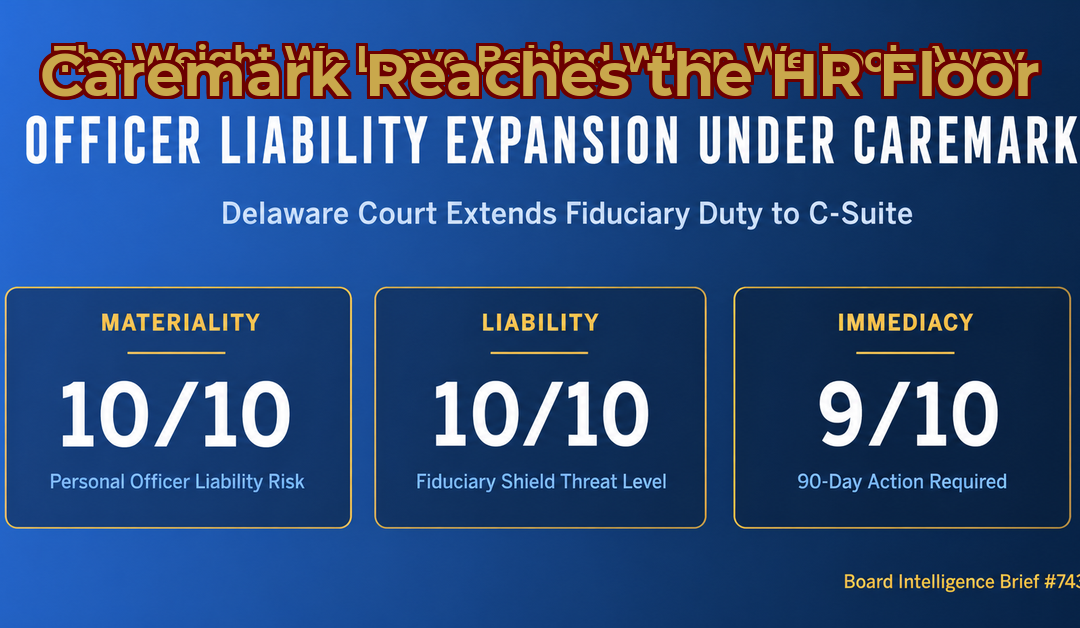
Delaware’s Court of Chancery ruled on January 16, 2026 that a board’s failure to act in good faith on credible red flags of workplace sexual misconduct constitutes a viable Caremark breach, denying motions to dismiss against directors and officers of eXp World Holdings Inc. The ruling extends a doctrine historically confined to financial controls and regulatory compliance into the workforce conduct domain, creating new fiduciary exposure for every Fortune 500 board that lacks a formal mechanism for escalating and acting on misconduct reports. Boards that have not mapped HR red-flag protocols to their existing governance architecture should treat this opinion as a 90-day action item.
The Signal at a Glance
Chancellor McCormick held that conscious disregard of sexual-misconduct red flags at the board and officer level satisfies the pleading standard for a Caremark oversight claim, surviving a motion to dismiss in Los Angeles City Employees’ Retirement System v. Sanford, C.A. No. 2024-0998-KSM (Del. Ch. Jan. 16, 2026).
The Deep Dive
The Signal
On January 16, 2026, Chancellor Kathaleen St. J. McCormick of the Delaware Court of Chancery issued a precedent-setting opinion in Los Angeles City Employees’ Retirement System v. Sanford, denying motions to dismiss Caremark oversight claims and duty-of-loyalty claims against directors and the General Counsel of eXp World Holdings Inc.
The court found it reasonably conceivable that eXp’s board consciously ignored a sustained pattern of sexual assault and misconduct, including a 2020 viral Facebook post that named specific perpetrators, and that the company’s response was, in the Chancellor’s words, “nominal, tainted by deliberate heel-dragging, and ran parallel to a campaign of concealment.” A sitting director who raised the issue internally was alleged to have faced retaliation. The CEO additionally faces a duty-of-loyalty claim for his personal conduct.
This is the first Chancery opinion to apply the Caremark “corporate trauma” framework to HR-domain misconduct at scale, rather than restricting its reach to financial fraud, product safety failures, or regulatory noncompliance.
The Evidence
Case: Los Angeles City Employees’ Retirement System v. Glenn Sanford et al., C.A. No. 2024-0998-KSM. Court: Delaware Court of Chancery. Judge: Chancellor Kathaleen St. J. McCormick. Decision date: January 16, 2026. Procedural posture: denial of motions to dismiss; claims survive to discovery.
The operative legal test is unchanged from prior Caremark doctrine: plaintiffs must plead that directors either (a) utterly failed to implement a reporting system for the relevant risk category, or (b) having implemented one, consciously failed to monitor and respond. The court’s extension here is categorical: workforce sexual misconduct now qualifies as a “central legal risk” that activates the Caremark duty, not merely an employment law matter insulated from derivative claims.
The court further held that the duty of oversight now extends to corporate officers on this issue, consistent with the 2023 officer-liability framework established in In re McDonald’s Corporation Stockholder Derivative Litigation. Named defendants include the CEO, General Counsel, and multiple board members. The plaintiff’s counsel confirmed the ruling creates a new lane of derivative liability exposure for companies that treat workplace misconduct as an HR matter rather than a governance matter.
The Strategic Implication
Defensive Risk. Any Fortune 500 board that has not formally assigned oversight of workforce misconduct to a specific committee, with defined escalation thresholds and documented board-level responses to credible complaints, is now exposed to derivative suit under the same framework that governs financial controls. The risk is not limited to the most egregious cases. The court’s language about “nominal” responses and “deliberate heel-dragging” signals that a paper compliance program, one that creates records of inaction rather than action, may be more dangerous than no program at all. Audit committees and compensation committees should expect plaintiffs’ counsel to scrutinize board minutes, HR escalation logs, and whistleblower records in the next cycle of proxy-season activism.
Offensive Advantage. Boards that move now can convert this liability signal into a governance differentiator. A credible, board-level workforce integrity protocol, documented, reviewed annually, and tied to executive performance metrics, will be a meaningful answer to institutional investor questions that are already arriving under ISS and Glass Lewis 2026 governance frameworks. General Counsels who brief their audit committees on this opinion before Q2 earnings cycles position the company as ahead of the doctrine rather than behind it.
Tone at the Top
Caremark has always required boards to monitor what kills the company. The Delaware Chancery’s ruling in January 2026 makes clear that boards do not get to decide, unilaterally, what qualifies as a central legal risk and what does not. The Tone at the Top is now being measured not just in financial controls but in how leadership responds when someone in the building raises an alarm.