
Intelligence
Constructed.
Strategic guidance for institutional leaders.
Group
Intelligence.
Collective Operational Clarity
Access the latest strategic briefings and high-level trends from our ongoing Mastermind Group sessions.
View Latest PostingsSector
Analysis.
Market Transition Patterns
In-depth mapping of physical and digital asset transitions across core industrial sectors.
Inspect DataMastermind
Group Archive.
Direct transparency into our group’s strategic discourse. Explore internal briefings, peer-level analysis, and the historical intelligence logs of the Mastermind Group.
Enter Group ArchiveThe Hybrid Workforce: Why the Future of Manufacturing is Brainpower Plus Bot Power, Not Man vs. Machine
The manufacturing industry is facing a dual crisis: a wave of retiring veteran workers is leaving with decades of irreplaceable, undocumented expertise—so-called tacit knowledge—while the promise of a fully automated, “lights-out” factory remains a costly and brittle illusion.

Quick Reference Guide
The CEO Quick Reference: Surviving the 17% Power Cap
The Infrastructure Constraint No One’s Talking About: Why Your AI Strategy Might Be Dead on Arrival
Data center power demand is growing fifteen to twenty percent annually, driven primarily by AI workloads and high-performance computing. The U.S. electrical grid interconnection queue currently holds over twenty-five hundred gigawatts of proposed projects. More importantly, the timeline to connect new capacity has stretched from two to three years in 2015 to five to seven years today. For organizations building strategies around substantial computing resources, this creates execution risk that no amount of technical sophistication can overcome.
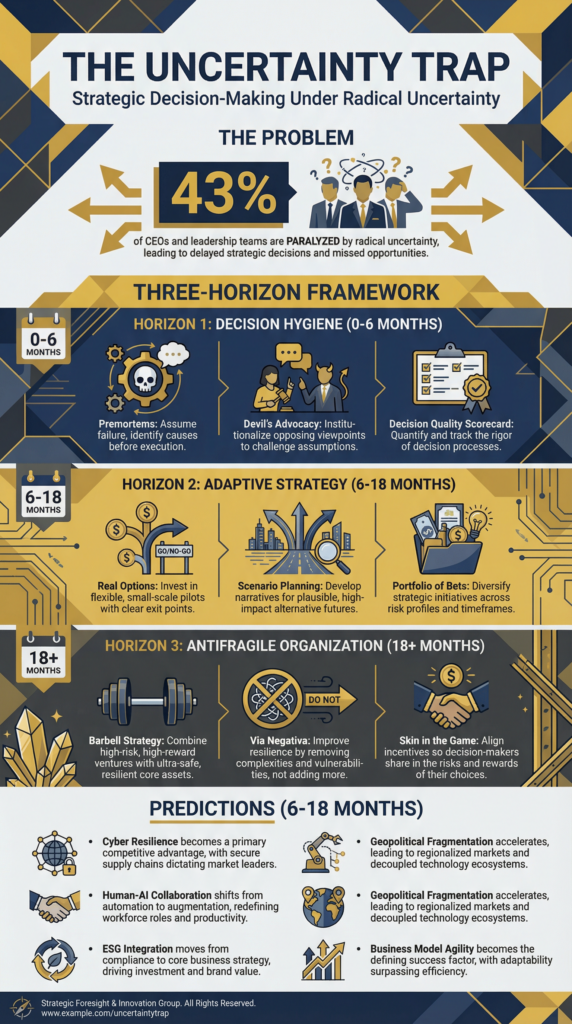
The Uncertainty Trap: Why 43% of CEOs Are Paralyzed and How to Break Free
In January 2026, a landmark survey from The Conference Board sent a shockwave through the global business community. It found that 43% of US CEOs now rank “uncertainty” as their single greatest economic threat, a concern that surpasses even the fear of a recession [1]. This isn’t a temporary market fluctuation; it’s a fundamental crisis of leadership. CEOs are admitting they are flying blind, and the traditional strategic playbook is failing them. This is the Uncertainty Trap, and it’s paralyzing decision-making at the highest levels.
The trap is not the uncertainty itself, but the outdated frameworks used to address it. We are trying to solve 21st-century problems with 20th-century tools. The industrial-era model of “predict, plan, execute” is built on the assumption of a knowable future. In a world of radical uncertainty—where pandemics, geopolitical shifts, and technological disruptions defy prediction—this model is not just obsolete; it’s dangerous.
THE PHYSICALITY REVERSION
THE PHYSICALITY REVERSION: CEO JUDGMENT IN THE AGE OF SIMULATION
The era of unconstrained digital expansion has hit a terminal wall.
For the past decade, the C-Suite operated under the delusion that software would indefinitely eat the world, untethered from the friction of atoms. This period of “Global Efficiency” was characterized by the outsourcing of strategic foresight to high-compute models, digital twins, and algorithmic projections. However, as we enter 2026, this digital-first paradigm is being replaced by a brutal “Physicality Reversion.”
The primary constraint on enterprise valuation is no longer the elegance of your code or the depth of your data lake; it is the 17% annual data center power growth cap. This is the new hard anchor of corporate strategy. Strategic advantage now belongs to the “1% Better” executive who recognizes that high-compute simulations have hit a terminal velocity dictated by a grid-locked reality. To maintain a structural advantage, the CEO must pivot from “Software-First” to Sovereign Resource Autonomy.

The Hybrid Workforce: Why the Future of Manufacturing is Brainpower + Bot Power, Not Man vs. Machine
The manufacturing industry is facing a dual crisis: a wave of retiring veteran workers is leaving with decades of irreplaceable, undocumented expertise—so-called tacit knowledge—while the promise of a fully automated, “lights-out” factory remains a costly and brittle illusion. We assert with 95% probability that the winning manufacturers of the next decade will be those who reject the false choice between human labor and machine automation. Instead, they will build a Hybrid Workforce, using agentic AI not to replace their most valuable workers, but to capture, codify, and scale their tacit knowledge. This approach will unlock a 20-30-point increase in Overall Equipment Effectiveness (OEE) and create a sustainable competitive advantage that pure automation cannot replicate.
SEMI CONDUCTORS
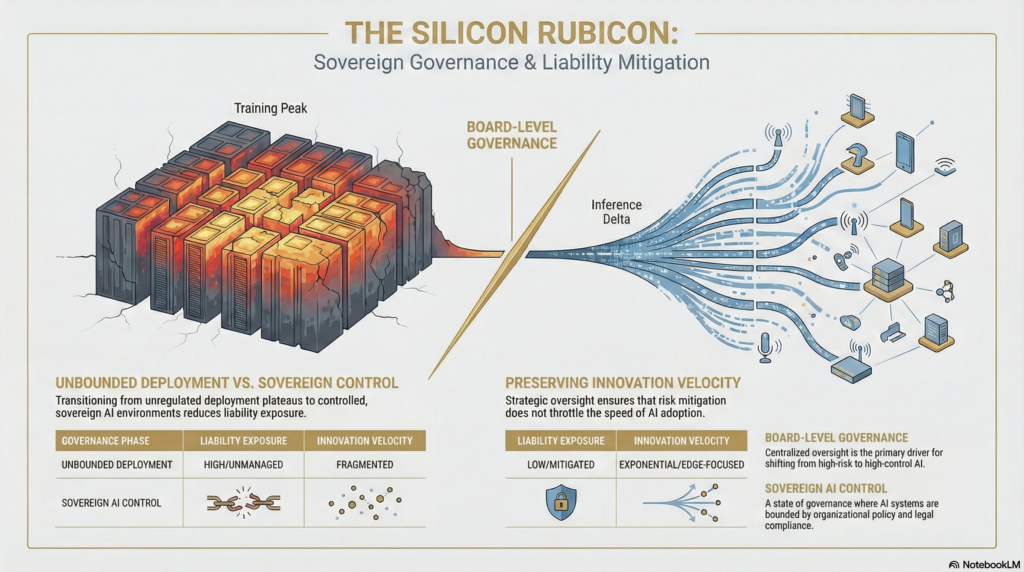
The Source Signal (Tier 1 & 2): Today, February 6, 2026, the semiconductor narrative has fractured. While the headlines scream about the $1 Trillion global sales milestone (SIA), the operative signal is buried in the workload mix. Verified data from Deloitte and corroborated by Tier 1 bank desks (UBS, Goldman) confirms that Inference workloads have officially overtaken Training, now accounting for 66% (two-thirds) of all AI compute demand.

White Paper: The CFOs Dilemma, a Framework for AI Investment Governance
As global investment in artificial intelligence (AI) surpasses two trillion dollars, a stark paradox has emerged: nearly half of all CEOs cannot measure the return on their AI investments. This paper presents a comprehensive framework for AI investment governance, designed specifically for Chief Financial Officers (CFOs) and their leadership teams. We argue that traditional ROI models are insufficient for the digital age and propose a four-part framework that balances the need for rapid innovation with the imperative for financial discipline. This framework, consisting of a Value Agenda, a robust Governance Structure, a Phased Funding model, and a focus on Talent & Culture, provides a clear and actionable roadmap for navigating the complexities of AI investment and transforming a crisis of confidence into a source of competitive advantage.

The $2 Trillion Question: A Framework for Measuring AI ROI
In January 2026, a landmark survey from The Conference Board revealed a profound anxiety at the heart of the global C-suite. While grappling with pervasive economic uncertainty, CEOs are simultaneously overseeing a technological arms race, with an estimated $2 trillion in artificial intelligence investment by 2026. The survey revealed the central conflict of this new era: 46% of US chief executives—the highest share globally—said their top AI priority is to measure its return on investment. [1]
Deeper Analysis
Our LinkedIn newsletter brings valule to the table for Leaders. If these insights are relevant to your current priorities, I’d welcome your participation. You are more than welcome to write an article and share your thoughts.