
Executive Summary
The SEC has formed a dedicated enforcement unit, the “SOX Group,” to investigate and prosecute violations of auditing standards. These are functions held by the PCAOB for the past 20 years. Fortune 500 audit committees now operate under a dual oversight regime: PCAOB authority intact, SEC enforcement newly activated and hunting for fraud and material control failures. Boards that have treated auditor relationships as a PCAOB matter should update that assumption before their next audit cycle.
The Signal at a Glance
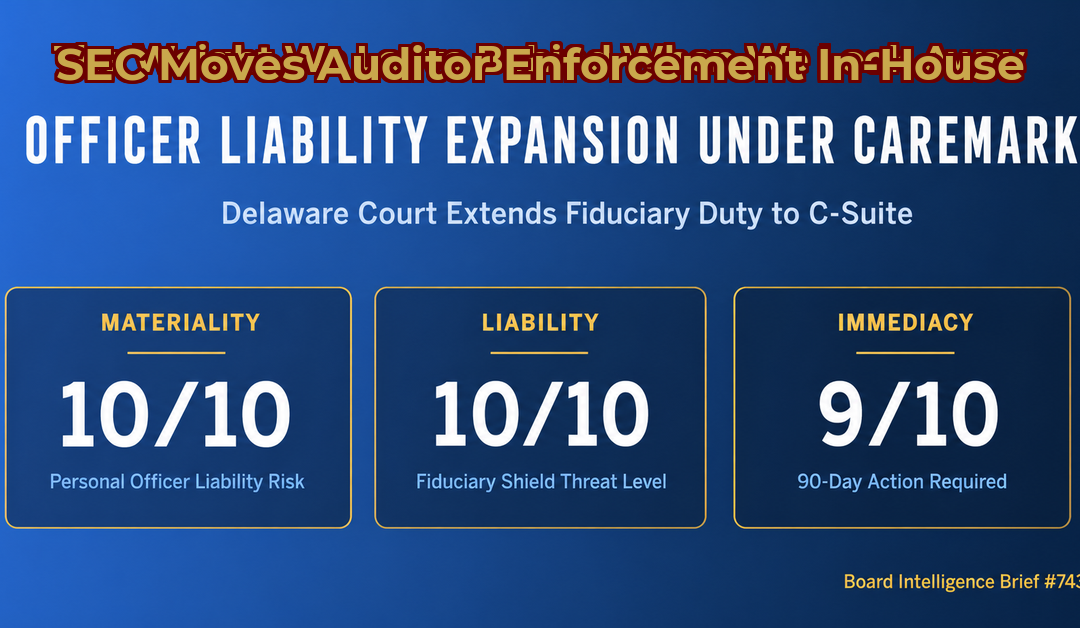
The SEC’s new SOX enforcement unit absorbs PCAOB functions, placing audit quality and internal financial controls directly in the SEC’s crosshairs for the first time in two decades.
The Deep Dive
The Signal
On March 19, 2026, Reuters reported that the SEC’s Division of Enforcement had begun forming a new team to police accounting issues. Two days later, at the SEC Speaks conference in Washington, Acting Enforcement Director Sam Waldon and Chief Enforcement Accountant Ryan Wolfe confirmed the unit’s existence and mission. According to official SEC job postings, the new group will “investigate and litigate matters involving potential violations of auditing and related professional standards” under the Sarbanes-Oxley Act.
The timing is not coincidental. The SEC simultaneously reduced the PCAOB’s budget and staffing, signaling that the independent board’s role as primary cop for auditor misconduct is shifting to the Commission itself. As King & Spalding noted in an April 28, 2026 analysis, the new group will report to the Chief Accountant for the Enforcement Division and is expected to absorb cases historically deferred to the PCAOB.
The Evidence
The SEC posted supervisory general attorney and supervisory trial counsel positions for the SOX Group on March 16, 2026. Ryan Wolfe, Chief Accountant for the Enforcement Division, highlighted both the group and the postings at the accounting panel of SEC Speaks on March 19 and 20, 2026. According to the Reuters report from March 19, 2026, an SEC spokesperson confirmed the group is intended to “crack down on bad actors” in the auditing profession.
Since 2021, the SEC brought 50 standalone enforcement actions against auditors. Over the same period, the PCAOB brought nearly four times as many. The new unit is designed to close that gap. King & Spalding cites data from the Brattle Group’s February 2026 report showing the SEC settled only nine audit misconduct matters in the past two years, a figure the SOX Group is structured to increase.
Harvard Law School’s Forum on Corporate Governance confirmed at SEC Speaks 2026 that these structural changes signal the SEC’s intent to “centralize auditing oversight and intensify its internal scrutiny” of financial disclosures, internal controls, and gatekeepers.
The Strategic Implication
Defensive Risk. Audit committees that have managed auditor relationships primarily through PCAOB oversight now face direct SEC scrutiny of the same territory. The SOX Group’s mandate covers internal controls, financial statement integrity, and professional standards: the core of every audit committee’s oversight charter. Early self-disclosure of potential misconduct is now the clearest path to reduced exposure: the SEC has stated that cooperation credit goes to companies that report before the agency learns of issues from outside sources. Boards should reassess their audit committee calendars and ensure internal control testing protocols are documented and current before the SOX Group reaches full staffing.
Offensive Advantage. Companies with genuinely strong internal controls, clean audit relationships, and documented board-level oversight of financial reporting now carry a measurable competitive advantage in capital markets. Institutional investors and lenders read SEC enforcement patterns. A company that can demonstrate proactive audit governance (signed off at the board level, not just the CFO level) differentiates itself in credit pricing, governance ratings, and director recruitment. The window to establish that posture before the SOX Group begins active investigations is open now.
Tone at the Top
The SEC’s move is not an expansion of ambition. It is a consolidation of authority. It follows the money and the risk directly to the boardroom. Boards that have treated auditor oversight as a management function are about to learn otherwise.