The Rituals You Refuse To Redesign
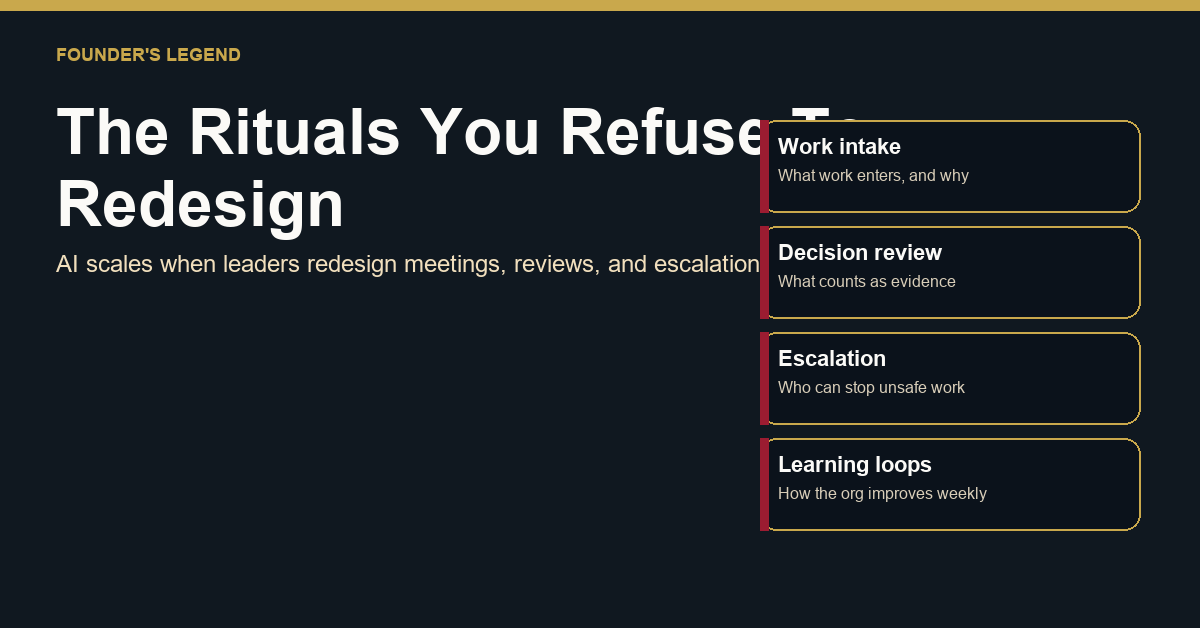
AI transformation is not a tooling problem. It is a ritual redesign decision, and leaders are revealed by which rituals they change first.
Dear leader,
If you want to know whether AI will help your people or replace them, do not start by looking at your tools. Start by looking at your rituals.
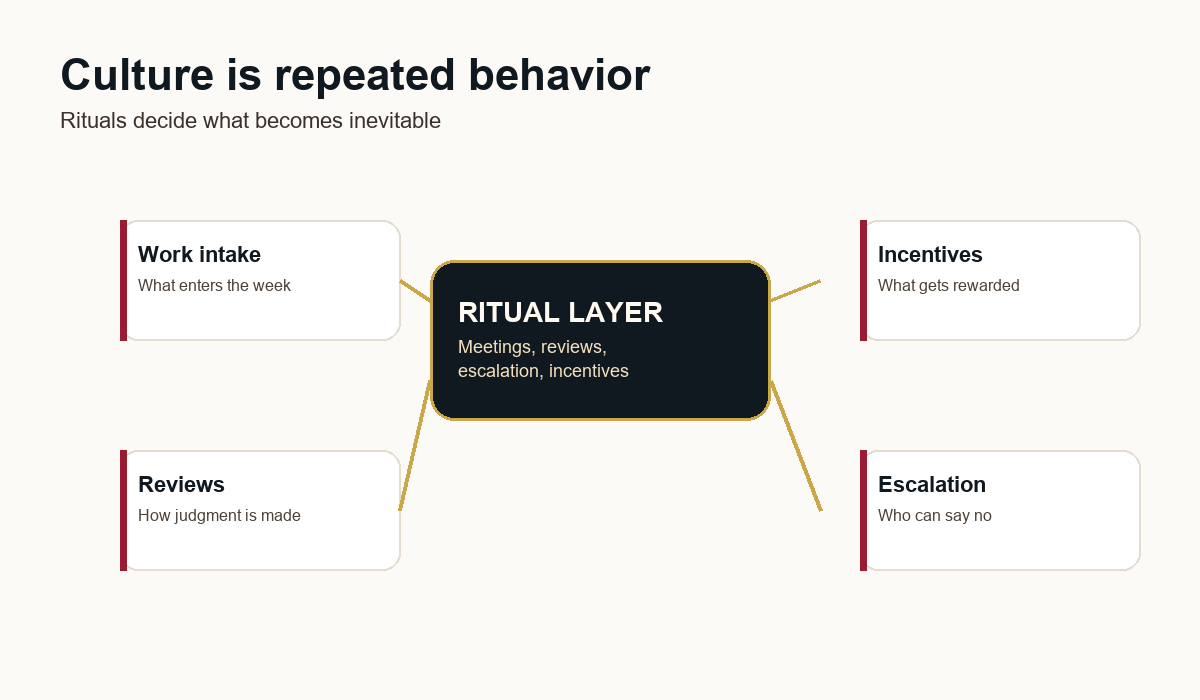
Every organization has a set of repeated behaviors that quietly determine what is safe, what is rewarded, and what is punished. Most leaders call that culture. I call it the ritual layer. The meetings where work is assigned. The reviews where judgment is made. The escalation rules that decide who is allowed to say no. The incentives that teach your best people what not to care about.
AI transformation fails when leaders treat those rituals as permanent. They run pilots, buy licenses, and add training. Then they wonder why nothing truly changes. The answer is simple. You cannot bolt a new capability onto a set of rituals designed for a different era and expect the system to evolve on its own.
Culture is what your rituals make inevitable
Most companies talk about values. But values do not run the week. Rituals do.
If your intake meeting is built to defend managers, your people will stop telling you the truth. If your review meeting is built to protect reputations, your teams will hide risk until it is too late. If your escalation rules punish initiative, your operators will learn to wait for permission. Over time, those rituals become the company.
AI does not bypass this. AI amplifies it. A weak ritual layer turns AI into a multiplier of confusion. A strong ritual layer turns AI into a multiplier of judgment.
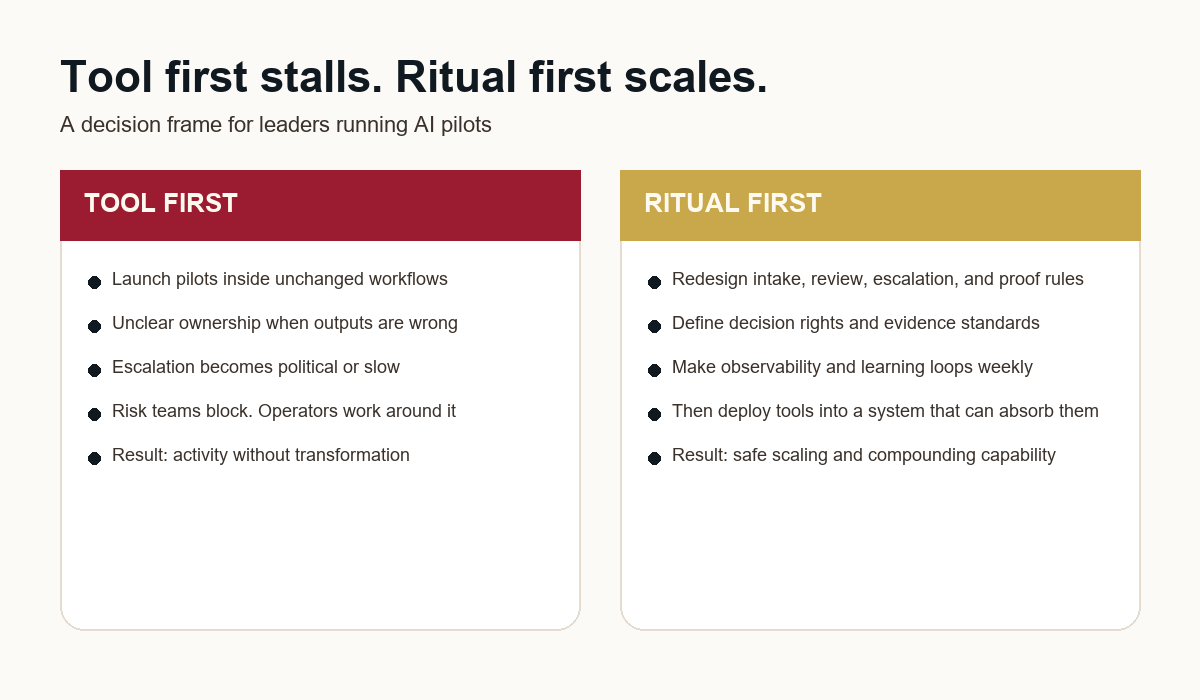
If you want AI to scale, redesign the rituals before the tools
In our AI-First Culture work, the pattern is consistent. Leaders launch pilots inside unchanged workflows and call it progress. The pilots produce activity. They do not produce transformation.
When a team is asked to use AI, three questions appear immediately, whether they say them out loud or not. Who owns the decision when the model is wrong. What gets escalated and what stays local. What proof is required before AI output is trusted in production.
If the answers are vague, the pilot stays a pilot. The risk team blocks it, the operators work around it, and the leaders quietly lose confidence. But when leaders redesign rituals first, new tools land inside a system that can absorb them.
The first ritual redesign is usually boring. It is the weekly review. The definition of done. The required evidence for a decision. The question the manager must ask before approving work that is partially AI generated. Those are leadership choices, not technical choices.
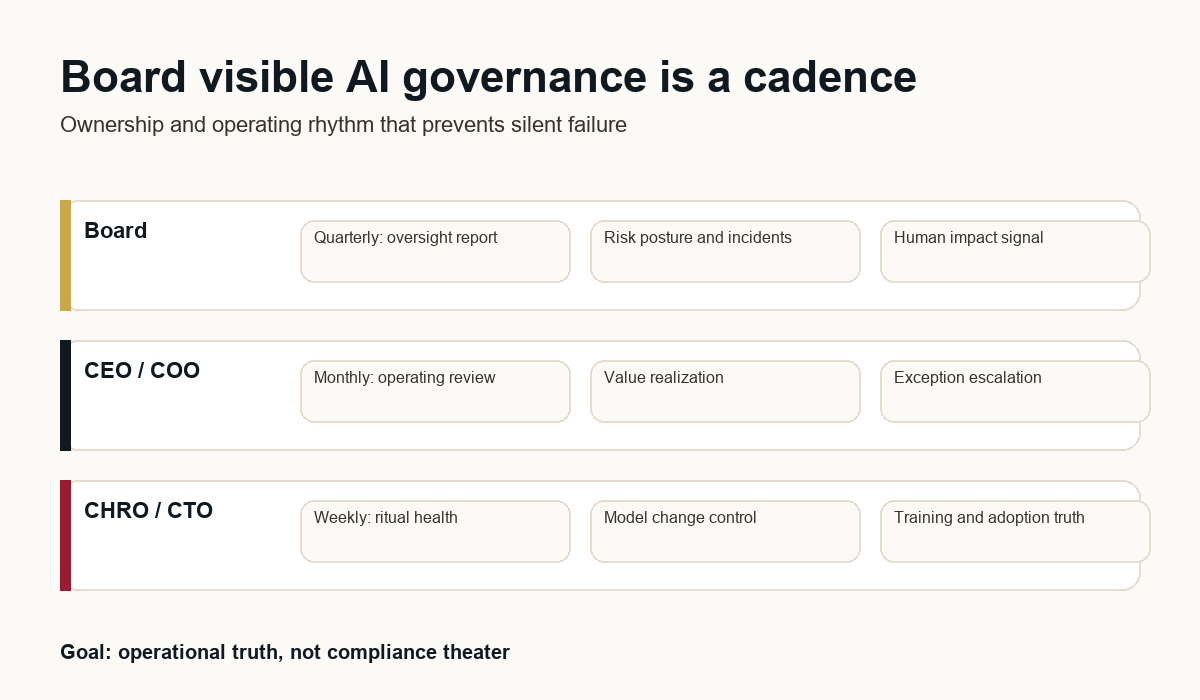
The board will see your ritual layer before your people do
Boards are moving from curiosity to oversight. They do not need to understand every model. They need to know whether the company has governance rituals that prevent silent failure.
That means cadence. Ownership. And a clean separation between risk, value, and human impact. When those lanes are blurred, executives start performing AI progress instead of managing AI reality.
If you redesign only one thing this quarter, redesign the rituals that make AI governance visible. Decide what the board will receive, how often, and what it means when the numbers move. The goal is not compliance theater. The goal is operational truth.
I will leave you with a simple test.
If your people can use AI in ways that change outcomes, but they do not trust the rituals that govern consequences, they will either hide the work or stop doing it. If they do trust the rituals, they will bring the work into the light, improve it, and scale it.
Leadership in this era is not your opinion about AI. Leadership is the ritual redesign you are willing to do first.
Respectfully,
Glenn E. Daniels II
Sources
Primary source base used:
- Touch Stone Publishers, Executive Leadership Playbook: AI-First Culture (TSP-2026-019), May 2026 (internal source base).

Note:
- This Founder's Legend version avoids numeric claims in-text to keep attribution clean in founder voice. Numeric and regulatory citations remain available in the AI-First Culture white papers and playbook.
Get the board-ready argument, the governance cadence, and the ritual redesign method for CEOs, CHROs, CTOs, COOs, CFOs, CROs, and Chiefs of Staff.