
Intelligence
Constructed.
Strategic guidance for institutional leaders.
Group
Intelligence.
Collective Operational Clarity
Access the latest strategic briefings and high-level trends from our ongoing Mastermind Group sessions.
View Latest PostingsSector
Analysis.
Market Transition Patterns
In-depth mapping of physical and digital asset transitions across core industrial sectors.
Inspect DataMastermind
Group Archive.
Direct transparency into our group’s strategic discourse. Explore internal briefings, peer-level analysis, and the historical intelligence logs of the Mastermind Group.
Enter Group Archive
The Boundary That Doesn’t Exist
Most boards operating under a Dual-Core mandate have approved a governance architecture they have never actually built. The scope is named. The core is designated. But the three structural elements that make the mandate enforceable — a formally defined boundary, a quantitative threshold specification, and an accountability chain that reaches the board independent of management — have never been formally established. That absence is not a strategic gap. It is a structural governance failure.
The failure is most acute where it is least expected: in organizations that believe they have already addressed it. The board that has chartered an AI oversight committee, published an agility mandate, and designated a “core” is operating without the enforcement architecture that makes any of those instruments mean anything. And when AI acceleration enters that environment, it eliminates the last remaining friction. The governance gap that existed at human speed now operates at machine speed — with no checkpoint, no threshold trigger, and no defined owner of the consequences.
This piece establishes what the three-component boundary architecture requires, why the sequence cannot be compressed, and what every board that has approved transformation velocity without governing the core it operates against is now obligated to address.

Governing the Dual-Core Mandate at the Board Level
This protocol specifies the minimum governance actions required before a board can consider its Dual-Core mandate formally bounded, legally defensible, and operationally enforced.

The Dual-Core Mandate
Your Calendar is a Crime Scene
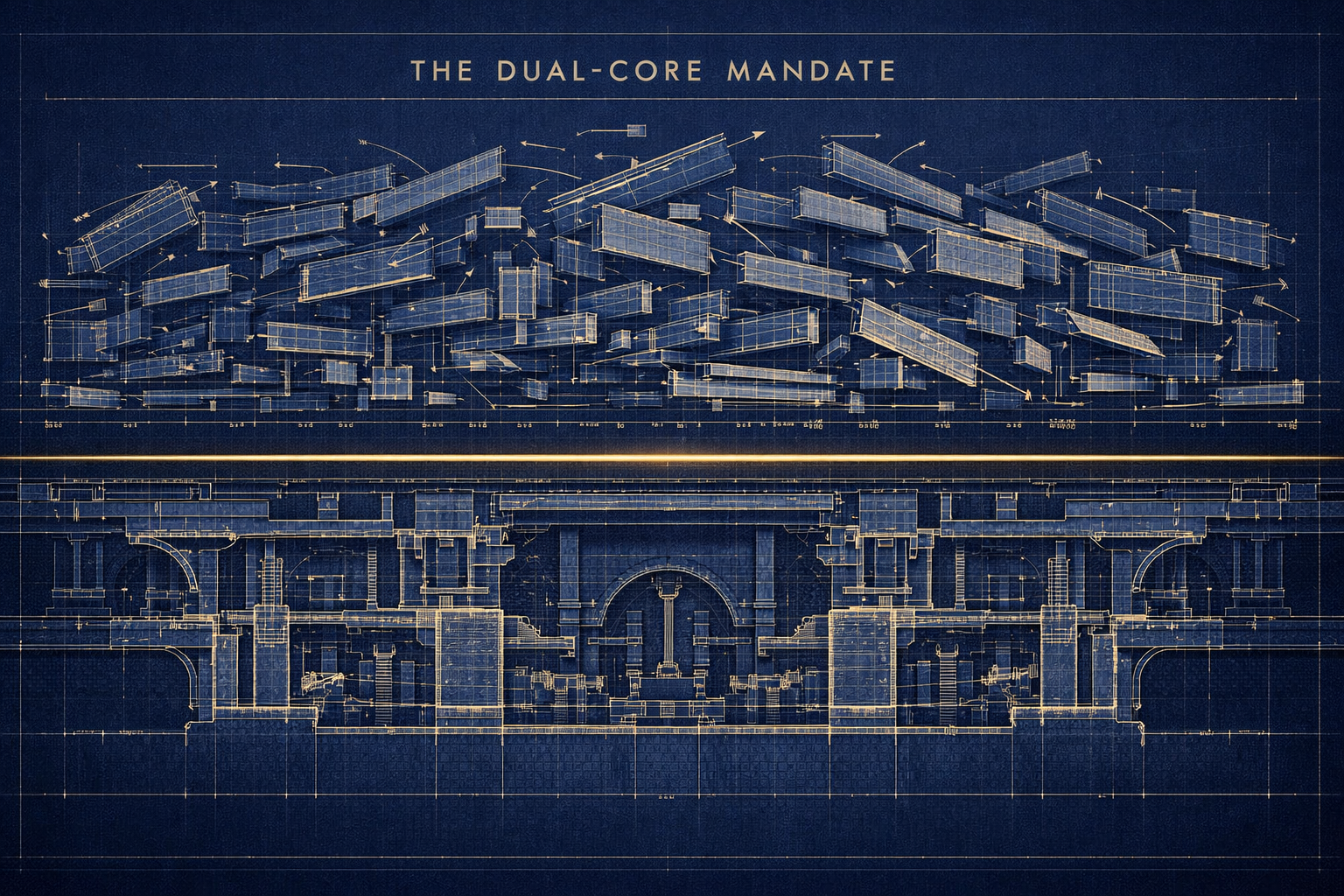
The Dual-Core Mandate: Why Strategic Agility Is a Governance Problem, Not a Strategy Problem
The mandate to bifurcate the operating model — running a transient product layer on top of a stable organizational core — is not a strategy decision. It is a decision-rights decision. Who owns the boundary between the transient layer and the core? What thresholds determine when a reconfiguration initiative crosses from transient rotation into core disruption? What accountability chain owns the outcome when a transformation initiative, launched with board approval at the strategy level, collapses the stability it was launched to protect? Without a formal answer to those questions, the Dual-Core Architecture reduces to aspiration. Boards approve transformation initiatives. Executives delegate execution. Autonomous systems accelerate delivery. And no governance instrument in the authority chain is positioned to surface the moment when transient velocity begins consuming the core it was built to protect.

The Sanctions Firewall: Washington Waives Russian Oil Restrictions as $150 Oil Looms
Washington waived its own Russian oil sanctions to prevent $150 crude. Zero tankers have transited Hormuz in a week. Qatar warns of Gulf-wide force majeure within days. The war has forced the US to choose between its sanctions regime and economic stability — and sanctions lost.

Hormuz Paralysis: The Strait Shutdown Reshaping Global Energy
The near-total shutdown of the Strait of Hormuz has triggered the most severe energy supply disruption since 2022, with Brent crude surging 20% in one week and Goldman Sachs warning of $100+ oil. Boards must now treat chokepoint vulnerability as a first-order strategic variable.

The Question Your Board Is Not Asking
The working assumption in most peer advisory circles is that governance follows deployment. That once the system is operational, the governance infrastructure catches up.
The forensic record of AI governance failures argues the opposite: governance that follows deployment does not govern. It documents. And the documentation of outcomes that a board had no structural capacity to influence is not oversight. It is the evidence that oversight was absent.
The decision-rights threshold is not a constraint on deployment velocity. It is the structural condition that makes deployment sustainable.

The Algorithmic Liability Crisis
The-Algorithmic-Liability-Crisis Download

The Insurance Chokepoint: How a 90% Strait of Hormuz Shutdown Is Rewriting Global Energy Architecture
The Strait of Hormuz has been effectively closed — not by naval blockade, but by an insurance-driven shutdown that caught the White House off guard. With 90% of tanker traffic eliminated and Brent crude surging past $84, boards face the most severe energy disruption since 1973.

The Accountability Architecture: Who Owns the Decision When AI Fails?
When 95% of enterprise AI projects fail to deliver value, the root cause is not the technology — it is the accountability gap. This white paper deconstructs the failure of traditional governance and introduces the Law of Designed Accountability.
Deeper Analysis
Our LinkedIn newsletter brings valule to the table for Leaders. If these insights are relevant to your current priorities, I’d welcome your participation. You are more than welcome to write an article and share your thoughts.